My Experience
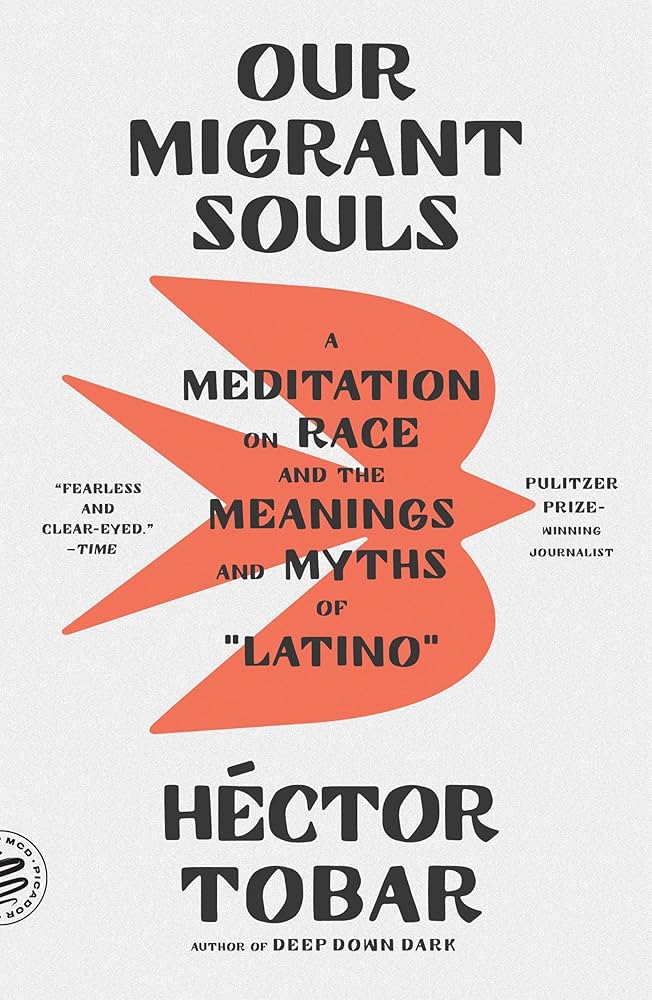
I thought this was an interesting book to go through as it shares many stories about what it’s like to be Latino in the U.S. in the present day from the perspective of a father and teacher. Throughout the book, author Hector Tobar addresses commentary on this through a sociological perspective and also through citing historical events which I found very interesting. Towards the end of the book, Tobar uses the last few chapters to look into how people travel back to their country of origin for residency or visiting. This book doesn’t occur in chronological order, but each chapter tackles the experiences from Tobar and others to express and attempt to break down stigmas and other stereotypes present. I have not finished the book, but do intend to do so on my own.
Classifying My Experience
An experience that I have taken in is curiosity based off of the various stories and ways of wording that Tobar uses. I had been thinking heavily when reading this book about my past sociology class I had taken in 12th grade when it came to structures and how things and people are perceived. I did want to look into more of the historical backgrounds presented by Tomar as well as the stereotypes and ways of living he discussed as well, especially in the prologue of the story.
“Ethnicity” and “race” are sold to us as boxes containing our skin tones and our surnames, but the truth about you, about us, will not fit in any box. You have the labels “undocumented” and “Mexican” and “Cubana” attached to you, and yet English is your mother tongue, and your favorite band is the Smiths. You were born in the United States but can speak Zapotec. You describe, again and again, how terrible you feel about your Spanish, or your lack of it, because Spanish is this language that’s supposed to bind us to our people and our past.”
-Tomar, p. 5
These lines stuck out to me and made me heavily think about the pressures that Latinos deal with especially among younger generations, but also systemic stigmas that have kept going on over time. The labels which are coming from those who aren’t in their shoes only make things worse and results in others carrying on assumptions which I’ve come to believe is a major issue. I was curious about the language used here as well and felt that it was a statement on how pressure doesn’t go away because the systems don’t change and result in an evergreen cycle.
“Latino,” “Latinx,” and “Hispanic” are terms that are said to describe our “ethnicity,” or “common cultural background.” In practice, however, the rest of the country treats us as a “race.” Police transmissions describe “Hispanic male” suspects, and news reports list “Latino” alongside the races “white,” “Black,” “Native American,” and “Asian” when discussing the demographics of the United States. Behind these categories is the belief that “race” is a biological subdivision of the species Homo sapiens, and that the members of the race are similar in more ways than just skin color. Racist ideas about “Latino” people are tied to the belief that we are born into a lower caste, and that, as a people, we are inconsequential in the American story.”
-Tomar, p. 8
These lines also stuck out to me thinking about the various stigmas that are in place based off of simply just how people look and results in some people thinking that those of a race will be similar to each other. The news reporting example also caught my attention because of my curiosity towards how people think of each other differently or similarly. This quote also attacks the idea that Latinos have similar backgrounds considering that all come from very different countries and borders such as the author of the book who’s the son of Guatemalan immigrants.
“When a migrant arrives in a new city at the end of a long journey, it’s almost inevitable that he or she or they will land in a place of grime or grit, a community where other poor and unsettled people live. If they are lucky, a room in a home with friends or cousins from the old country awaits them. These friends or cousins will themselves be relatively new to the United States, and they will live in a neighborhood of transience. A Latino “barrio” is born in this way, in boarding rooms, hotel rooms and overcrowded apartments.”
– Tomar, p. 46
This section also stuck out to me as it made me think more curiously about how hard it is to establish yourself in this country trying to build a new life at the jump. Systemically, being able to build a new life is very hard, little job opportunities, little money, little family there for you which also had me thinking multiple times about how my own family in the late 1890s and early 1900s came to this country from Eastern Europe with little as well. It took until the second generations of those born in the U.S. to start reaching prosperity and living in less crowded areas as they grew older after making it out of college. This was something that really had me thinking heavily about how this still goes on for immigrants today knowing my family four-five generations ago went through this too.
Narrative Technology
One narrative technology that I had thought about regarding how Tomar goes through his storytelling is second look which is when a narrator takes another look at something with the intent of challenging the original idea that is presented. Tomar does this a few times when discussing his experiences in teaching both his students and own children such as when he originally took his children to the U.S.-Mexico border between San Diego and Tijuana. I do enjoy how he does this throughout the story because I find it interesting to see how he goes from original observations and beliefs earlier in his life to what he thinks he’d do differently today as he learns more about experiences from others.
Featured Image
Cover for Our Migrant Souls. Vintage. All Rights Reserved.