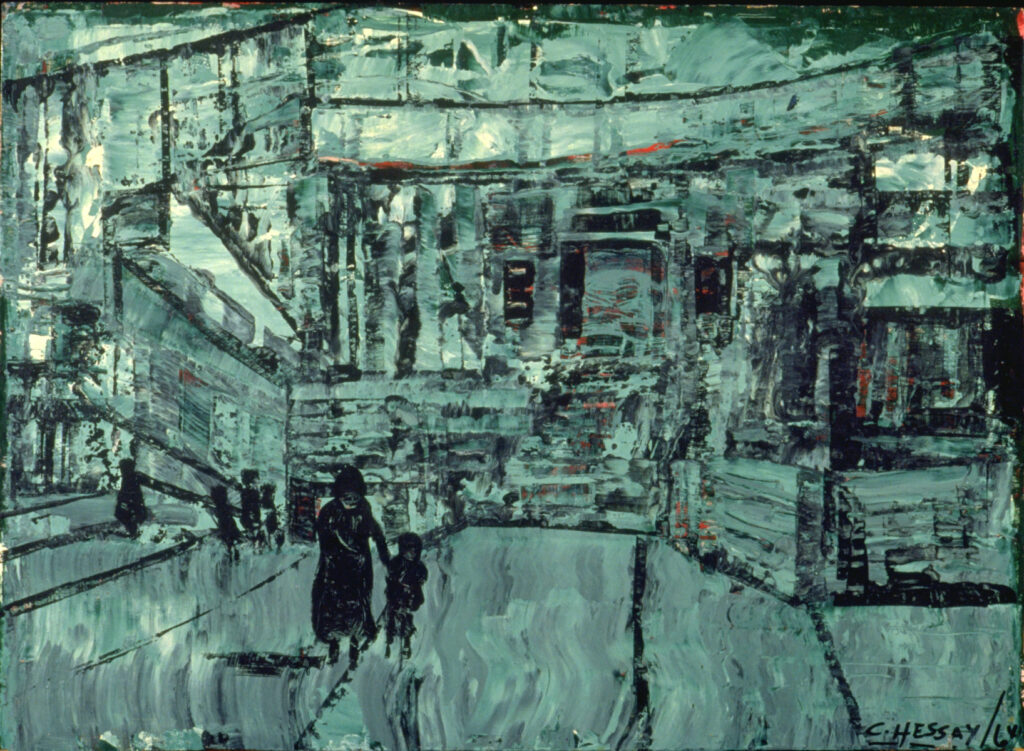
Welcome to Literature and Immigration! I am Dr. Mary Isbell, and I’ve created this syllabus to communicate what we’ll learn and how we’ll learn it this semester.
Carle Hessay, CC BY-SA 4.0, via Wikimedia Commons
Contact Me
I love talking to students. Please get in touch often to ask questions, share ideas you’re having about the course, or discuss something interesting you’ve read or watched.
- E-mail: misbell@newhaven.edu
- Office: Harugari Hall, room 300A
- Office Hours: By appointment (via zoom or in my office). Send me an e-mail to set something up!
Course Description
Analytical and critical study of literature about the immigrant experience. Students will develop projects around texts they have selected from a wide-ranging archive of poetry, novels, and memoirs about people adapting to life in a new country.
Learning Outcomes
Upon successful completion of this course, students should be able to:
- Interpret various aspects of another society’s material and expressive culture.
- Identify differences among the culture being studied and other cultures.
- Explain some of the cultural practices related to the formation of social identities.
Required Materials
- Any assigned reading will be made available for free online or through Canvas
- A laptop or tablet for use during class
- A notebook and pen for use when devices are put away
Registrar Forms and Deadlines
The university registrar maintains a webpage in myCharger that includes add/drop and withdrawal deadlines as well as links to the necessary forms. You can access this site at:
https://mycharger.newhaven.edu/one-stop/
Major Assignments
- 25% Preparation and Participation
- 25% OpenLab Posts
- 25% Responding to Feedback
- 25% Final Project
My Approach to Grading
In order to truly learn, I think we all need the freedom to make mistakes. In the past, when I’ve graded student work by assessing its quality, I’ve found myself inadvertently discouraging students who were trying very hard but had made a mistake or gotten stuck on something. While low grades have occasionally motivated my students, I have encountered students who get so discouraged by grades that they stop engaging in the work of the course. I now focus more on helping students understand and learn from my feedback.
Instead of giving your work a grade based on it’s quality, I mark it as complete (100%) or incomplete (0%). In all, each assignment is made up of three parts: A complete draft submitted by the deadline, a revised version of the assignment, and a response to my feedback. A full draft of each assignment will be due a week before the final version is due (students who miss this deadline receive no credit). We will have a revision activity during class that will help students revise their work so it meets assignment requirements. If the revised work meets all requirements, it will receive full credit. After a student submits the revised version of each project, I prepare feedback (most often in video form). I ask students to read or watch my feedback and compose a response (this is submitted in Canvas). Student responses that indicate engagement with my feedback receive full credit.
Occasionally a student submits work that does not meet assignment requirements (usually this is because the student has gotten stuck or misunderstood the assignment). When this happens, I offer guidance and an opportunity for the student to revise before submitting their response to my feedback. Students who revise their work after I’ve given feedback need to reach out to request that I look at their revised work (an e-mail works best). I will review and update the grade if the revision is successful or provide additional feedback if something is still missing.
This opportunity for revision works best when engaged promptly; it rarely works well for a student to rush to revise work at the end of the semester. If necessary, I will communicate a final deadline for revisions to incomplete work.
Open Educational Practices
One of my highest priorities as an educator is to help you all see that a classroom is a space to collaborate in the pursuit of new knowledge. We all bring knowledge and experience to the classroom and, if we put in the effort to build a collaborative learning community, we all benefit. I draw on strategies known as open educational practices or open pedagogy to help me in this pursuit. You will notice that we take advantage of open educational resources in this course (you don’t need to purchase any textbooks) and you’ll also notice that some of your assignments invite you to create resources that can be used by future students. I will frequently ask you to complete brief anonymous surveys to share how particular things are working for you and make adjustments based on that feedback. I hope you’ll share ideas even when I don’t explicitly ask. This is your class too!
My Course Policies (read carefully!)
Diversity Statement
I value human diversity, whether expressed through race and ethnicity, culture, political and social views, religious and spiritual beliefs, language and geographic characteristics, gender, gender identities and sexual orientations, learning and physical abilities, age, and social or economic classes. I respect the value of every member of the class, and everyone in the class is encouraged to share their unique perspective as an individual, not as a representative of any category. I intend to present material and classroom activities that respect and celebrate diversity of thought, background, and experience.
Attendance, Preparation, and Participation
I will ask you to do significant reading and thinking in preparation for class and to participate actively in workshops and class discussions. Preparation and participation assignments not completed by the deadline will not receive credit.
If you have one, please bring your laptop or tablet to every class. We will often use a shared Word Online document and a shared spreadsheet during class. If you don’t have a laptop or tablet or you forget it, you can complete your work by hand and type it up after class for credit. Please talk to me after class if you’ll need extra time to get your handwritten work into the appropriate place.
When our goal is in-person discussion, I will ask everyone to put screened devices away and take notes by hand. I will also encourage everyone to voluntarily contribute to class discussion. Some of my best students have been quiet and not initially inclined to jump into our group conversations. If you are nervous about joining our discussion, you’ll have ways to share your ideas that don’t require speaking during class (I’m also happy to brainstorm strategies if you want to learn how to speak up).
If you are behaving disrespectfully to your classmates (like sleeping or looking at your phone when it should be away), I will write you an email with some tips on how you can avoid being disrespectful going forward and a request that you confirm getting the message. If I don’t hear back from you, I’ll try to talk to you in person before or after class because…if you are a disruption a second time, I will lower your overall grade in the course by one letter.
If you are unable to attend class, please let me know in advance so I can make arrangements to record our class session for you to access after the fact. Watching this recording does not cancel your absence, but may help you keep up. The university permits up to two weeks of absence for illness and emergencies. Students who miss more than two weeks before the withdrawal period will be administratively withdrawn from the course. After the withdrawal period, each absence beyond the allowed number will reduce your preparation and participation grade by ten points.
Deadlines
There is no penalty for requesting an extension in this course, but you must request it before the deadline. If you don’t request an extension and have not completed a formal assignment by the deadline, you may complete it within 24 hours of the due date and I will accept your work, but lower the highest possible grade by one letter. If you have not contacted me before the end of this 24-hour window, you will receive no credit for the assignment. I am strict about this policy because I am very generous about deadline extensions. If you have a busy week when an assignment is due in this course, I would much prefer you ask for more time than miss a deadline or turn in an incomplete assignment. Really!
Academic Integrity
Every item you turn in with your name on it should be your own work with all sources clearly cited. If you use generative AI, please make sure it is clearly acknowledged with a signal phrase (“In a paragraph generated by ChatGPT, ____”) and with a clear in-text citation. Here’s how the MLA suggests citing generative AI. In short, treat generative AI as a source and do not present it as your original work.
Please do not use Grammarly or any other tool that offers to take something you’ve written and improve it. Revising on your own is part of what you’re learning how to do in this course.
For the university policy on academic integrity, see the Student Handbook.
Online Tools (to reference as needed)
I will be introducing a number of free online tools for reading, writing, and researching over the course of this semester. I include instructions for each of these tools below and I will also introduce them in class. Please don’t hesitate to get in touch if you have trouble navigating this technology.
OpenLab
OpenLab is a platform where University of New Haven faculty, students, and staff come together to teach, learn and share ideas. Anyone with a University of New Haven e-mail account can join this virtual community, and we’ll be using the platform to build a website together this semester. I will be demonstrating how to create an account and join our course site in class, but you can also check out the written resources for OpenLab at any time.
Office 365
Office 365 makes it possible for me to create Word and Excel documents that I can share with a link (they live in “the cloud”). Any changes made to these shared documents are available in real time. You can use documents I’ve created without downloading Microsoft Office for your computer, but you will need to set up Microsoft Office on your computer to create formal assignments in this and other classes. Instructions for getting set up with Office 365 and downloading the applications for your computer are at this link.
Zotero
Zotero is an excellent free tool for gathering, annotating, and citing sources, (zoterobib is a tiny version that is also much better than other ad-filled citation generators!). I don’t require students to use Zotero, but I will encourage you to try it out. Most of my students who have experimented with Zotero wind up using it for research projects in other courses. I will demonstrate how I use Zotero in class, and you can watch the video below (I created it for faculty) or the instructions provided by Zotero.
The process will be slightly different depending on your computer and the Internet browser you use most often. I am happy to help during class if you’d like!

.jpg)