My Experience
The book is narrated through Riad Sattouf during his childhood experiences of his family living in France. Riad Sattouf is also the author of the book. In the first chapter, we are immediately given a physical description of the character, Riad. The author then throws the reader (me) right into a tense discussion between Riad’s mother and his grandmother.
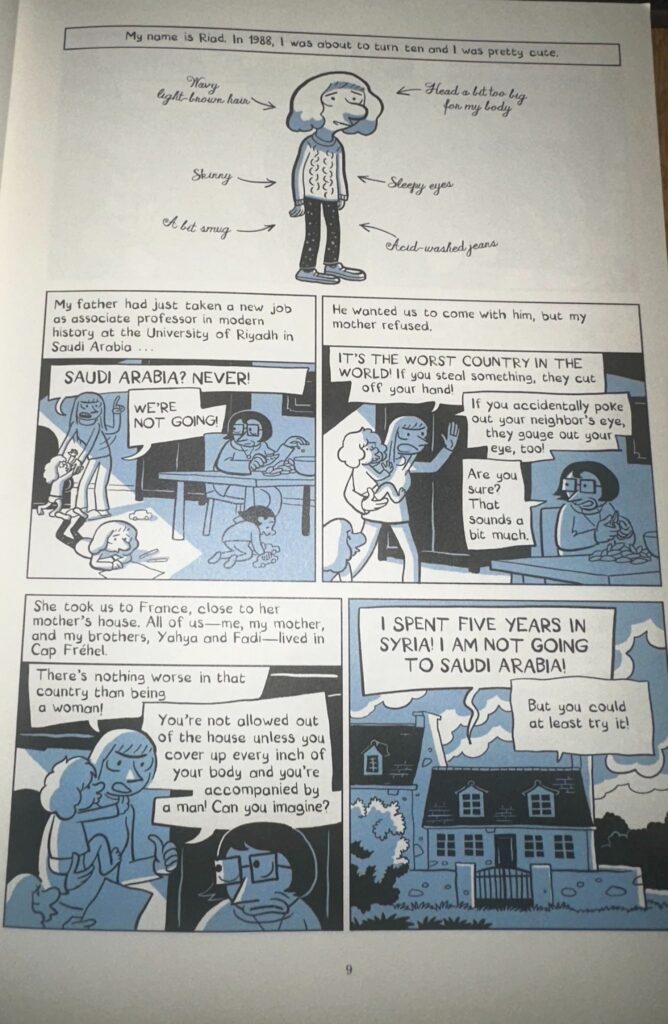
Riad’s mother, Clementine, is set on the family never going to Saudia Arabia as there are no rights for women. Uniquely, Riad’s father Abdel-Razak, is teaching there and tries to persuade Clementine to bring the family to move there with him. Clementine still refuses to go, so she applies to jobs to earn extra money for the family.
I feel stress for the family, and I am not even in this situation. With the illustrations of their facial expressions, the different variations in text, the specific colors shown on the page, all while understanding the situation they are in, has led me to feel anguish almost for the book.
Something that really stands out is Abdel’s personality. He is displayed as very intense and aggressive. The relationship between Riad and his father can be seen through phone calls and conversations they have had in the beginning of the book. To me, it seems as though Riad is intimidated or maybe even scared by his father.
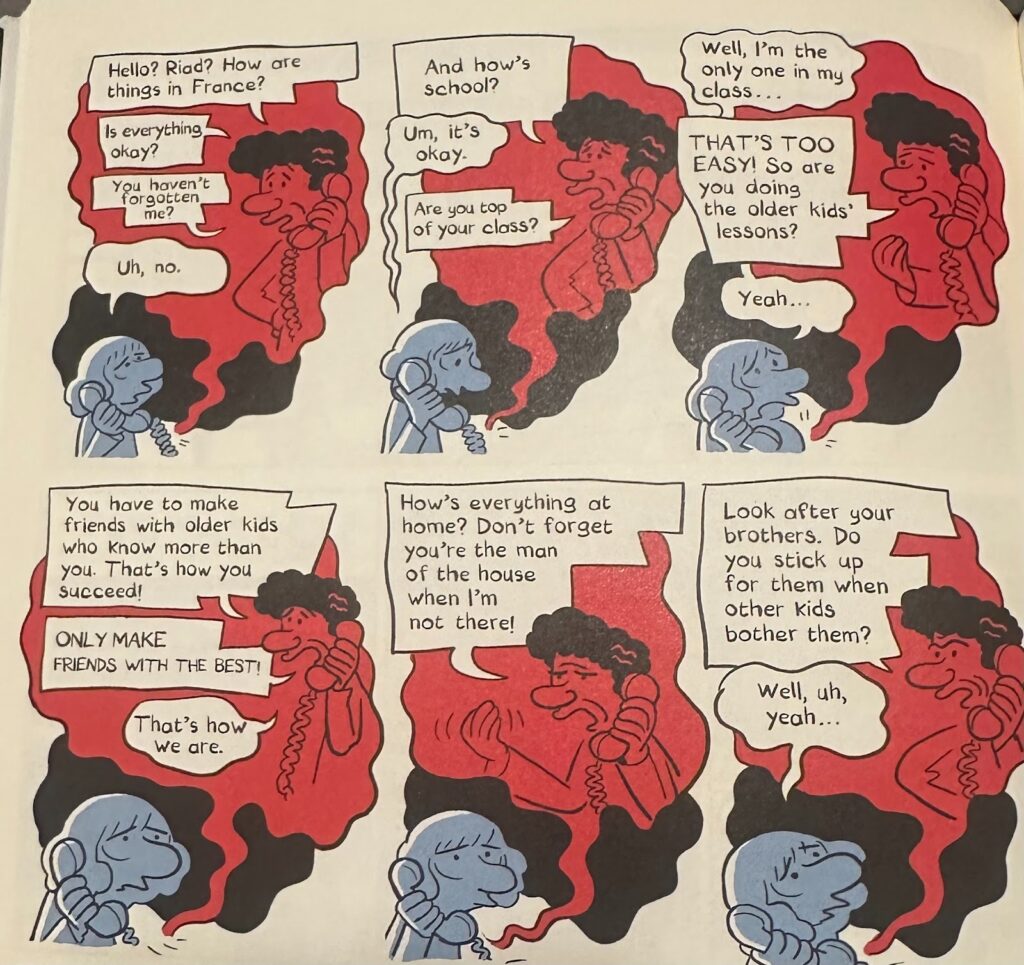
What is cool about graphic books, is that it is easier to notice emotions through facial expressions, colors, and body language. Here we can see Riad is a blue/gray and his father is red. When looking at Abdel, he seems angry and frustrated. Looking at Riad, we can tell he is anxious or maybe even afraid. The conversation between Riad and his father show he is held up to high expectations by his father. It makes me think, a child shouldn’t feel anxious when speaking to their parent or loved one through the phone.
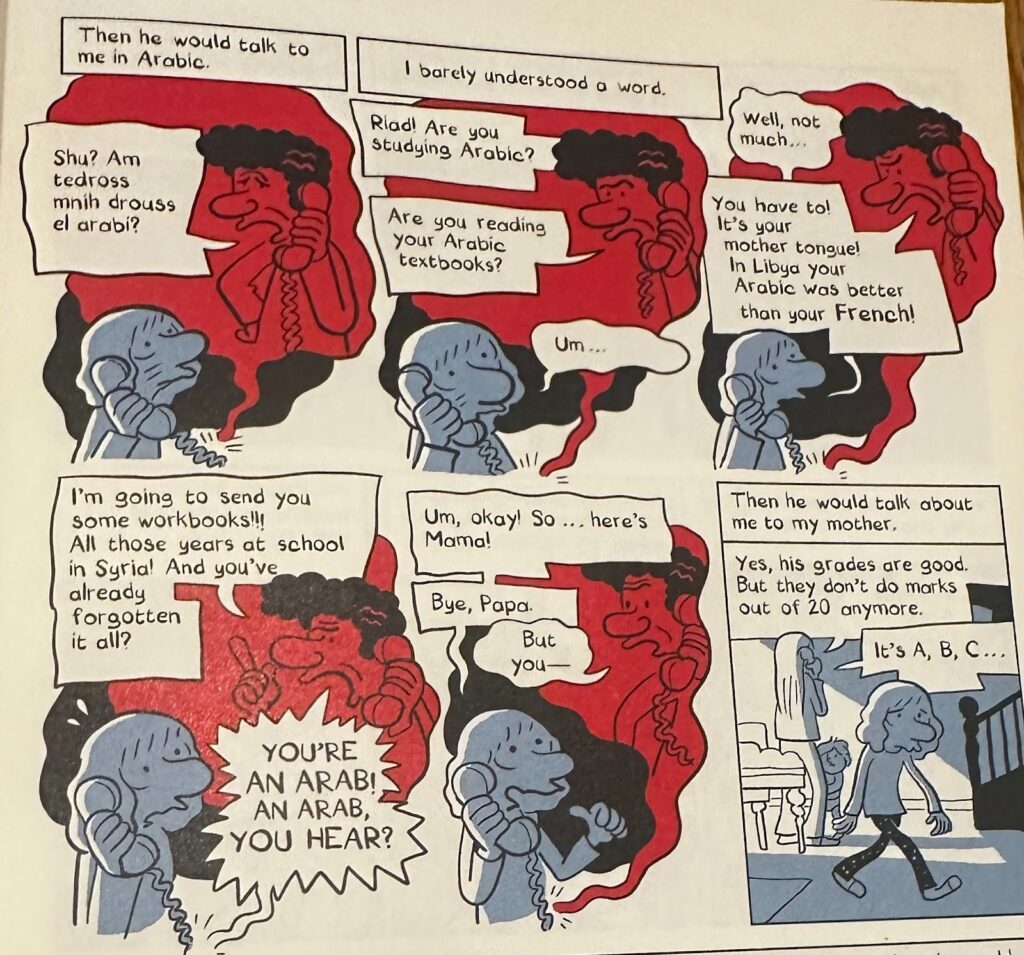
Abdel is a very intense man and sometimes the way he speaks to his family is alarming to me. I have found myself shaking my head reading his dialogue.
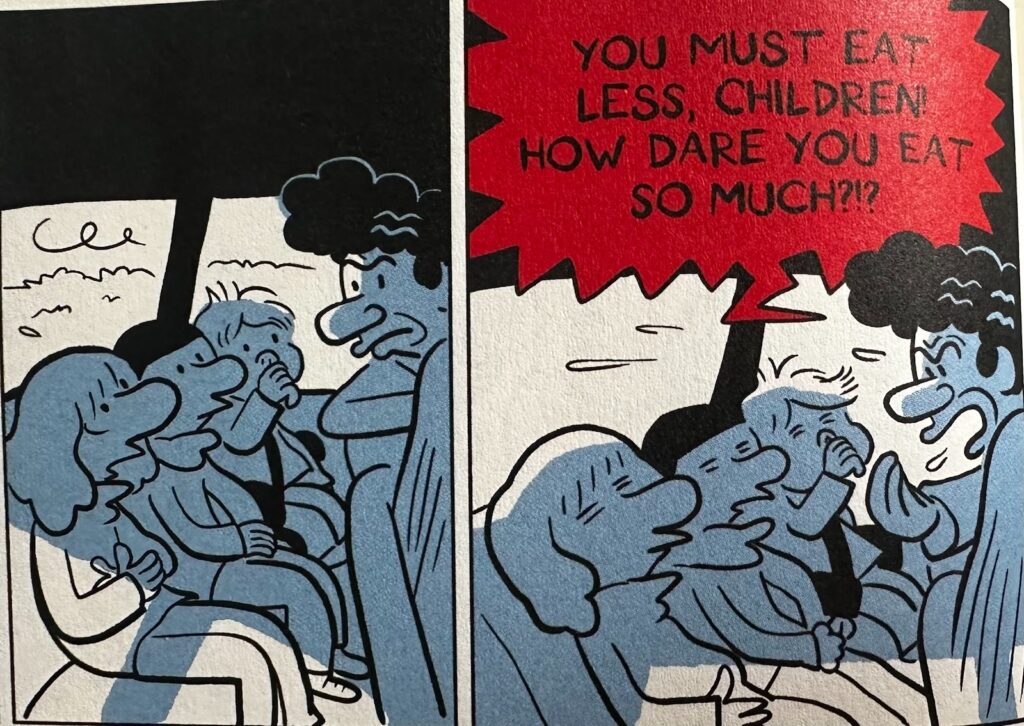
I thought to myself, who says that to their children? Who implies for children to eat less because it takes more money to feed them as they are GROWING children?
His intense emotional reaction almost makes me feel like I am part of the story. I have felt immersion with story. Immersion is defined by our glossary of terms as “Absorbing or engrossing involvement in a story. You might feel as though you’ve been swallowed by the story.”
Classifying My Experience
An experience that explains how I felt when reading was distress. Distress is defined in our glossary of terms as “anxiety or mental suffering that you have not chosen.” I can feel the anxiety and the intimidation through the book when Abdel is speaking to the family. His strong emotions really spark a feeling of suffering inside me. The family has a lot of things going on. Riad’s family is forced to move out of their home, and move to Syria with Abdel, Abdel pressured the family to move with him back to Saudia Arabia all while making life changing decisions without consulting or considering the family.
Features Prompting My Experience
Parts of the book that have made me feel distress are specifically when only Abdel is speaking. Interestingly, since this is the author’s father, with as much respect as possible, Abdel seems to have a problem of controlling his emotions. Here we can see it through a conversation of him explaining the history behind why “Jews have control of everything” to Riad.
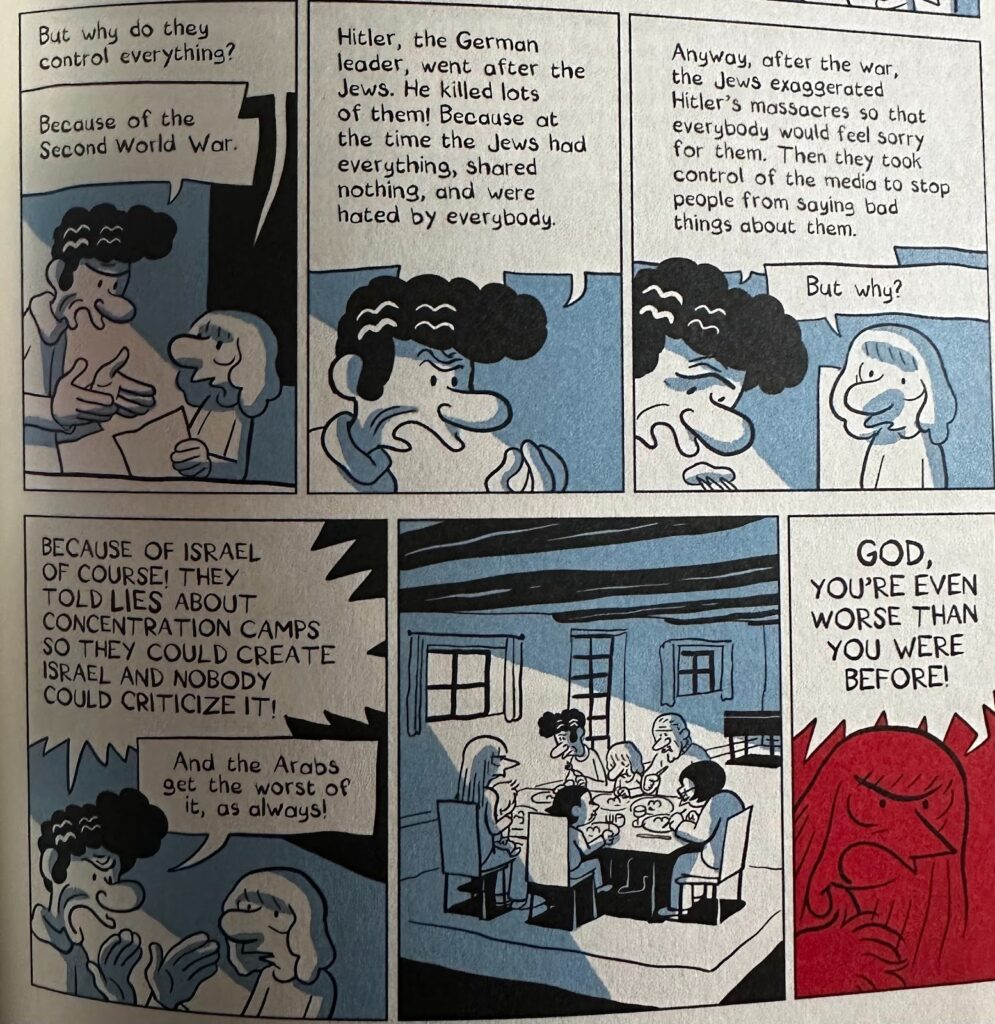
I think to myself, is this reaction necessary? And what does Clementine mean or what is she referring to when she states, “God you’re even worse than you were before!” Even only being on chapter 3, I feel annoyed by Abdel. But his anger and aggression don’t stop here.
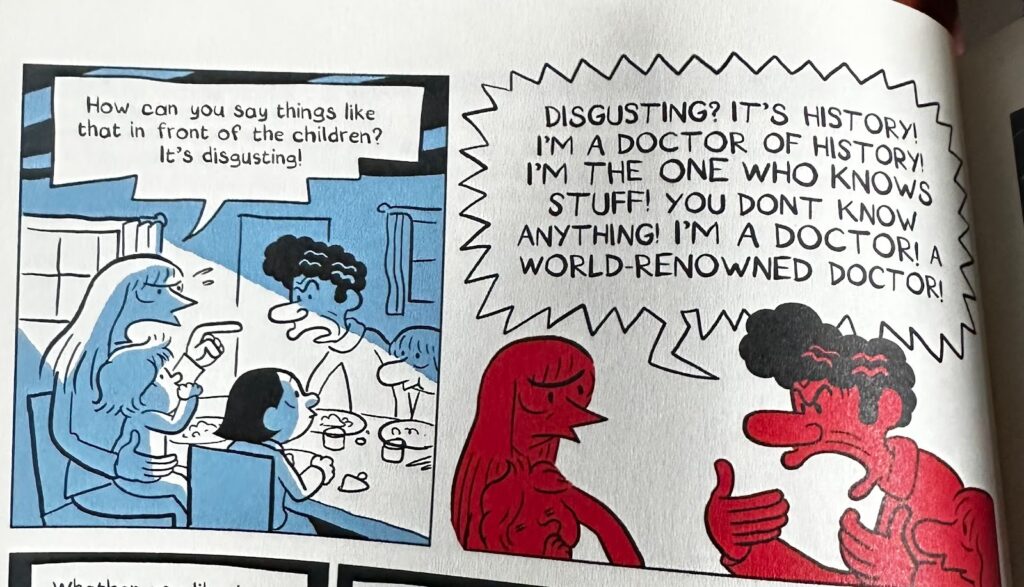
Why must a question of curiosity be turned into an argument? Was this normal? So many questions popped in my head, and maybe because I have experienced this in my own life. Where someone’s approach to explaining something is to yell. This part of the book made me feel identification. This is defined by our glossary of terms as “recognizing, in a character’s experience, a conflict that you have experienced.”
Another part in the story where I feel distress, is when the family is in Abdel’s home village Syria. He brought the family on a walk near his land. For some context, Abdel’s mother was very ill, so he decided the family would stay in Syria for a bit until she got better. Unfortunately, Abdel has been hiding things from the family. In this scene, we can see through Riad’s perspective of the conversation between his mother and father.
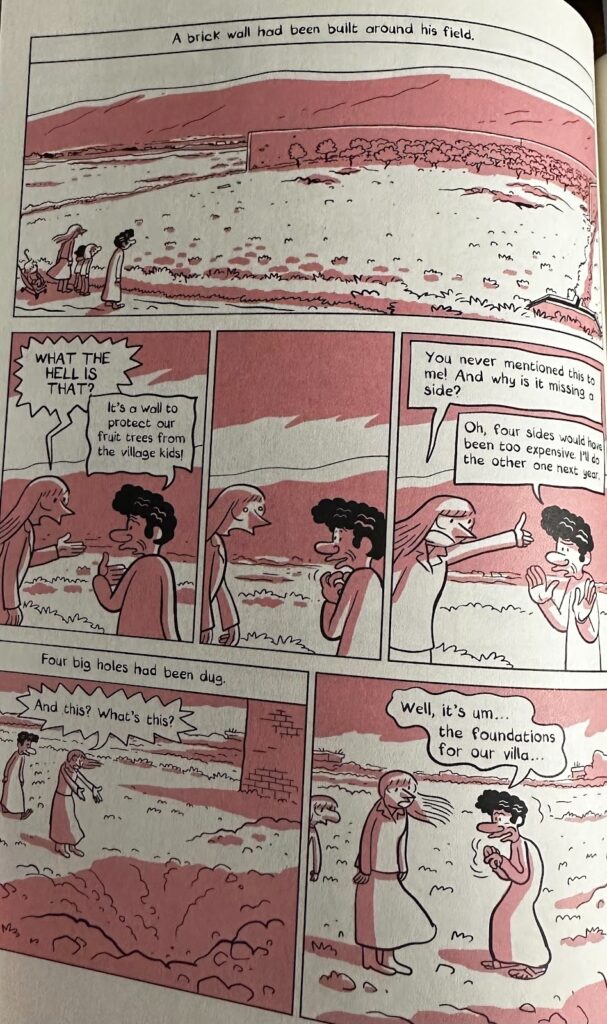
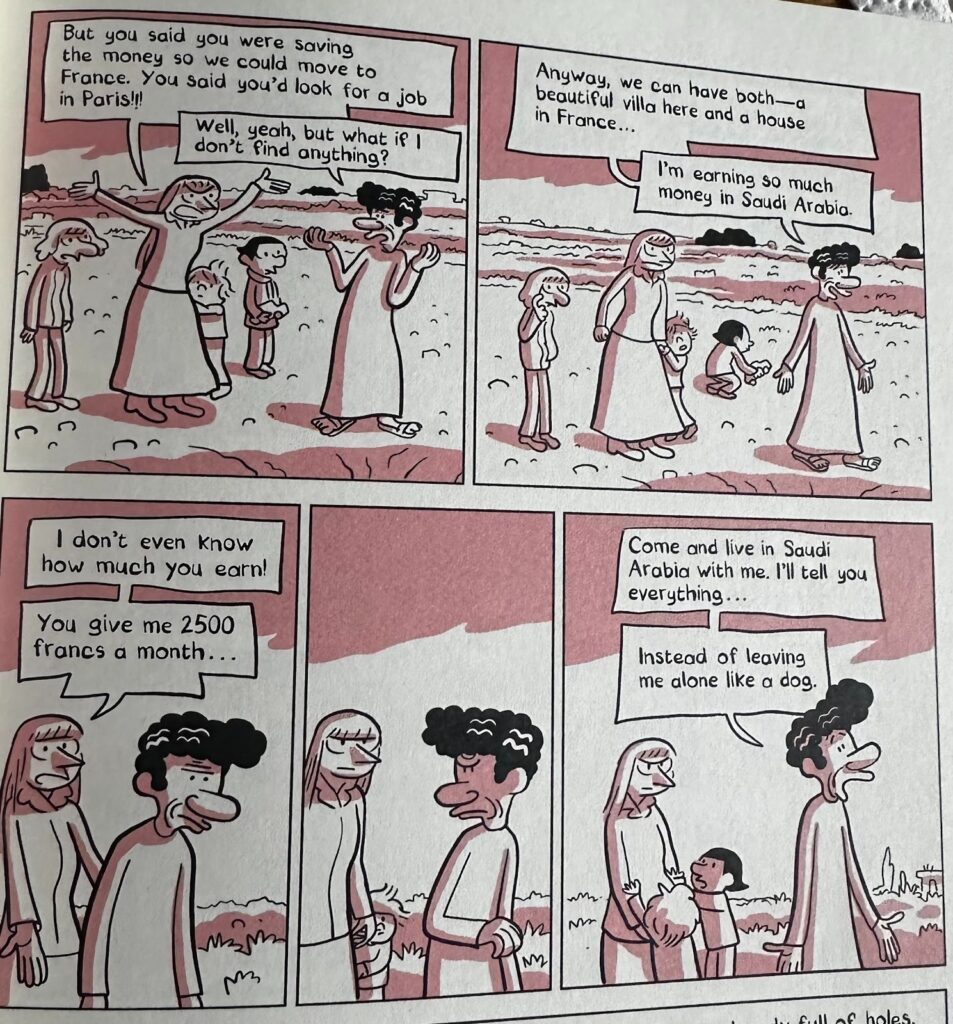
I understand Abdel wanting a better life for his family, obviously that I can comprehend. His intentions are there, but the approach is wrong. This has been contributing to the distress I feel. It makes me think, did something happen in Saudia Arabia that is causing him to be so aggressive and intense? I haven’t read the previous books of this series, but I am curious to see if it is mentioned. How did he behave?
Narrative Technologies at Work
Reviewing the narrative technologies, the one that best fits is opportunity to observe. This is defined as “constructing a story in which characters display many emotions, perhaps unpredictably, encouraging the viewers or readers to observe and recognize the emotions they are experiencing.” As I stated before, reading a graphic book is easier to identify feelings experienced by characters. I think the author is consistent and clear of showing the emotions very well. Partial dopamine + perspective of a child is also a narrative technology that can be seen at work. This is defined by our glossary of terms as “dissonance that isn’t resolved into full harmony narrated by a child.” As we see through Riad’s perspective of everything that is going on, their family is going through a lot of dissonance. Arguments, tension, disagreements, uncertainty, which can be seen with the lack of communication with Abdel.
I am curious in this story to know what happened with Abdel in Saudia Arabia, that can explain or relate to his aggressiveness. Suspense, defined as “revealing some part of the story, but not all the pieces” also is another narrative technology contributing to how I am curious and wonder, what really happened to Abdel?
Opportunity to observe has given me a clear sense of what the characters emotions are, based on the illustrations the author has chosen to use. I propose to add a new narrative technology that describes and explains how a narrator uses illustrations to present emotions specifically in comic books, Mangas, and graphic series. Potentially it could be termed “Illustration” with an added word to it. Stated in the feedback video from Dr. Isbel, the recommendation stated was this could be an added term within “soliloquy” titled “illustration of facial expressions” as a related term. I know the way the author has illustrated the graphic series using different colors for different sections of the book, is with intention.
Final Thoughts
The graphic memoir has set up an engaging way of following the author’s journey with his family, leaves me wanting to read more. Reading a different genre of literature that I normally don’t read was a great experience I had. As someone who expresses emotion through facial expressions and body language, I was able to really connect with the characters well and not have to make as many assumptions to how the characters were feelings, as opposed to analyzing a text without pictures. Reading this specific book in the series, has made me want to read the previous books in the graphic series. I am interested if the other books talk about his parents’ experiences told by the author.
Work Cited
Featured Image
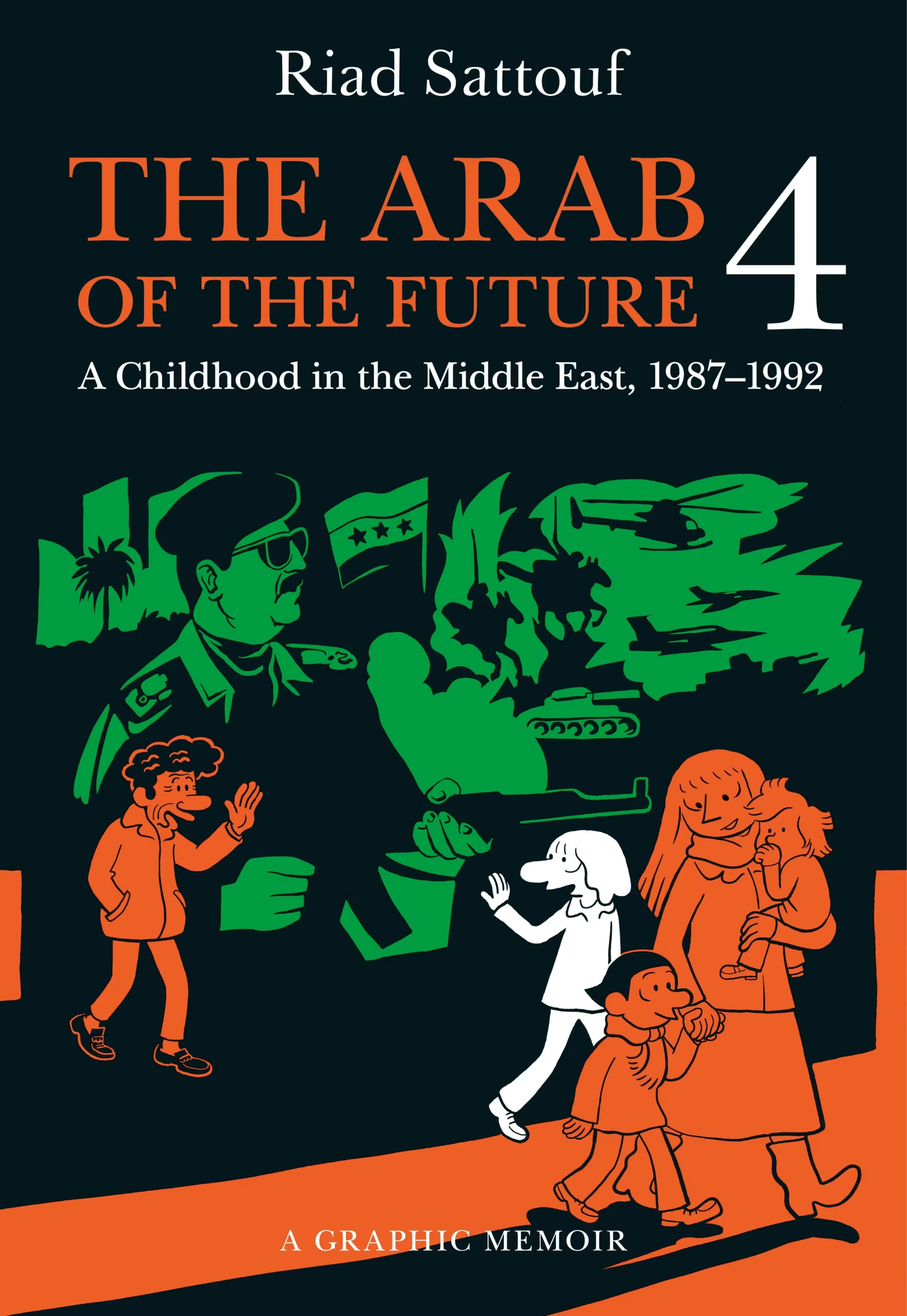
Cover for The Arab of the Future 4. Macmillan Publishing. All Rights Reserved.