Why I Chose This:
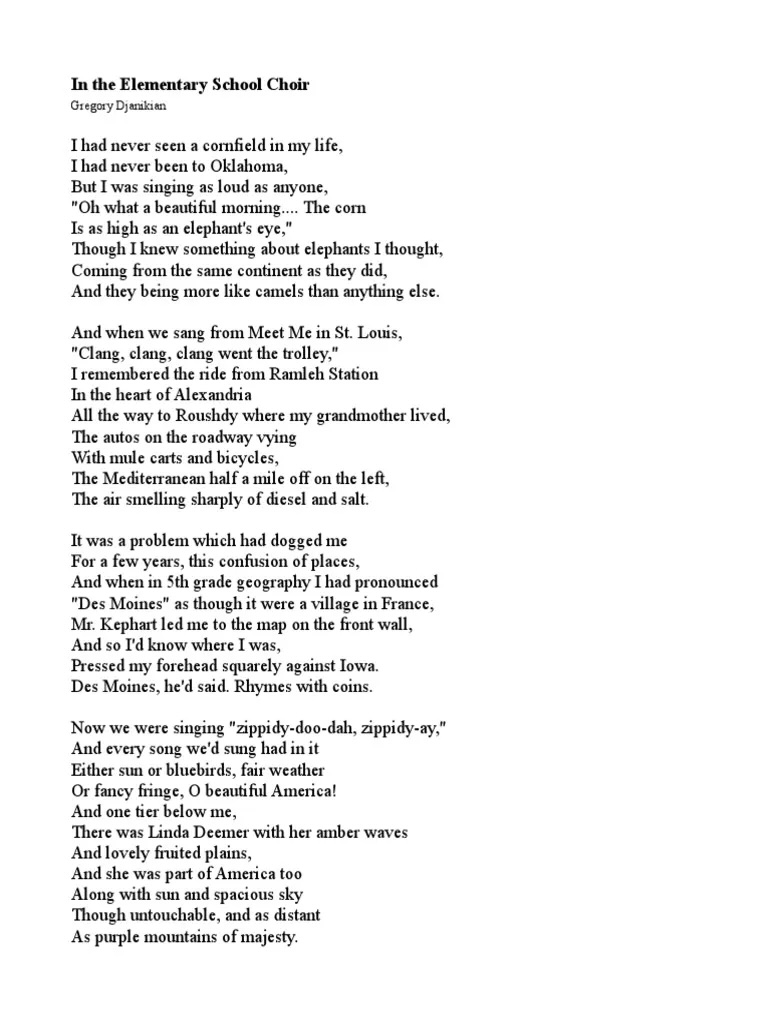
When I first read “In the Elementary School Choir” by Gregory Djanikian, I wasn’t sure if choosing a poem for this assignment was the right decision. I usually prefer readings with clear structure and straightforward meaning, but poetry felt more complicated and open to interpretation. However, after reading the poem more closely, I began to understand how much emotion and meaning can be packed into a small space. Even when the poem didn’t fully explain every detail, it encouraged me to imagine the scenes and emotions myself. Listening to the author read the poem aloud also deepened my understanding. His tone, rhythm, and voice added meaning that I might not have noticed just by reading. This experience helped me recognize poetry as a powerful and complex form of storytelling. I found this poem on Poetry Foundation, but this poem is also in Gregory Djanikian’s book collection, Falling Deeply into America.
Experience 1:
As I read the first section of the poem, I experienced confusion because I wasn’t sure how to fully understand the meaning or connect to the emotions being expressed. The unfamiliar references and structure made it difficult for me to immediately interpret what the author was trying to convey. This made me pause and reflect on how different backgrounds and experiences can affect the way a reader understands a text.
The first part of the poem uses descriptive language and unfamiliar imagery that intitally made the meaning unclear.
“Oh what a beautiful morning. . . . The corn
Is as high as an elephant’s eye,”
Though I knew something about elephants, I thought,
Coming from the same continent as they did,
And they being more like camels than anything else.
Though I recognized some of the words, the way they were used and the references being made did not fully make sense to me at first. In this moment, I struggled to understand the deeper meaning behind the imagery and references. I realized that my confusion came from not recognizing the cultural or contextual background connected to the poem. Instead of making assumptions, I had to slow down and think more carefully about what the author might be trying to express and how the imagery connects to a broader idea.
This reflects confusion. I felt unsure about how to interpret the poem, which made it harder to connect emotionally at first. The unfamiliar imagery and references made me question whether I was fully understanding what the author was trying to express. Instead of immediately relating to it, I found myself pausing and rereading certain lines to try to make sense of them. However, this confusion also pushed me to think more deeply and remain open to different interpretations. It made me realize that not every piece of writing is meant to be understood right away, and that taking time to reflect can lead to a better and more meaningful understanding of the text.
The narrative technology used is adaptation. The poem reflects how the author is adjusting to a new environment and expressing that experience through unfamiliar imagery and references. This technique highlights how meaning can change depending on perspective, especially when the reader does not share the same cultural or personal background as the author. Because of this, I initially struggled to fully understand the poem and its deeper meaning. However, what helped me understand it better was talking it over with my class and hearing different interpretations. Through those discussions, I began to realize that the meaning connects to the cultural memory of the author’s experience, which made the imagery and references feel more intentional and meaningful. This showed me that understanding a text sometimes requires looking beyond your own perspective and considering the experiences that shaped the author’s point of view.
Experience 2:
As I continued reading the poem, my experience shifted from confusion to optimism as I began to better understand the meaning behind the imagery. This section stood out to me because it presents America as a place of possibility and belonging, even if that perspective differs from my own. It made me think about how someone from a different background might view the same place in a more hopeful way.
It reflects a sense of admiration and emotional connection to a place that feels meaningful and full of opportunity.
How could anyone not think America
Was exotic when it had Massachusetts
And the long tables of thanksgiving?
And how could it not be home
If it were the place where love first struck?
The language in this section creates a strong sense of appreciation and wonder, showing how the author views America in a positive and meaningful way. In this part of the poem, the imagery and tone become clearer, allowing me to better understand the author’s perspective. The references to familiar places and traditions helped me see how the author connects personal experiences to a sense of belonging. This made it easier for me to relate to the emotions being expressed, even if my own experiences are different.
This reflects my feeling of optimism. I began to see the poem in a more positive light and understand how the author views America as a place filled with opportunities and meaning. The imagery and tone made it seem like a place where new beginnings are possible, even if the experience is not perfect. This shift in perspective helped me connect more with the author’s emotions and see how hope can exist alongside uncertainty. It made me reflect on how perspective can shape whether something feels hopeful or unfamiliar, and how the same place can be experienced very differently depending on a person’s background and experiences.
The narrative technology used is also adaptation. The author is adapting to a new environment and forming a new sense of identity and belonging through their experiences. This process is reflected in the way the poem presents familiar places and ideas in a new and meaningful way. It shows how people can reinterpret their surroundings in a hopeful way, even when they come from a different background or are still adjusting. As I read, I began to understand how adaptation is not just about change, but about finding meaning and connection in something new. This technique highlights how identity can evolve over time and how perspective plays a major role in shaping how someone experiences a place.
Experience 3:
As I reached the final section of the poem one section stood out to me the most. My experience shifted to suspended judgment as I realized that I could not fully relate to the author’s perspective. Instead of trying to fully agree or disagree, I focused on understanding the differences between my experiences and the author’s. This made me reflect on the importance of being open-minded when reading perspectives that are different from my own.
The detailed imagery to describe memoires and sensory experiences that are meaningful to the author made this last section even more touching.
“This is my country,” we sang,
And a few years ago there would have been
A scent of figs in the air, mangoes,
And someone playing the oud along a clear stream.
In this moment, I realized that I could not fully connect to these experiences because they come from a different cultural background than my own. Instead of trying to force a connection, I focused on understanding the meaning behind the imagery and what it represents for the author. This helped me recognize the importance of respecting different perspectives.
This moment reflects my feelings of suspended judgment. I chose not to immediately judge or fully interpret the poem based only on my own experiences. Instead, I remained open to understanding the author’s perspective, even if it was unfamiliar to me. I realized that my first reaction might not fully capture the meaning of the poem, especially since it is shaped by experiences different from my own. Rather than forcing a single interpretation, I allowed myself to sit with the uncertainty and consider multiple possibilities. This helped me recognize the importance of being open-minded when reading, and how stepping back from judgment can lead to a deeper and more thoughtful understanding of the text.
The narrative technology is again adaptation. The poem reflects how the author is navigating identity and belonging by connecting past experiences with a new environment. This is shown through the way memories, culture, and personal history are blended with present surroundings, creating a layered understanding of identity. As I read, I began to see how the author is not only adjusting to a new place but also trying to hold onto parts of their past at the same time. This technique emphasizes how personal and cultural experiences shape the way people see the world, and how those experiences continue to influence someone even as they adapt to something new.
Featured Image:
In the Elementary School Choir. Scribd. All Rights Reserved.