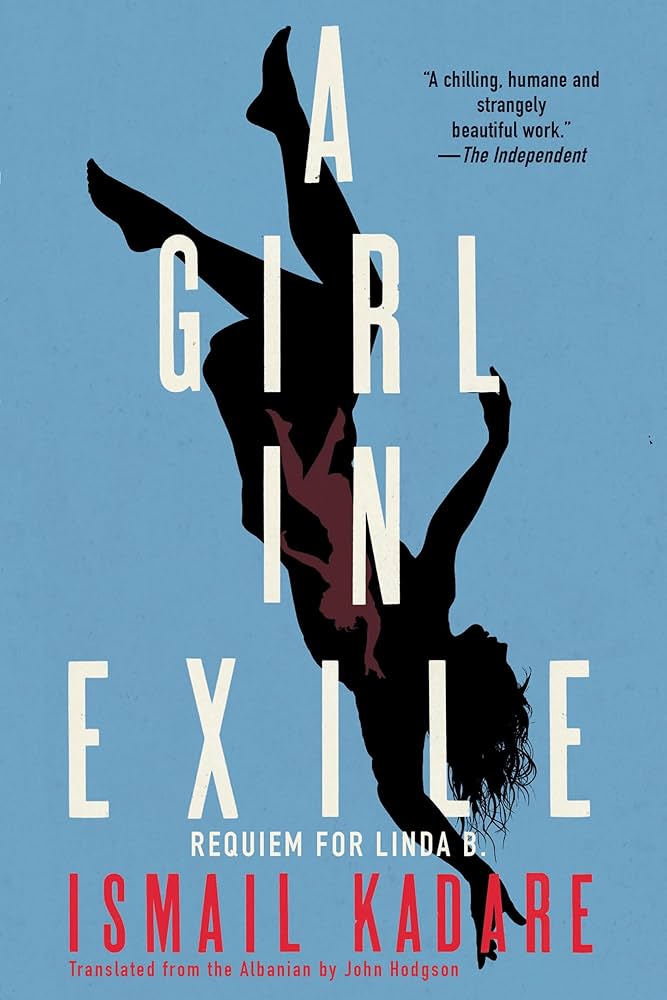
My Experience
This was not a very long story, but I think it is one of my favorites written by Ismail Kadare. At first I didn’t know what to think – because I was so hung up on trying to pinpoint and articulate what I felt in the first couple of chapters, I realized that didn’t work. I went and reread the beginning sections to actually allow myself to enjoy what was being given to me rather than having expectaitions.
Classifying My Experience
The one thing that comes to my mind right now would be connection. I say this due to the setting and conflict the character situates herself in. However, something that made me connect immediately would be the dedication he gives:
“Dedicated to the young Albanian women who were born, grew up and spent their youth in internal exile.”
With this dedication on the first page, it allowed me to feel a sense of connection right from the start with the idea of being in exile and forced to adapt in an environment that you don’t belong to or connect with.
Features and Technology
I think throughout the story, there are a lot of totalitarian system features that Kadare makes clear in the character, Linda.
“Quietly, Linda described what had gone through her mind on that bitter day. She was eighteen, and the next directive would arrive when she was twenty-three. Then twenty-eight. Two more directives and then thirty-eight, and then finally forty-three. She had no desire to live beyond that. Thank you, dictatorship of the proletariat, I know that you are a good thing, just and infallible, as we learned at school, but I’m tired . . . I’ve had enough of this life.”
I took this in away that Linda doesn’t measure her life to dreams but rather state directives. In this sense, her future is already engineered for her; it is written. This puts emphasis on how the regime she lives in constrains her within a administrative schedule. She is only eighteen years old, yet I am able to depict that she already knows what her future holds – very monotone, empty, with no hope. That is why she mentally stops at the age of forty three. Through this, we see how dictatorship ages you mentally.
Also, when she says “Thank you, dictatorship of the proletariat…” – it is almost mocking what she was taught; propaganda. Her experience becomes a testament that education has failed her, instead of truth, she was taught slogans.
“How was she able to rise above it all? Where did she find the strength?
Migena would ask herself these questions many times later, but at that moment she could think only of how to escape.”
Here we have the other character, Migena, whom Kadare writes in a way to contrast admiration with survival. The ‘she’ in question is Linda; Migena wonders how Linda was able to rise above everything, which shows a sense of heroism. Kadare suggests that resilience under a dictatorship isn’t guaranteed and it is rather fragile. Living in this system doesn’t allow for fear or thinking; it rather demands immediate reaction. With this, I am shown how that Migena admired Linda but can’t afford to mimic it; the system they live in forces people to survive the moment rather than change it. This shows how oppression separates people on a moral level which only makes empathy for one another dangerous. While reading this, I kept asking how were men allowed more freedom in a system that ‘oppressed’ all?
Also, I feel like I experienced Moral Omniscience here because while I read I can identify what is morally right and wrong. The depiction of women’s “freedom” is quite ironic, given that women are socially more vulnerable, and because of this, politics limits females’ freedom more harshly. They must be very careful about who they associate with because their freedom can be taken away in an instance. While they are also offered education, they are not taught freely – instead they are taught slogans. This creates the illusion of independence while having no autonomy at all.
Additional Technologies
I think that there is Irony used to expose the oppressive system – especially regarding the freedom of the girls. A big prospect would be school and how it is rather meant to empower girls, but instead it teaches propaganda. Women in this context are ‘equal’ but their lives are monitored and analyzed. The relationships they have surrounding others can pose a threat to them. This shows that freedom only exists in language, it isn’t practiced. Kadare puts an emphasis how what the regime says and what people actually live through. This only unveils how the oppression of girls is coated in progress and justice.
Conclusion
Overall, Linda represents a person crushed by the apathy of totalitarianism. Even though she is dead at the start of the novel, her spirit is prominent throughout the story, which only illuminates how the regime maintains its grip on power even after a person has passed away. Her exile shows how punishment can be silent while lacking a public rationale which mirrors how the state obliterates individuals while escaping accountability. The fate of Linda epitomizes the fragility of everyday citizens, particularly young women, who can be silenced and erased by a system that prioritizes one’s compliance over compassion.
Linda’s expulsion from the capital is not just a change of location but rather a profound disconnection from society, opportunities, and safety. Kadare portrays exile to remind others that punishment can occur without guilt, only on mere suspicion. Through the act of exile, the regime illuminates its ability to manipulate lives indirectly, which reinforces compliance while maintaining the illusion of order and freedom.
Featured Image
Cover for A Girl In Exile. Vintage. All Rights Reserved.