Good Times
a U.S. sitcom produced by Norman Lear that premiered in 1974. A spin-off of Lear’s Maude (which was a spin-off of All in the Family), the show followed a poor African-American family trying to make the best of things in Chicago, tackling topics such as unemployment, evictions, crime, and discrimination. Jimmie J. J. Walker played the character J.J., whose catchphrase “dynomite” “became part of the national vocabulary.” (https://www.pbs.org/wnet/pioneers-of-television/pioneering-people/823/)
Good Times: The Norman Lear Effect (YouTube channel)
Green Acres
a U.S. sitcom that aired from 1965-1971. NYC attorney Oliver (Eddie Alert) and his socialite wife Lisa (Eva Gabor) left the city to live on a farm in the country.
Lysistrata by Aristophanes
A comedy by Aristophanes produced in 411 BCE. It is about the women of Sparta joining forces, led by Lysistrata, to end the Peloponnesian war (which lasted more than 20 years) by declaring a ban on sexual contact with their partners. The women are able to persist until the men arrange for peace.
Marketplace and Kai Ryssdal
Marketplace is a podcast/radio show that started in 2005, hosted by Kai Ryssdal.
Marketplace is part of American Public Media, one of the largest producers of public radio programming in the world. “…providing context on the economic news of the day” and interviews with CEO’s and small business owners.
Clifford Odets, Waiting for Lefty
“First produced at the Fourteenth Street Theatre in January of 1935 as part of a benefit for the magazine, Lefty became an overnight sensation and Odets an international celebrity. The Group produced it in on Broadway in February, alongside his anti-Nazi play Till the Day I Die. A month later, they produced Awake and Sing!, generally considered his masterpiece. A fourth play, Paradise Lost, was also produced at this end of this momentous year. That work features the Gordons, a middle-class family, battling against economic, social, and health problems.”
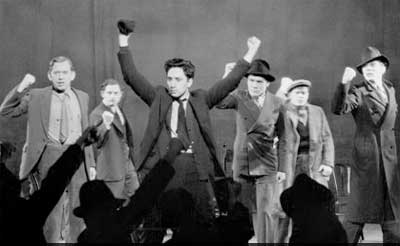
https://depts.washington.edu/depress/seattle_waiting_for_lefty.shtml
Mortgage Crisis of 2008
According to Colin McArthur and Sarah Edelman in their 2017 report “The 2008 Housing Crisis: Don’t Blame Federal Housing Programs for Wall Street’s Recklessness,” “There is near consensus among experts that the housing crisis was caused primarily by the rise of predatory lending and products with exotic features marketed to consumers without adequate information or preparation and sometimes using fraudulent information, as well as the failure of the PLS (private label securities) market.”2
Duke Fuqua Insights: The Myth of the Subprime Mortgage Crisis
Learn more here: “Crisis and Response: An FDIC History, 2008–2013“
Continuing consequences of the mortgage crisis exist to the present. In an episdoe of National Public Radio’s Planet Money, “Zombie 2nd Mortgages Are Coming to Life, Threatening Thousands of Americans’ Homes,” a profile of Karen McDonough’s experience resembles the one Wanda in The Veri**on Play describes:
“In 2007, McDonough’s first mortgage adjusted, and the monthly payments were suddenly $700 a month higher, which she couldn’t afford. This was happening to millions of Americans. It was happening to so many that the federal government launched a nationwide intervention — a loan modification program to save at least some people from foreclosure. In 2008, McDonough was able to get her first mortgage modified to lower the interest rate and make it affordable again.
This was the crucial moment that would eventually lead to those men standing on her front lawn. McDonough says her mortgage company told her not to worry about the second mortgage anymore, that it was written off and forgiven. “I was actually in my kitchen. I was cooking dinner, and I was talking to a representative … and he told me I would never have to make a payment again on the second mortgage,” she said. “And I just didn’t question any of it ’cause I was so grateful that the loan was modified.”
There didn’t seem to be any reason to question it. The same company had given her both mortgages. She says that after a while she stopped getting statements on the second mortgage. She thought it was dead . . . Then, in 2020, she received a letter in the mail from a company she had never heard of, First American National. It said she owed the company money. “It had an amount and they wanted a payment … like $77,000,” she said. “I was kind of in disbelief.” She says she called the number listed in the letter and spoke to a man who said he was a lawyer with First American National. “I’m like, ‘Why are you doing this?’ And he goes, ‘Well, why do you think I’m doing this?'” McDonough said the man kept answering her questions with other questions.
https://www.npr.org/2024/05/10/1197959049/zombie-second-mortgages-homeowners-foreclosure
