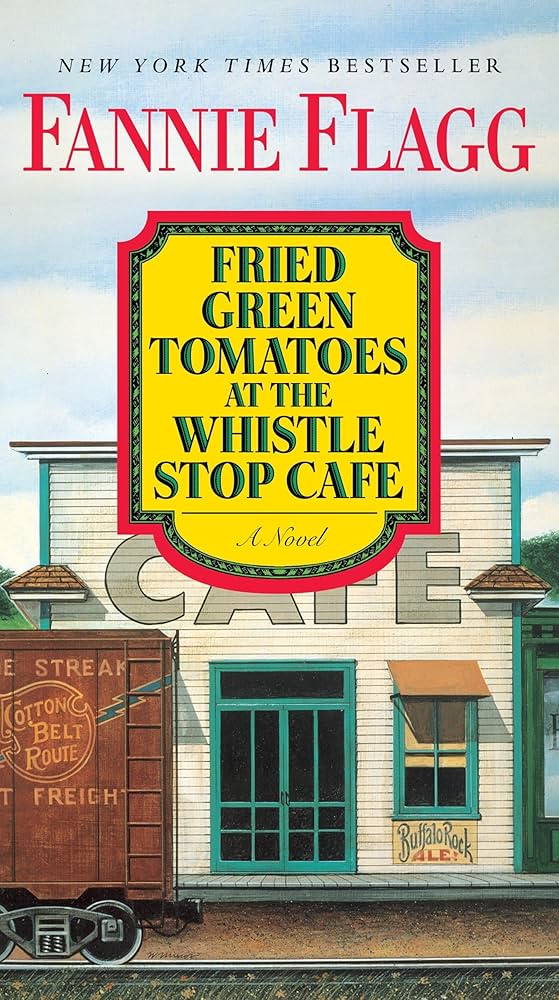
For this post, I decided to read “Fried Green Tomatoes at the Whistle Stop Cafe” by Fannie Flagg. I first became aware of this book about a year ago when I was flipping through TV channels and watched a bit of the 1991 movie version. It seemed like an interesting plot, so I looked it up and saw it was originally a book. I never got around to reading it, as I am not a big fan of reading books published before the 2000s. I wasn’t sure if I would be interested enough to read what seemed like a coming-of-age story set in the historical early-mid 20th century United States South.
During the summer of 2024, I did an internship at a recording studio in Harford, CT, where the book would come up again. One of the clients of the studio had a song featured on the movie soundtrack. The song, “I’ll Remember You”, by Grayson Hugh is an ode to a close friend/partner and the good times they had together. This piqued my interest again as to what the plot of the story was, as I had never watched the whole movie.
This assignment gave me the challenge to finally read the book, and the experience has exceeded my expectations.
Describing My Experience
I have read about 60% of the book as I am drafting this. The book jumps between different character’s stories or retellings, and through different narration mediums. While this style is new to me and hard to follow at first, I am enjoying it. Many times, a story is presented in three ways. The first is through Ninny Threadgoode, telling stories from 40+ years ago of the community she lived in. The second perspective is through newspapers from Whistle Stop and other areas the characters end up in. Finally, first-hand accounts of what the characters experienced are included.
The emotions and experiences of each character are very detailed. These descriptions helped me get lost in the world of the story and see situations as the characters did.
Additionally, there are many allusions to possible future events throughout the story. Some of them are heartwarming or seem to be insignificant. However, there are greater, over-arching foreshadowing that makes me feel uneasy about what will happen by the end of the book.
Classifying My Experience
The writing style of the book contributes to my experiences of immersion, empathy, and connection to the characters and community.
Wanting what’s best for the characters and seeing them strive contributes to my experience of gratification.
Finally, my uneasiness due to foreshadowing hints, is close to distress, due to a possible impending doom.
Features That Prompted My Experience
Immersion
In the following passage, Artis has taken a train to Birmingham, Alabama. Growing up in the 1930s, Artis had always felt outcasted in his hometown due to the color of his skin. As he walks through the train station and city, he passes white businesses, where he knows he would be unwelcome. He makes it to Slagtown, a community in the city that celebrates black culture. As Artis sees the robust nightlife of Slagtown, for the first time in his life, he feels like he belongs.
“…he found 4th Avenue North, where all of a sudden the complexion began to change.”
“He had found it: Here it was, those twelve square blocks, better known as Slagtown…Birmingham’s own Harlem of the South, the place he had dreamed about.”
“Couples began moving past him, all dressed up, talking and laughing on their way to somewhere; and he was being pulled along with them, like a whitecap floating on the crest of a wave. Music throbbed out of every door and window and spilled down flights of stairs into the streets…”
“Hot jazz and blues were melting together as he passed by the Frolic Theater, which boasted to be the finest colored theater in the South, featuring only musicals and high comedy.”
“And the people kept on moving…Down the block, Ethel Waters sang and asked the musical question, ‘What did I do to be so black and blue?’ While next door, Ma Rainey shouted out ‘Hey, Jailor, tell me what have I done?’…And people in the Silver Moon Blue Note Club were doing the shimmy-sham-shimmy to Art Tatum’s ‘Red Hot Pepper Stomp…'”
“…as he continued on down the street with the crowd; he knew he was home at last.”
The descriptive nature of Slagtown reminds me of the guided readings done in class. While I fall into the category of not being able to see images in my mind, the written details of Slagtown still immersed me into the storyworld. The atmosphere of music, dancing, and joy highlights a place where Artis will not shamed for the color of his skin, but celebrated.
In another example, the character Evelyn imagines herself in another world as an alter ego named Towanda. Her detailed immersion also immersed me into her thought process.
“Towanda went to Rome and kicked the pope off the throne and put a nun there, with the priests cooking and cleaning for her, for a change…”
“Towanda ordained that an equal number of men and women would be in the government and sit in on peace talks; she and her staff of crack chemical scientists would find a cure for cancer and invent a pill that would let you eat all you want and not gain weight; people would be suddenly became sexually desirable. Low-fat cottage cheese was banned from the land forever. Ditto carrot sticks.”
“Towanda would be so busy all day that Evelyn was exhausted by bedtime.”
Evelyn is unhappy in her own life and uses Towanda as a coping/escape mechanism. Her sentiment is also relatable, as most people feel like they are not good enough or doing enough. She wants to solve all the issues that plague her so no one else has to go through them. I also became more aware of Evelyn’s poor mental state at this point, as she would rather live in this imaginative world and has issues separating it from reality at times.
Empathy, Connection, and Gratification
When he was 7 years old, Buddy Jr. Threadgoode lost his arm after a train ran him over. Idgie, who has assumed a motherly role to him, gives him the nickname “Stump,” not to make fun of him, but to have him embrace the injury as a part of what makes him special. On Christmas one year, Stump is playing with toy guns with his friends and can’t reload his gun fast enough with one arm. He gets embarrassed that he keeps getting “shot” in front of his crush. Idgie sees his frustration and takes him to visit her friend’s house.
“Idgie walked down off the porch and said, ‘Come on, Lady! Come on, girl!’ and threw the ball up in the air. The little white rat terrier jumped at least four feet and caught the ball in midair, and then ran back to Idgie and gave it back to her. Then Idgie threw the ball up against the house and Lady jumped straight up and caught it again.”
“That’s when Stump noticed that the little dog only had three legs.”
“That dog jumped and ran after that ball for about ten minutes and never once lost its balance.”
The point of Idgie showing Stump the three-legged dog was to prove he can do anything he puts his mind to. The dog isn’t slowed down with three legs and is seemingly unaware of its disability. This scene made me feel empathy for Stump, but more so I felt gratification that Idgie was able to change Stump’s perspective. Seeing the characters in both good and bad moments, adds to the sense of connection I feel towards them while reading.
Sense of Impending Doom
“‘I told Cleo just the other day, I’d like for us to ride the train to Memphis and back so I could see Jasper and see what he’s up to. He works on the dining car.'”
“Evelyn looked at her friend and realized that she was confused about time again.”
Ninny Threadgoode, who is retelling the story of the Threadgoodes and their community to Evelyn, is a resident in a nursing home. As the time of Evelyn visiting her progresses, so do the signs of Ninny’s mental decline. Many times, her clothes are inside out, and she forgets what she is talking about, or forgets what time period she is in.
This can be seen in the above quote, as Cleo is her deceased husband and Jasper no longer works on the trains. There is constant uneasiness due to these comments, making it seem likely Ninny will pass away by the end of the book.
“‘I’m gonna kill that son of a bitch some-day, you wait and see.”
“Eva poured Idgie another drink. ‘No you’re not. You’re not gonna kill anyone and you’re not going back over there. You promise?’ Idgie promised. Both of them knew she was lying.”
Idgie is talking about Frank, the husband of Ruth. Idgie was in love with Ruth, but Ruth left town to marry Frank. For a couple of years, Idgie kept tabs on her and tried to find out if Frank was a good person. She finds out he is beating Ruth and threatens to kill him – to his face and her friend Eva. Idgie eventually gets Ruth away from Frank, and when he shows up in town, he goes “missing”. It called me back to the ominous fact that both Idgie and Eva knew she was serious about killing Frank for what he had done.
Possible Technologies
Immersion
One of the narration styles used to create the sense of immersion is second look. The multiple narrators of the same stories (Ninny, newspapers, and first-hand accounts) allow the reader to learn new details from each retelling.
Similarly, the story in the story technology is utilized. Ninny could be talking about a story involving Idgie, and in the next chapter, Idgie is the narrator of her own experiences.
Empathy, Connection, and Gratification
One of the plot technologies that help evoke empathy, connection, and gratification to the characters is pivot to a positive emotion. Many times throughout the story, a tragic event (like Stump losing his arm) eventually pivots to positivity (Stump becoming a successful quarterback in high school). The love the community of Whistle Stop has for one another shines through.
Catharsis is a technology used to further these experiences. When Ruth finally got away from Frank, I felt relief. Furthermore, when he went “missing” I was glad he would presumably never be able to hurt anyone else.
Sense of Impending Doom
While there are many possible technologies used for this experience, the main one used at time of drafting this, is suspense. There are many lurking questions at this point in the book: who/did someone kill Frank, will Ninny die, what happened to the Whistle Stop characters, will Evelyn make a change in her life, and more. The suspense is scattered throughout the book, dropping crumbs that hint something may happen in the future.
Other technologies that add to the sense of impending doom may be Idgie’s revenge plot against Frank and untrustworthy narrator – is Ninny retelling the story correctly if she is having lapses in her memory?
Further Thoughts/Experiences After Finishing the Book
The main experiences I had as I finished the book were closure, sadness, and nostalgia.
Many questions were answered, such as who killed Frank. Although it was hinted it was Idgie – especially since she went to trial for it – it was Sipsey, the cafe’s cook. Sipsey had been with the Threadgoode family for many years and is described as very caring to all, especially children. Since all signs pointed to Idgie, this reveal can be classified as a plot twist. When Frank comes to the cafe one night to steal his and Ruth’s baby, Sipsey hits him in the head with a frying pan, killing him. The only witness is her young grandson Artis, who gets his father George to get rid of Frank’s car and body – which he ends up cooking with the barbeque and feeding to the investigating sheriff. No one is ever charged with Frank’s murder. This is a form of poetic justice as Frank was a terrible person who would continue to hurt others if not for Sipsey.
While Artis was waiting for his dad to get rid of the truck, he stabbed Frank’s body and felt powerful. He cherished his secret of stabbing a white man until his death. The following passage mirrors Artis’s immersive first time in Slagtown, but occurs in a delusional state as he passes away:
“Artis’s mind had become just like the Frolic Theater; it chose only to run light comedies and romances, starring himself and a number of brown, tan, and cinnamon-colored beauties with swishing hips and flashing eyes…”
“Artis tapped his foot on the floor three times and, magically, the movie changed. He is a little boy now, and his momma is cooking in the back of the cafe… Oh, don’t get in Momma’s way, she slap you out the door… There’s Naughty Bird and Willie Boy. and sweet Jasper… Grandma Sipsey’s there, dipping her cornbread in honey… Miss Idgie and Miss Ruth… they treat you white… And Stump… and Smokey Lonesome…”
“Then, the old man, who had been agitated just a moment before, begins to smile and relax. He is out in the back of the cafe, helping his daddy barbecue… and he is happy… we know a secret.”
“His daddy gives him a barbecue and a Grapico, and he runs way back up in the woods to eat it, where it’s cool and green and the pine needles are soft…”
“…Artis was still way up in the woods, with his barbecue… and he is happy… we know a secret.”
As Artis is going through this dream state, there are two white men making fun of him and his condition. Little do they know what he is capable of, which brings comfort to Artis as he dies and returns to his peace in the woods.
Additionally, Ninny Threadgoode does end up passing away while Evelyn goes to a model/weight loss camp. The camp is controversial, yes, but I believe the author was trying to emphasize that Evelyn was able to turn her life around after Ninny accepted who she was and encouraged her to do anything wants. Before Evelyn left, Ninny said she was having dreams of being back at Whistle Stop in its prime with all her passed-on family members and friends. Evelyn visits her gravestone, which reads “GONE HOME,” and tells Ninny everything that has happened since she passed.
It is interesting how Artis, Ninny, and others all think about Whistle Stop and its people as they pass away. It is somewhere they want to return to and be reunited in.
While at the cemetery Evelyn sees a recent Easter card left on Ruth’s gravestone signed: “Your friend: The Bee Keeper”, a callback to Idgie’s nickname. This reveals that Idgie is still alive, and it is later noted she is a bee keeper selling honey in Florida with her younger brother.
I felt sadness as the book wrapped up due to many characters dying as well as the downfall of the Whistle Stop town. The trains stopped going through the area, beloved businesses closed, and many people moved away. The weekly newspaper columnist Dot Williams wrote:
“Now that I look back, it seems to me that after the cafe closed, the heart of the town just stopped beating.”
The book spent a long time building up the storyworld of Whistle Stop and Idgie and Ruth’s cafe, and it is sad to learn of its demise. Something once cherished and full of love is now nearly abandoned and run-down.
The worlds of Whistle Stop and Evelyn collide as she visits Ninny’s neighbor to get some items she had left to her. They drive around the town and see the buildings and landmarks Ninny told her about.
“…they drove a few blocks from the house and she showed her where the cafe used to be, sitting not twenty feet from the railroad tracks. Right beside it was a little brick building, also abandoned, but Evelyn could just make out a faded sign in the window: OPAL’S BEAUTY SHOP.”
“Everything was just as she had imagined.”
Although the town and buildings are in disarray, Evelyn can still see the heart of it all and the memories they will always hold. This gives me a wave of nostalgia for a community/place that doesn’t even exist.
Evelyn later visits the Threadgoode house and sees it in a very similar way to Ninny’s description at the very beginning of the book:
Ninny’s Perspective
“Of course, most of the house is all boarded up and falling down now, but when we came down the street, the headlights hit the windows in such a way that, just for a minute, that house looked to me just like it had so many of those nights, some twenty years ago, all lit up and full of fun and noise. I could hear people laughing, and Essie Rue pounding away at the piano in the parlor, ‘Buffalo Gal, Won’t You Come Out Tonight’… and I could almost see Idgie Threadgoode sitting in the chinaberry tree, howling like a dog every time Essie Rue tried to sing… I guess, driving by that house and me being so homesick made me go back in my mind…”
“I remember it just like it was yesterday, but then I don’t think there’s anything about the Threadgoode family I don’t remember.”
Evelyn’s Perspective
“It was just getting dark, and as she came down the street, her lights hit the windows in such a way that it looked to her like there were people inside, moving around… and all of a sudden, she could have sworn that she heard Essie Rue pounding away at the old piano in the parlor…”
“Buffalo gals, won’t you come out tonight, come out tonight.”
“Evelyn stopped the car and sat there, sobbing like her heart would break, wondering why people had to get old and die.”
It’s a bittersweet feeling knowing that Ninny and most of the Threadgoodes are gone, but their stories gave Evelyn the will to live and make changes. Although the town is not the same, its memories and people will live on – especially for Evelyn.
Works Cited
Experiences Glossary – Story & The Brain. https://unewhavendh.org/story-and-the-brain/experiences-glossary/. Accessed 22 Feb. 2025.
Flagg, Fannie. “Fried Green Tomatoes at the Whistle Stop Cafe.” Goodreads, Goodreads, 12 Aug. 1987, www.goodreads.com/book/show/9375.Fried_Green_Tomatoes_at_the_Whistle_Stop_Cafe. Accessed 22 Feb. 2025.
Hugh, Grayson. “‘I’ll Remember You’ Lyrics”. https://graysonhugh.net/track/2565085/i-ll-remember-you Accessed 22 February. 2025
Technologies by Element of Narrative – Story & The Brain. https://unewhavendh.org/story-and-the-brain/technologies-by-element-of-narrative/. Accessed 22 Feb. 2025.
Featured Image
Cover for Fried Green Tomatoes at the Whistle Stop Cafe by Fannie Flagg. Cover Design by Wendell Minor. Random House Publishing. All Rights Reserved.