After many suggestions from others, I decided to read Metamorphosis for this assignment. I chose it because my immediate reaction was that it sounded like something I wouldn’t read, so I’m giving it a go to push myself. I also wanted to try reading older books, and this one was written in 1915 – perfect!
Describing my Experience
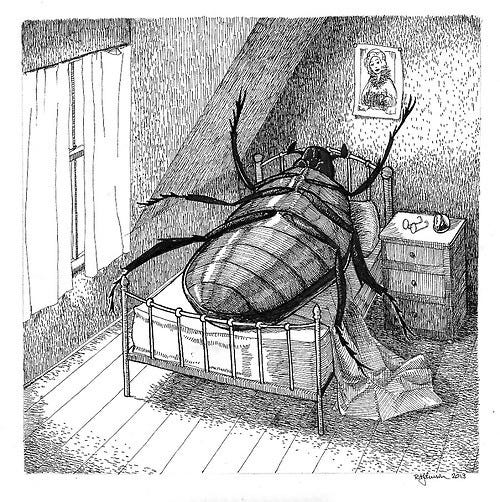
My initial reaction to the story was that I was confused. Granted I was pleasantly confused because I liked the writing well enough, but in terms of plot I didn’t understand what was going on. Diving into storyworld, there is a huge emphasis on the importance of a career. I thought that this would subside throughout the story but it was a huge plot point. The entire plot is dedicated to Gregor getting to work so he isn’t fired and seen poorly by his boss, and then shifts to become about the lack of income that results from this. But he woke up as a bug? That’s where I get lost because that seems to be a trivial detail in him getting to work. He speaks of his bug body in such a matter of fact way, as if it’s just a common wrench in the plan. I was sincerely hoping as the story unfolds this will resolve itself, because I couldn’t get over it. While other characters acknowledged their disgust by it, there was no emphasis on figuring out a solution, which is all I could focus on. Someone suggested to me that Gregor is experiencing psychosis, which changes my perspective somewhat. Overall I just could not exactly follow the purpose of it which was frustrating to me. However, the other aspect of storyworld was the idea that Gregor had to hide this part of him that he could not change. This part of story is what stuck out to me in my misunderstanding of everything else.
“If I didn’t have my parents to think about I’d have given in my notice a long time ago, I’d have gone up to the boss and told him just what I think, tell him everything I would, let him know just what I feel. He’d fall right off his desk! And it’s a funny sort of business to be sitting up there at your desk, talking down at your subordinates from up there, especially when you have to go right up close because the boss is hard of hearing.”
Classifying my Experience
So naturally my first experience from the experiences glossary is confusion, because everything is unclear to me. I think my struggle is that I don’t have the mind for anything outside of realistic fiction, and I can’t picture anything fantastical. This was clear to me as I was reading and could not get over the bug aspect, instead of just accepting it and moving forward.
“As Gregor Samsa awoke one morning from uneasy dreams he found himself transformed in his bed into a gigantic insect.”
While the storyworld was frustrating to me, I think I was mostly just confused. Among the characters, I’m not sure how the author (Franz Kafka) wants us to feel about Gregor’s family and boss. I was a bit lost at his family’s reaction to him being a bug, but it was not pleasant. As I continued reading it became clear that his family was not supportive of his experience, and in hindsight that was set up from the beginning. As I read I felt good about his sister, but she eventually became hurtful towards Gregor and his experience as well. They were so focused on the money he provided for them that they overlooked his experience as a bug, which was heartbreaking to me. I would describe this as skepticism because something seemed off to the other characters to me before I could pinpoint it.
“At that time Gregor’s sole desire was to do his utmost to help the family to forget as soon as possible the catastrophe that had overwhelmed the business and thrown them all into a state of complete despair.”
Initially I was reluctant toward the rest of the story, but I was feeling nimbleness towards the remainder of the book. I wasn’t quite sure how it’s going to play out, but I was prepared to dive into whichever way it turned. After finishing it, I am feeling frustration. I did not come to accept the storyworld or the fantastical element. As it went on I only felt more frustrated for Gregor’s experience, and it did not play out in the way I wanted (despite my feeling of nimbleness). I was frustrated especially by his family and their role in his experience. Their lack of care for their son who poured everything he had into them just self selfish to me. And yes he was a bug, that was weird to me too, but they didn’t empathize with him at all. Even more strangely they didn’t even question it, and that frustrated me more. As the story went on they lost their hope for Gregor even further, but it seemed like they didn’t care much for him before he turned into a bug.
“He must go,” cried Gregor’s sister, “that’s the only solution, Father. You must just try to get rid of the idea that this is Gregor. The fact that we’ve believed it for so long is the root of all our trouble.”
Narrative Technologies
So my confusion is coming from the reality shifter, which the technologies by element page describes as “Presenting an alternate reality in the form of an absurd or unrealistic plot, character, or storyworld”. I understand that Gregor being a bug is the point of the story, but I just don’t get the reactions to it because of its absurdity. As the story went on, I just felt that the lack of resolution or answers to the issue at hand confused me more.
“The next train went at seven o’clock; to catch that he would need to hurry like mad and his samples weren’t even packed up, and he himself wasn’t feeling particularly fresh and active. And even if he did catch the train he wouldn’t avoid a row with the chief, since the warehouse porter would have been waiting for the five o’clock train and would have long since reported his failure to turn up. The porter was a creature of the chief’s, spineless and stupid. Well, supposing he were to say he was sick? But that would be most unpleasant and would look suspicious, since during his five years of employment he had not been ill once.”
When I started this story, I felt like I was made to be reading a parable. I wasn’t quite sure which lesson I was learning. As the story went on I think you could take many lessons from the story, depending on how you interpret it. The lesson I felt that was apparent to me was the idea of a physical representation of not living as yourself. Gregor was living this invisible life for his family, and was unappreciated and unrecognized. As he experienced his transformation this became more apparent. He gave all he had to protect his family, who never truly appreciated the sacrifice he gave. This manifested in his death, where his family was able to benefit from it. The parable is a cautionary tale about devotion, and how it can break someone when it becomes all consuming.
“To spare her from even these glimpses, he dragged the sheet to the sofa on his back one day—this required four hours’ work—and laid it in such a way as to conceal himself entirely, so the sister could not see him even if she stooped down.”
Lastly, the plot is using second method to illustrate the story. There is a chaos in the beginning, a lack of harmony, that I thought would become resolved as the story unfolded. This became somewhat true, except the resolution came in Gregor’s death. The chaos he felt internally as well as his family’s financial burden ended when he died. Although this is not necessarily a positive resolution in the way I expected or wanted for Gregor’s sake, it is a use of a technology to illustrate resolution after dissonance.
“His growing lack of concern for the others hardly surprised him, whereas previously he had prided himself on being considerate.
Conclusion
After I finished this story I stand by my initial reactions, however I do see the beauty in this story as one to dissect. I can see how there are many ways to interpret the story, and for that I see how it’s considered classic. While I am still somewhat confused and could not allow myself to just enjoy the story without questioning it, I feel good about finishing it. I decided not to do any research on other perspectives because I want to keep mine as my own, which is something I often do with stories that are not cut and dry.
Sources
Kafka, F. (2005). Metamorphosis. Penguin Random House. (Original work published 1916)