My Experience
Inferno is a story that has been taunting me for years, because despite many references to it in pop culture and generally feeling like it is something I would enjoy, I have never quite been able to force myself to read it. But I figured my goal for this class was to stretch the scope of my reading, so this presented me with the perfect opportunity to leap into this story. I think discussing allusions to it in my first post also helped to really give me that final push to actually start reading it. So far, my experience has mostly just been a desire to know more about what will happen next and how little details in the writing might influence the rest of my experience. Although, I will admit that I am at times finding it difficult to keep pushing through it, not because I don’t find it interesting, but because either my mind ends up drifting or I just for one reason or another have to reread a stanza because I wasn’t fully paying attention.
I also like the illustrations that periodically are placed in between the cantos, because the art looks cool and some of them are drawings of either specific circles of hell or a handful of circles that show a couple of them in order as you journey further down. However, they’re a little inconvenient to reference again, and personally I don’t think that they enhance my understanding of the story itself all that much. I will say that that could also be due to me taking breaks of a few days in between reading certain sections so I might also just not exactly remember where I’m picking up in the story again.
Classifying the Experience
Despite not being all that far into the book yet, my experience with Inferno thus far has been a mixture of confusion and curiosity. Going into this, I only had a very limited basic understanding of the story from what I had heard or experienced through popular media, so I really had minimal knowledge of what to expect from actually cracking open the book (well, technically opening it on my Kindle, but still). I feel confused about where exactly the story is going, and the way in which it is structured is a little bit weird to get used to, because it’s written in poetry form rather than like a typical novel would be. Something I do find interesting about this formatting is that the words themselves, for the most part, seem to be very straightforward while still being structured like a poem, although that could in part be a result of the specific translation that I am reading. For instance:
I, who was eager to obey him, thus
concealed nothing, but opened all to him;
at which he raised his brows a little up:
“They were fiercely hostile,” he uttered
then,
“to me, my forebears, my party – so averse
that two times I expelled and scattered
them.”
“If they were driven out, then they re-
turned
from every side,” I answered him, “both times;
and yet for yours, that art was not well
learned.”
And then arose, uncovered to my sight,
a shade alongside him, just to his chin:
I think it was upon his knees he climbed.
He peered around me then, as if intent
to see if someone else was with me too
This passage from Canto 10 is when Dante sees Farinata, one of the figures in Hell. From this section, it is very straightforward that he is having a conversation – just before this piece he was asked who his ancestors were – in which he felt compelled to answer the question. It seems clear that Dante’s ancestors were violent towards the ancestors of Farinata. Farinata then looks around to see if Dante is making this journey by himself. So this little section, while structured poetically, is very clear-cut and straightforward in terms of the actual actions and events taking place.
However, certain phrasings still lead to me feeling a bit confused, but I’ll admit that could be partially due to my mind wandering while reading. So, I am a bit confused about the structure and the language. I am also curious, because I want to continue the story to see where the rest of it goes and if the setup of the story adds anything to my experience that I might not have gotten out of a typical novel format, though I am not entirely sure quite how I would measure that without something to compare this to.
Even after reading through a bit more of the story or rereading certain sections, usually still just because I cannot seem to get my mind to remain fully focused on it, I still feel that mixture of curiosity and confusion. I feel very frustrated – though more with myself than the story – because I so desperately want to be able to just read it straight through and understand it like I would with a contemporary novel, despite knowing that this kind of literature often requires a very different approach. It’s moments like these that have me wishing that I had the ability to read literature in their original language because I often feel frustrated with English translations because I know that no matter how well it may be done, it likely does not fully capture the depth of the original. I do wonder how similar the translation I chose is to other translations and how that has impacted my experience, because I feel like it definitely has a role to play. I also get frustrated with my general inability to focus on what I’m reading at times because my mind wandering ranges from simply being distracted by other things I have to do or seeing a single phrase like “through me” and spending the next five minutes thinking about the Hozier song which inevitably leads to me thinking about other media that references Inferno like the show Over the Garden Wall, and suddenly my mind is full of allusions to the story I’m reading instead of being focused on the actual story. So I have felt so much frustration in the bits I’ve managed to read, which would be solved easily if my brain would just turn off the thoughts that aren’t directly about what I’m reading. Despite this intense frustration for not being able to focus or otherwise not being able to magically understand what’s happening from first glance, I do have a desire to keep pushing through and finish the book because I’ve committed myself to it this much; unfortunately it might just take me longer than I would have liked. I think that a lot of this comes from feeling as though I have to understand this within its context instead of simply reading a story. For better or for worse, my brain can be very analytical about what I’m consuming at times, but regardless it affects how I experience a story.
The Features
So far, something I find interesting in the story world is that Dante’s explanations of the environment of Hell seem to blend the Christian concept of Hell with elements from Greek mythology, as well as references to real people who existed. For instance, the narrator mentions Charon, who is the guide across the River Styx to the Underworld in Greek mythology. I think it’s also worth noting that Dante is following the poet Virgil through hell in this story, another real-life person. Here is an excerpt from when the narrator is pointing out the souls residing in hell in Canto 4:
“I saw the good collector of which and what,
Dioscorides, I mean; Orpheus I could see,
Tully and Linus and moral Seneca;
Euclid the geometer and Ptolemy,
Galen, Avicenna and Hippocrates,
the great Commentator, Averroës.”
Just in these couple of lines, Dante mentions several figures, some of whom are characters from ancient myth, and many of which were great scholars and philosophers. I think that the reference to Orpheus is particularly interesting, as the myth of Orpheus and Eurydice is about a trip through the underworld to attempt to rescue a loved one, and Inferno centers around this descent into Hell. I am also wondering if there was a particular reason for blending the references to myth and real life with a more Christian notion of hell. Like, did Dante mix this all together in order to emphasize a particular point in his work or build a richer and more full storyworld? I’m curious to see how the rest of the story unfolds in relation to the combination of elements used to deepen the world.
I have unfortunately not gotten far enough to explore Dante’s use of blending various types of references to see if it continues this way through the next stages of the journey, but I still think that it is a really interesting idea that continues to fuel my curiosity about the world-building and the thought process behind it.
Technologies
This story seems to have a very sort of mythological feel to it, which could be because of the nature of it revolving around a journey through Hell or the references to ancient myths. It feels almost fantastical in a sense, which I think might be because of the way reality and fiction are blended.
A technology that I noticed right off the bat was the I Voice, as the story is narrated from the perspective of the main character – in this case a fictionalized version of Dante himself – rather than some omniscient narrator who is speaking in the third person. I think that this contributes to the worldbuilding because the first person narration means that it is from one specific character’s perspective, which usually makes me question the reliability of the narrator. If I were to think of Dante as a sort of unreliable narrator, that might affect the world of the story. I think I want to read a little further before I fully flesh this out as something that contributes to the overall storyworld, but I think that it is an interesting element to consider. The I Voice is found throughout the entirety of the work, but some passages showcase the narrator and the events of the story better than others – or in slightly better detail for my brain to wrap around, for example:
Now onwards, by a narrow secret path
between the city wall and torturing fires,
my master goes, and I behind his back.
“O highest virtue, who through the impious gyres
resolves me,” I began, “speak to me then,
as you may please; satisfy my desires.
Could one observe the people lain within
the sepulchers? their lids are lifted up
already, and there’s no one guarding them.”
This passage is in the beginning of Canto 10, in which Dante and Virgil are still in the sixth circle, which is heresy. There is a clear description that Dante is still following Virgil through the levels of Hell, told through the first-person perspective. Dante is clearly curious about who resides in the layer reserved for heretics here, which is a detail I find interesting.
I think that poetic language is also present; while this is more of a narrative technology than a storyworld technology, I think the language used in a story definitely contributes to how I conceptualize the world as a reader. The poetic structure of Inferno was one of the first things that jumped out at me upon starting the story.
I’m sure there are other storyworld technologies present, but I feel like I need to read a bit further before I can have a more comprehensive grasp on which ones apply, so I will revisit the technologies after that.
Admittedly, I did not get as far before revising this portion of the draft as I would have liked. What little bits I did read, I did not come across any other technologies that particularly jumped out at me, though the use of a passage I contributed last class as a sort of allegory struck me as interesting.
And I: “Though I have come, I don’t remain;
but who are you, who have become so ugly?”
He said: “You see I’m one who weeps in pain.”
And I to him: “With weeping and with hurting,
you accursed spirit, may you remain;
for I know you, though you’re completely dirty.”
Upon rereading this section of Canto 8, the prior stanza reveals that he is in fact talking to a person – or I guess spirit in hell? – who is covered in mud, so that clears up a little bit of the context that I had previously been confused about. As I mentioned, I remember the idea of this section potentially being an allegory, although for exactly what I’m not certain. I could see it potentially being a lesson about judgment, or those last couple of lines could be talking about recognizing something or someone for who/what they are or who you know them to be, despite them being covered, whether physically or metaphorically.
I think that there is a lot in Inferno that I’ve yet to uncover in terms of technologies and the world of the story, but I feel like with something like this there is a lot that can be left open to interpretation.
Works Cited
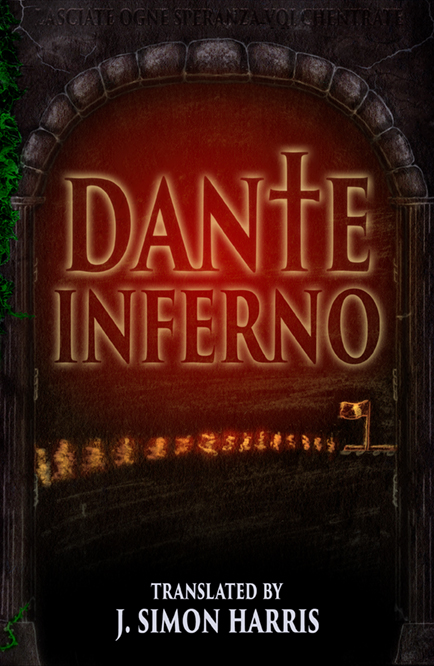
Alighieri, D. (2022). Inferno (J. S. Harris, Trans.). Nostra Vita Books.
Featured Image
Cover of Inferno. Nostra Vita Books. All Rights Reserved.