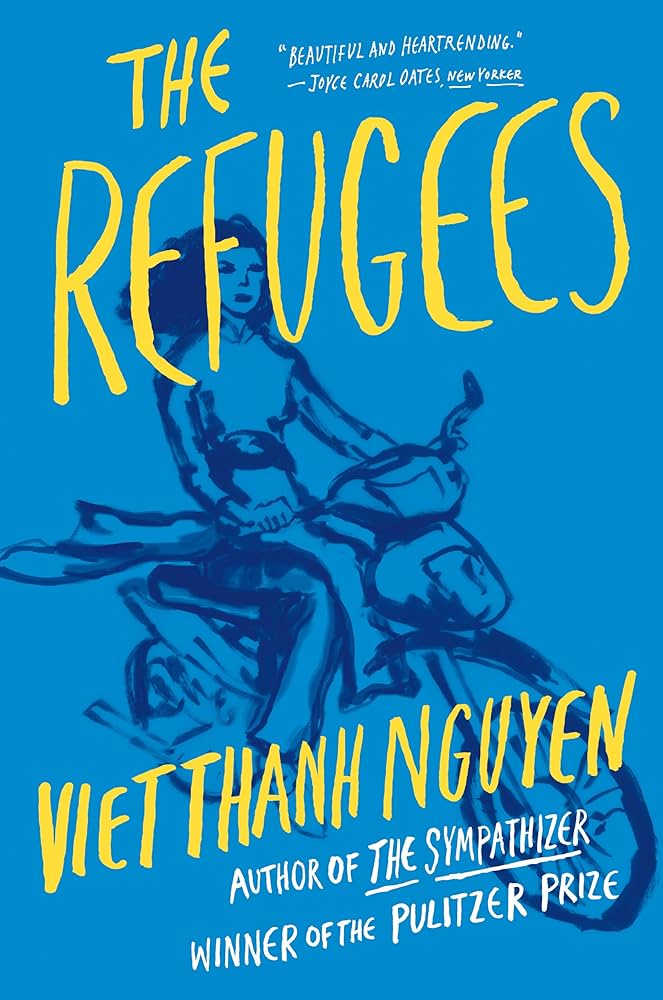
Black-Eyed Women, one short story from The Refugees by Viet Thanh Nguyen is intriguing commentary on grief. The story is the first one in the collection. The main character is a nameless ghostwriter, a thirty-eight year-old woman struggling with the death of her brother and her new belief in ghosts. The protagonist is introduced as a writer of memoirs for people who have experienced extreme tragedies. She leaves no trace of her identity in any work she creates. This segues into the protagonist’s mother explaining that she had just been visited by the ghost of her son, who left a wet trail on the carpet after taking years swimming across the Pacific ocean to come back to them. The protagonist has recurring paranormal experiences involving her late brother that bring up deep themes of war, grief, and suffering.
My Experience
This was an extremely sad but profound short story. It had me deeply engaged and I read the 21 pdf pages straight through in one sitting. It developed very believable characters and realistic conflict. The tension was so tangible I teared up a little when I was reading.
So far, I don’t believe anything I’ve read for this class is a “typical” immigration narrative. This one especially. Instead of focusing on the hardships of the journey, there is one mass traumatic event along the way that haunts the rest of the story. We get that event through the protagonist’s processing of it years later. Because of that and many other reasons, Black-Eyed Women is very unique. And that isn’t to say that it isn’t about immigration. The themes of immigration are visited through the context of the protagonist’s memories which are tied strongly to her family and events she went through. Through this unique perspective, the protagonist comes to learn the nuance in life and death, and the true weight a story holds.
In a country where possessions counted for everything, we had no belongings except our stories.
Nguyen, page 7
This quote is said when the protagonist realizes how much stories and warnings kept her company in her youth. Before her brother died, they huddled in a shelter their father built during the war while the brother would tell tales of folklore as a way to comfort her. This is a very powerful concept, and I loved how the protagonist would interrupt the present narrative to tell her memories, the stories of her own she has to share.
Classifying my Experience / Identifying Technologies
I was very immersed in this story, though this did take me a few pages to achieve. I didn’t have any frustrations with this story at all — I just had to pay close attention to the writing style and limit my over-analyzing so I didn’t jump to conclusions. I couldn’t fully get into it at first, but once the style clicked with me I was very immersed. I think that the part of the style that I had to get used to was that this story introduces a lot of information pretty quickly. And that’s part of the short story genre, having to establish character and plot pretty quickly. Once I understood and retained that this character is a ghostwriter for traumatized individuals, has a mother who is slightly displeased with this career choice, is currently working on a memoir for a man who was the only one who survived a plane crash, and is trying to come to terms with her brother returning after he died, I was completely fine and was enamored by this story.
I also realized that this story uses a little bit of magical realism, where an otherwise realistic fiction piece has mythical qualities that are never explained. Though this doesn’t perfectly fit because the protagonist is originally skeptical of her mother’s experience, but she also doesn’t take that much convincing once her brother visits her. Once it was established that the protagonist was seeing him and that he was there, I had to pay attention to how the family treated him. In some senses, they treat him like a ghost. They know he disappears when they turn their back on him. But there are other instances where the family’s perception of the brother blurs reality — for example I think at some points they touched him. This added to my intrigue. In many ways, the brother could be indistinguishable from a living person.
Part of my enamored nature was the perfectly measured subtly of the protagonist’s traumatic memories, such as the protagonist remembering her childhood.
That was my signal to follow him down our village’s lanes and pathways, through jackfruit and mango groves to the dikes and fields, dodging shattered palm trees and bomb craters. At the time, this was a normal childhood.
Nguyen, page 5
Some authors can get very heavy-handed when it comes to dark subjects. And this story does get incredibly, unapologetically dark. However, it eases you into that. Therefore, it makes the dark moments more meaningful instead of scaring readers off or boring them. For example, this quote is one of the earliest in reference to the protagonist’s childhood. It introduces war as something among a “normal” childhood in Vietnam during this time. Before the bomb shelter the father built was used for its intended purpose, the kids would play in it after school. We’re literally set up along a path of beautiful scenery that slowly morphs into the tragic reality of war. This description is beautiful, and I could see this technique as a camera panning to follow the characters in a movie.
This could be a more subtle example of hurt delay, where a character experiences trauma but does not recognize it until later on. But this is better shown through the protagonist’s arc when her brother starts to visit her. I think that would best fit the way that this story is written and how the most emotion is evoked, drawing parallels to both present and past. This does get pretty fluid though, as we are following the protagonist and the current man she is writing for, the protagonist and the ghost of her brother, and the protagonist and her family from within her memories.
A purple bruise with undertones of black gleamed on his left temple, but the blood I remembered was gone, washed away, I suppose, by salt water and storms . . . I could smell the boat, rancid with human sweat and excreta.
Nguyen, page 8
This is a description of the sensory experiences the protagonist was having when her brother visits her for the first time. This is not directly a piece of the past or her memory of him, but the brother’s visit in the present triggers the protagonist’s processing of the past. This is a great example of showing not telling, because we are introduced to the injury that got the brother murdered and the setting they were in but we aren’t explicitly told what happened until the protagonist is able to come to terms with it.
Something else that stuck out to me is the author’s use of ghosts as a metaphor. The protagonist even addresses the irony that she is a ghost writer and her mother often has paranormal experiences. This symbol of the spirit world is presented literally but has some metaphoric layers. For example, the author uses this to force the narrator to contend with her suppressed grief. While there are some bits of “ghostly logic” such as the brother not caring about what clothes he appeared in after his mother bought him more, these are equally mixed in with times where he is treated like a human would be. For example, the protagonist approaches her brother with concern in this scene.
I touched the bruise.
‘Does it hurt?’
‘Not any more. Does it still hurt for you?’
Once more I pretended to think about the question whose answer I already knew. ‘Yes,’ I said at last.
Nguyen, page 15
This was very emotional for me, because while we get a snapshot into the suffering of the brother we also see that this trauma has left her hurting too. This scene is right between a flashback where readers learn exactly what happened all those years ago. The family was traveling on a ship when pirates invaded the ship, stealing all of the gold, women, and girls. The brother attempts to disguise the protagonist as a boy, but this fails when he tries to protect his sister from the pirates. The brother stabbed one of the men and in return was struck in the head with the stock of a gun and bled out on the ship deck. The protagonist and her parents were the few who survived. The rest of the women and girls were taken by the pirates.
While ghosts are used in this story as a vessel for coming to terms with grief, grieving isn’t always for someone who died. The protagonist learns that she has herself to grieve, too. She realized this when she’s asking her brother questions to try and process what happened.
‘Tell me something . . . Why did I live and you die?’
. . .
‘You died too,’ he said. ‘You just don’t know it.’
Nguyen, page 17
There is a grief releaser moment here, where the protagonist’s search for meaning is halted and she allows herself to feel the pain of not only losing her brother, but losing herself.
My brother watched me curiously as I wept for him and for me, for all the years we could have been together but didn’t, for all the words never spoken between my mother, my father, and me. Most of all, I cried for those other girls who had vanished and never came back, including myself,
Nguyen 18.
After this, the protagonist realizes that not all ghosts are people who died. Ghost stories are not scary stories, but often the only things we have and the only way we can be remembered. This is a very unique way of using this metaphor and I thoroughly enjoyed this read because of that.
My biggest takeaway from this piece is that an immigration story doesn’t have to a be straightforward journey, but instead can be an inspection of the past through hurt and grief. That doesn’t mean we should be sulking in the past, but be aware how we can better process our trauma in the present.
Works Cited
Nguyen, Viet. The Refugees. Grove Press, February 7, 2017.
Featured Image
The Refugees. Grove Press. All Rights Reserved.