Describing my Experience
I decided to read The Grapes of Wrath because I am a big fan of John Steinbeck; I read Of Mice and Men in high school, and this past fall, I read East of Eden and loved it. Currently, I’m about a quarter of the way through the book and, so far, I am absolutely obsessed. The first few chapters were a little slow to start, I think, in part, because Steinbeck lays down the prose pretty heavily, so it can be a little challenging to get invested right away. But as I kept reading, I just kept getting more and more into the story.
Something I’ve noticed about Steinbeck is how adept he is at illustrating these sort of worldly concepts. East of Eden explores love, brotherhood, human nature, and family in really beautiful, and subsequently easily digestible and widely pertinent ways. Something similar is happening in Grapes of Wrath; one of the most prominent themes is hope, which stems from Steinbeck’s depiction of the Great Depression and the progression of capitalism and industrialization in America. I so greatly admire his ability to cover such broad, kind of intimidating, and deeply personal topics with so much accuracy and grace. I really look up to and respect (maybe even revere) Steinbeck as a writer, but I also think his writing is so one of a kind.
Another thing that’s been kind of fun for me as I’m reading is all of the connections I’ve been picking up on between Grapes of Wrath and my favorite musical, Hadestown. I don’t want to get off topic, but I also just need to get this out of my head, so I hope this small tangent will be forgiven. Hadestown is a retelling of the Greek myth of Orpheus and Eurydice. The musical purposefully lacks a precise time period or location, but the costuming and set design were heavily inspired by depression-era New Orleans. Hadestown addresses similar themes as The Grapes of Wrath: hope, love, industrialization, and capitalism. I don’t want to spiral off topic, but it has been so fun for me to see how these two works feed into and play off of each other. Hadestown was created sometime around 2010, if I remember correctly; Grapes of Wrath precedes it by… roughly 70 years? And yet, the connections between the two are so prominent that it only deepens my appreciation for both stories.
I think both stories portray industrialization and, more specifically, capitalism, as antagonistic
forces, which is really interesting because they aren’t personified, really. The human antagonists
in both stories are more like capitalism’s puppets—or vessels, maybe (I’m thinking about the
excerpt I shared about the bank being a monster, and Hades’s character in the musical… super
interesting stuff happening in my mind)—and our protagonists are the victims. And, although the
plot isn’t really similar, the protagonists do face a lot of similar obstacles: poverty, greed, hope
(yes, I’m including hope as an obstacle), etc.
Classifying my Experiences and the Technologies Prompting Them
Okay, I sort of just went on a spiel about how much I love John Steinbeck and how much I love Hadestown. To re-center this post, I’ll talk a little bit more about some of the specific experiences I’ve having with Grapes of Wrath.
Some of the experiences that stood out to me were skepticism, superiority, and moral omniscience, and I think the three of them are all sort of related. I picked out superiority because it’s defined as the experience of having an elevated, “God’s eye,” view of the story. The way that that relates to my experience is because I’m reading from the future, compared to the time the story takes place—the 1930s Dust Bowl/Depression. Furthermore, I have some background knowledge of the realities of this time period, thanks to my time in the American public education system. I’m not sure that superiority is entirely accurate, but I’m not sure how I’d define this experience another way. Regardless, this sort of “superiority” (for lack of better terminology) kind of branches off into two other experiences: skepticism and moral omniscience.
I think that skepticism is related to the dream of the world technology, which I took pretty literally: a narrative that moves between two worlds without providing a sense of certainty as to which is real. The story follows Tom Joad and his family as they journey to California after being kicked off of their homestead in Oklahoma. Steinbeck clearly articulates their expectations of what life will look like in California: plenty of jobs, fresh fruit, stable housing, advanced automobiles and farming technology, etc. From a superior standpoint, I know that that image is pretty idealistic. I’m skeptical, or doubtful, that the Joad family’s dreams will become actualized upon their arrival in California (assuming they make it, of course), but at the same time, I want to share their enthusiasm and hope for the future.
At the same time, but stemming from another perspective, is the experience of moral omniscience: having a clear sense of right and wrong. I think that this comes from the author’s use of poetic history, which sort of relies on the God’s eye view that superiority implies. Steinbeck uses poetic history to help illustrate the Great Depression for posterity, for readers living in the future. From this, readers develop an understanding of how the past has influenced their present; I found myself drawing a plethora of connections between America as it is today and the America that Steinbeck depicts in Grapes of Wrath. They helped me develop a sense of right and wrong in regards to capitalism, compassion, and nationalism.
Finally, I want to bring up the Voice of “You and Me”, which we discussed in class. That technology didn’t stand out to me at first because I was less interested in the style of narration, but our class discussion made me realize how important narration can be in determining readers’ experiences. Steinbeck has a really unique authorial voice and narration style, but I think that Voice of “You and Me” is pretty accurate: “A narration technology that positions the all-knowing narrator as one of us.” Steinbeck’s narrator is somehow omniscient and a character of it’s own at the same time. I think all of the other experiences and technologies that I’ve picked out can be traced back to this unique style of narration. It’s omniscient, but it’s also very human.
Identifying the Features that Prompted my Experience
I mentioned earlier that one of the most prominent themes in The Grapes of Wrath is hope. It comes through via all of the narrative technologies and experiences I discussed because they all work together to emphasize the reader’s internal conflict between wanting to share the characters’ hope and knowing that their dreams are unrealistic. The underlying question in all of this concerns the relevance and usefulness of hope. The following excerpt from page 122 explores that question:
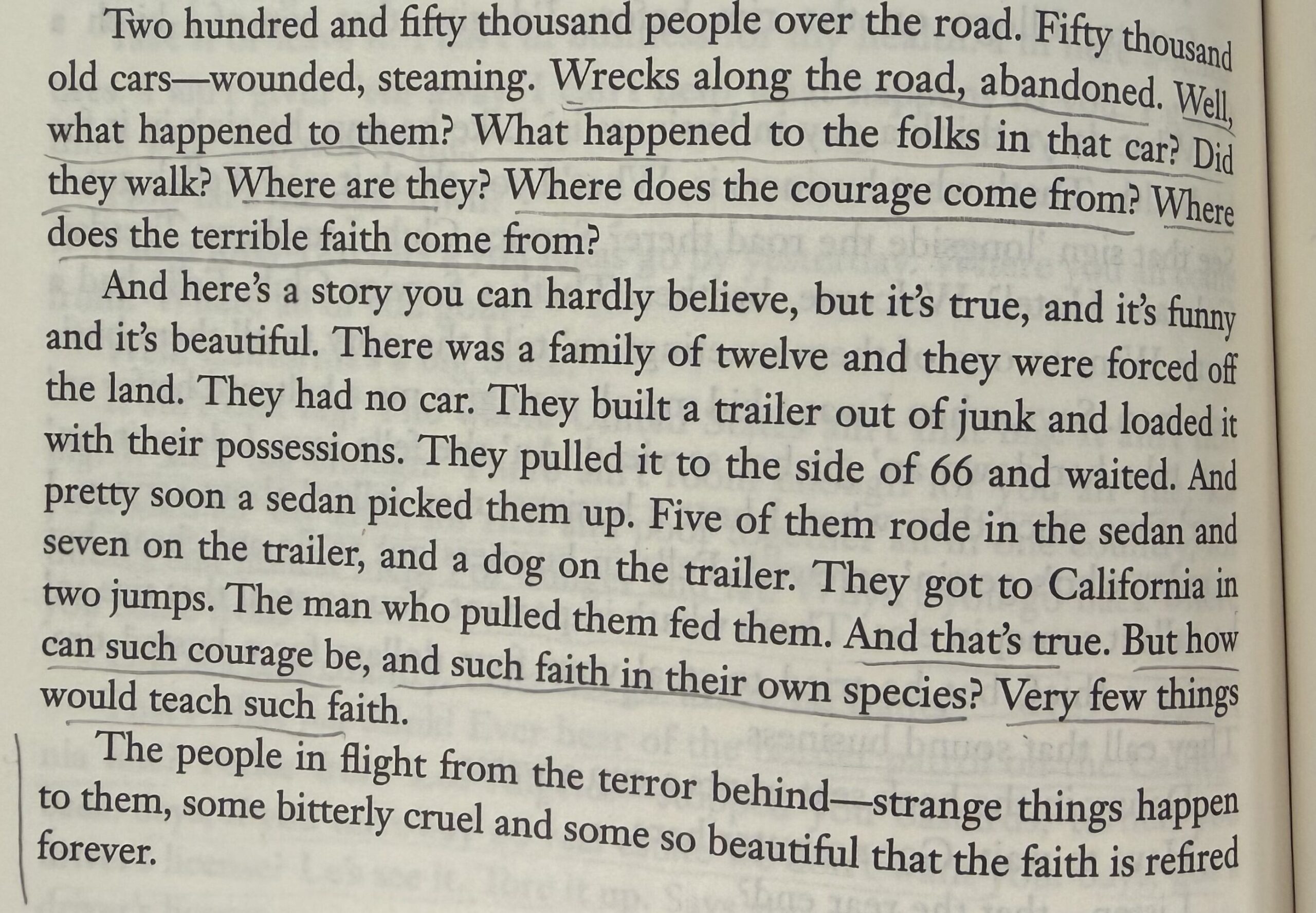
In class, someone asked if having this “terrible faith” made the characters naive, and I took some offence to that on behalf of humanity. I think every single life is built on hope. Steinbeck describes “people in flight from the terror behind,” and that terror could be anything, the people could be anyone. Perhaps some decisions are made from misinformation, such as the “handbills” in the story, which advertise fruit-picking jobs and liveable wages in California, but when you have nothing to sustain yourself with, you’ll take anything, even empty promises.
I think that the two things that make up America are hope and capitalism, and I don’t just mean in the book. Those two concepts are eternally, inherently at war with each other, and that war is the heart of the nation. In Chapter 5 of The Grapes of Wrath, Steinbeck creates a vignette in which men who work at banks come to evict tenants and their families from their homesteads:
We’re sorry. It’s not us. It’s the monster. The bank isn’t like a man.
Yes, but the bank is only made of men.
No, you’re wrong there—quite wrong there. The bank is something else than men. It happens that every man in a bank hates what the bank does, and yet the bank does it. The bank is something more than men, I tell you. It’s the monster. Men made it, but they can’t control it. (Steinbeck 33)
The extended metaphor of the bank as a monster, a prime example of poetic history, evolves through the banker’s conversation with the tenants. It helps establish the class divide, as well as conflict stemming from capitalism and greed. From these, I felt the sense of moral omniscience that I mentioned earlier. Seeing and understanding how these institutions brought harm to so many in the past, just like they do in the present, gives me a clear understanding of what—not who—is the enemy.
The following excerpt comes from Chapter 9, another vignette that represents the desperate bargaining between people who are trying to sell their belongings in order to raise enough money to leave and the people who are determined to stay, but hardly have any money of their own:
There’s a premium goes with this pile of junk and the bay horses—so beautiful—a packet of bitterness to grow in your house and to flower, some day. We could have saved you, but you cut us down, and soon you will be cut down and there’ll be none of us to save you. (Steinbeck 87)
I think these lines are really effective in illustrating how “the powers that be” work to divide the working class citizens against each other for monetary benefit. I’d say all of these vignettes, scattered throughout the book, are pretty strong examples of poetic history, but I think they are also related to the “God’s eye” view that comes with superiority. From my perspective as a reader, I can see all of the institutions at play, actively working against the protagonists and the people, but neither I nor they have the power to stop it. Skepticism comes into play with this because, again, I want so desperately to have hope; if things turn out okay for the characters, maybe they’ll turn out okay for us, too. But I already know the realities of this time period, and I can see so many patterns being repeated in the world today. It’s hard not to be doubtful.
Conclusion (because this post is kind of all over the place)
I haven’t read any more of this book since I started working on my post—ugh, y’know, life—but I genuinely can’t stop thinking about it. I know my post is a little word vomit-y, but this is my best attempt at organizing some of my thoughts. There is so much happening within this story already and I am really looking forward to the rest of the book.
Featured Image
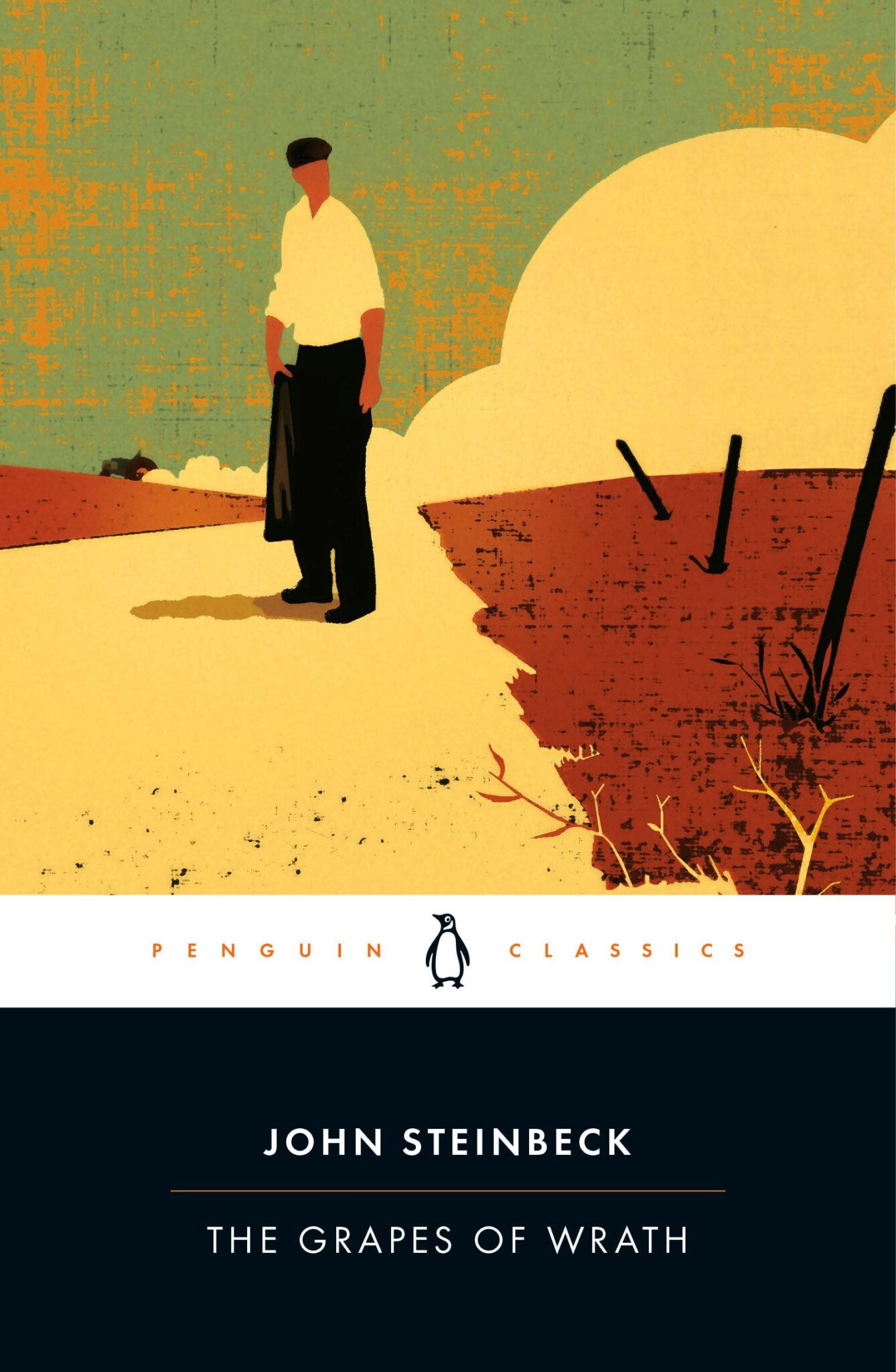
Penguin Classics cover of The Grapes of Wrath. Illustration by Mick Wiggins. All rights reserved.