
Introduction
For more than a century, a Confederate monument known as Silent Sam stood at the University of North Carolina at Chapel Hill. Dedicated in 1913, it was presented as a tribute to Confederate soldiers who laid down their lives in the line of duty; particularly, students and faculty of the university who had abandoned academics to fight for the south.
Though it was presented as a symbol of heroism to generations of students, in recent years, the purpose behind Silent Sam began to be questioned. What was the true intention behind the monument? Was it truly a simple celebration of the sacrifice of the students and staff of the university, or was it born from a history of white-supremacy and racist segregation? Our modern society constantly re-evaluates the symbols of our past. Silent Sam represents this conflict between historical rights and modern wrongs.
Background
The American Civil War officially began in 1861, the causes of which can be traced back to slavery. The free states of the north and the pro-slavery states of the south were at odds in the debate over how much power the government should hold in the permission or prohibition of slavery. Abraham Lincoln’s presidency, running on an anti-slavery platform, sparked seven slave states in the south to secede to form a new nation, the Confederate States of America. The Lincoln administration and most northern citizens refused to recognize this, for fears surrounding the fate of democracy in a now-divided nation. Despite this, tensions continued to rise, and a conflict at Fort Sumter in 1861 officially sparked the civil war between the north and south. At the end of 1861 going into 1862, the war was in full swing.
By the time the war officially concluded in 1865, Over 650,000 Americans had lost their lives–nearly as many American soldiers as died in all the other wars in which this country has fought combined (McPherson). Of the deceased, 287 are known to have been students and faculty of the University of North Carolina. The university managed to remain open during the civil war by educating students unable to fight; however, in the spring of 1865, the senior class had only one member. The majority of students had left for war. The American Civil War officially ended as the year 1865 came to a close, leaving a lasting impact on the university.
The United Daughters of Confederacy (UDC) is a heritage organization founded in 1894, whose membership is made up of women descended from soldiers or supporters of the confederacy. They were founded with the goal of commemorating their confederate ancestors, as well as funding Confederate memorials and monuments. The UDC is also known for promoting the “lost cause of the Confederacy”, a pseudohistorical ideology which depicts the American Civil War as having been an honorable and ultimately tragic struggle by the South to preserve its way of life in the face of destruction by the Union, or the North (Michael, 2023).
In 1907, the North Carolina chapter of the UDC turned their sights to a new goal: creating a monument to the students and faculty of the university who left their education to fight for the Confederate forces. The creation of the monument was quickly approved, and in 1913, the Soldier’s Monument–later dubbed “Silent Sam”–was unveiled.
The Monument
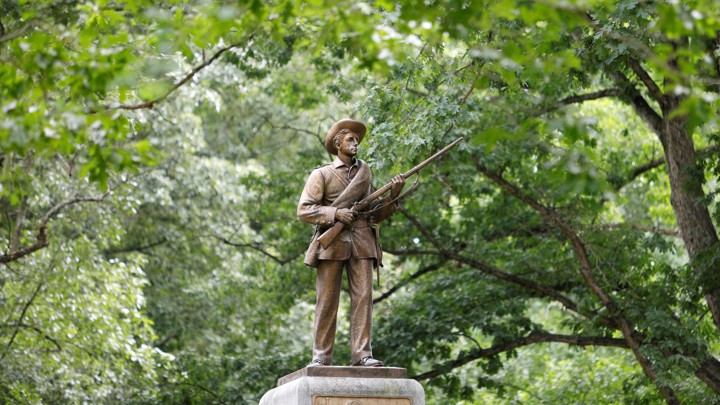
Silent Sam was one of many Confederate monuments which appeared across the south in the early 1900’s. These monuments were often funded by organizations like the United Daughters of the Confederacy. In fact, the UDC are said to be responsible for funding over 700 Confederate monuments across the south. UDC-funded monuments are distinguishable by their initials inscribed on the plaque of these monuments. Silent Sam itself is one of these monuments, with a plaque that reads:
ERECTED UNDER THE AUSPICES
OF THE
NORTH CAROLINA DIVISION
OF THE UNITED DAUGHTERS OF
THE CONFEDERACY
AIDED BY THE ALUMNI OF
THE UNIVERSITY
Silent Sam was sculpted by artist John A. Wilson. The monument depicts a confederate soldier standing stoically atop a plinth, holding a rifle, poised high above the surrounding park as if keeping watch. He has no cartridge box on his belt, meaning he carries no ammunition. This gave way to its name; unarmed soldier monuments were referred to as “silent soldiers”. This is an unusual contrast to the ideals of those who funded and dedicated the monument, who took great pride in those willing to stand up and fight. The soldier monument being a symbol of pacifism would have horrified them.
There are two inscriptions and a bronze plaque relief (image) on the plinth below the statue. The relief depicts a woman, representing the state of North Carolina, resting her hand on the shoulder of a student seated in a chair carrying books. The woman is carrying a sword in her right hand. The first, smaller inscription is the aforementioned acknowledgement of the funding of the monument, reading as follows: “erected under the auspices of the North Carolina division of the United Daughters of the Confederacy aided by the alumni of the university”. The second inscription reads, “To the sons of the university who entered the War of 1861–65 in answer to the call of their country and whose lives taught the lesson of their great commander that duty is the sublimest word in the English language”.
Rise of Controversy
The monument was welcomed and celebrated when first installed. Over a thousand people were in attendance for its unveiling, which was accompanied by many speeches. Governor Locke Craig was the primary speaker; the event also included other words from a variety of influential community figures, among which were the president of the North Carolina Division of the United Daughters of the Confederacy, and the chairman of the monument fund committee (the original proposer of the memorial).
“Following the addresses, the audience formed in order and marched to the monument for the unveiling. A thousand people gathered around the heroic figure, which is to stand through the years as symbolizing the response of the University boys to the call of home and duty, while the quartet sang with rare sweetness and tenderness “Tenting on the Old Camp Ground.””
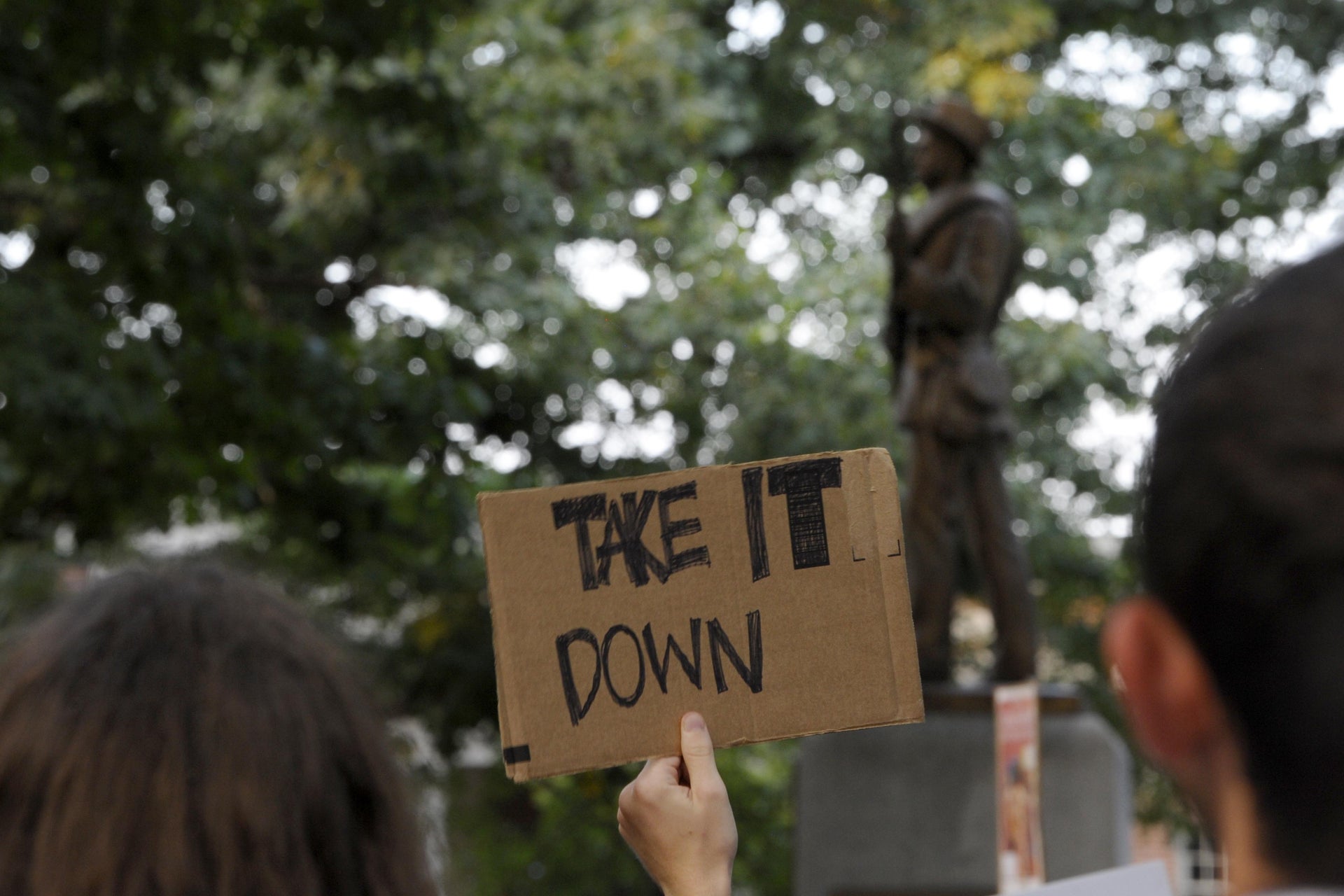
It wasn’t until much later that the monument began to become an item of controversy. The 1960s gave way to the Civil Rights Movement, a nationwide movement for equal rights for African Americans and for an end to racial segregation and exclusion (Library of Congress). For monuments, this meant new scrutiny surrounding their history. Questions began to be asked on what commonplace monuments and memorials actually stood for. In the case of Silent Sam, it meant pulling back the covers and taking a look at a long-ignored history rooted in the very things the civil rights movement was working to abolish. Under a guise of heroism, Silent Sam stood for poorly disguised white-supremacy.
In fact, the monument’s racist roots were under no disguise at all in a speech delivered by Julian Carr at its unveiling about 50 years prior. Carr, speaking on the Confederate soldiers, says that “their courage and steadfastness saved the very life of the Anglo Saxon race in the south”, and how “to-day, as a consequence, the purest strain of the Anglo Saxon is to be found in the 13 Southern States–praise God.” Later in his speech he goes on to describe horse-whipping a Black woman “until her skirts hung in shreds” for the reason of insulting a Southern-lady (a label of which Carr evidently did not consider the woman he whipped).
Down With Silent Sam
Controversy and vandalism may have begun in the 60s, but it wasn’t until the early 2000s when vandalism of Silent Sam began to ramp up. The monument was particularly targeted during the Black Lives Matter movement; in 2015, it was vandalized with the words “Black Lives Matter”, “KKK”, and “murderer”. The statue continued to be defaced through that year and into the next, when calls for its removal officially began.
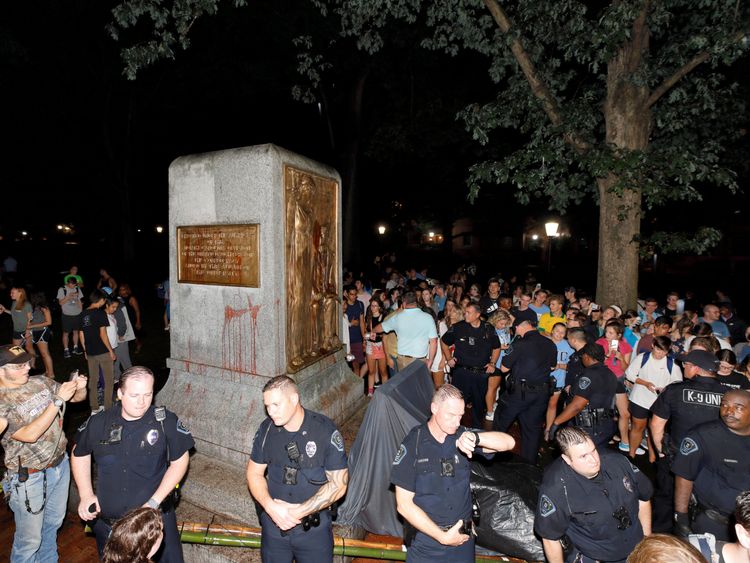
The statue was finally removed the night of August 20, 2018, the day before classes for the 2018-19 school year began. Reactions were mixed. Some members of the university’s community, like the UNC Undergraduate Executive Branch, were in favor of the demonstration and removal. “Last night, a group of students and community organizers did what few were prepared to do: they corrected a moral and historical wrong that needed to be righted if we were ever to move forward as a University. Last night, they tore down Silent Sam. They were right to do so,” they said in a statement (Ward and McGee, 2018). Others were not so happy. A statement from the governor of the state condemns the removal, describing it as “violent destruction of public property” (Ward and McGee, 2018).
Conclusion
Silent Sam stood for more than a century at the University of North Carolina at Chapel Hill. Originally presented as a tribute to the heroic actions of both students and staff of the university who laid down their lives in the line of duty, the monument no longer commanded the same reverence the night it fell. Silent Sam was indeed born from a history of white-supremacy and segregation, and it is just one monument of many where modern values won out over historical pride.
References
Library of Congress. “The Civil Rights Movement.” Library of Congress, Library of Congress, www.loc.gov/classroom-materials/united-states-history-primary-source-timeline/post-war-united-states-1945-1968/civil-rights-movement/.
Louis Round Wilson Special Collections Library . “Julian Shakespeare Carr Papers #141.” Unc.edu, 1913, dc.lib.unc.edu/cdm/singleitem/collection/00ddd/id/121638/rec/1. Accessed 15 Dec. 2025.
McPherson, James. “A Brief Overview of the American Civil War.” American Battlefield Trust, James McPherson, 20 Nov. 2008, www.battlefields.org/learn/articles/brief-overview-american-civil-war.
Ruth, Michael. “Lost Cause of the Confederacy | EBSCO.” EBSCO Information Services, Inc. | Www.ebsco.com, 2023, www.ebsco.com/research-starters/military-history-and-science/lost-cause-confederacy.
The Carolina Story. “Confederate Monument (“Silent Sam”).” Museum.unc.edu, museum.unc.edu/exhibits/show/civilwar/silent-sam.
University of North Carolina at Chapel Hill. “Silent Sam.” Silent Sam, 2019, silentsam.online/.
—. “The Soldier’s Monument Unveiled.” Internet Archive, 1913, archive.org/details/alumnireviewseriv1i6chap/page/184/mode/2up.
Ward, Myah, and Charlie McGee. “Silent Sam Toppled in Protest the Night before Classes Begin.” The Daily Tar Heel, 20 Aug. 2018, www.dailytarheel.com/article/2018/08/silent-sam-down.
Wikipedia Contributors. “American Civil War.” Wikipedia, Wikimedia Foundation, 2 Dec. 2018, en.wikipedia.org/wiki/American_Civil_War.
—. “Silent Sam.” Wikipedia, Wikimedia Foundation, 11 Nov. 2019, en.wikipedia.org/wiki/Silent_Sam.

