
In today’s society, it is almost impossible not to have heard of Christopher Columbus. Columbus’s name has been widely memorialized for his discovery of a new land at the time. He has been memorialized with street signs, parks, and monuments. But for the past few decades, Columbus’s image has drastically changed because of his actions towards the natives; his actions, like enslavement and mass killings, have drawn a lot of questions about whether this is a person that we should still memorialize. This paper will focus on one Columbus memorial, specifically, the Columbus monument in Marconi Plaza in Philadelphia. The paper will discuss what the monument commemorates, why it was erected, the message it conveys, the initial reactions to the monument upon its construction, and how people perceive it today.
The monument commemorates Christopher Columbus and his relationship with Italian discrimination in Philadelphia and the U.S at the time. Columbus was born in 1451 in Genoa, Italy, and died on May 20th. Although Columbus, in his early years, had a limited education, he came from a very poor background. But through this, I was able to get a good education at Pavia. Columbus studied arithmetic, grammar, Latin, astrology, and navigation. From these studies, he developed an obsession with maps, winds, and oceans.
Columbus would marry Filipa Moniz Perestrelo, who came from a high-class society, as her father was a general for Prince Henry. Prince Henry would further Columbus’s education in maps, readings, and navigation. Columbus knew he needed a massive amount of support for his voyage. Knowing this, he went to the courts of Portugal and England. He would get rejected from both. But with determination, he would go to the court of Spain. He ultimately would be rejected multiple times by the Spanish court, but through persistence and persuasion, he built the trust of the king and queen of Spain and secured the funding for the exposition. The king and queen built him a crew of established navigators and astrologers to join him on his journey. His expedition was to find a faster way to India, and he would travel with three boats: the Nina, the Pinta, and the Santa Maria. Through his journey, he would not find India and would find, as we know, North America in October of 1492.
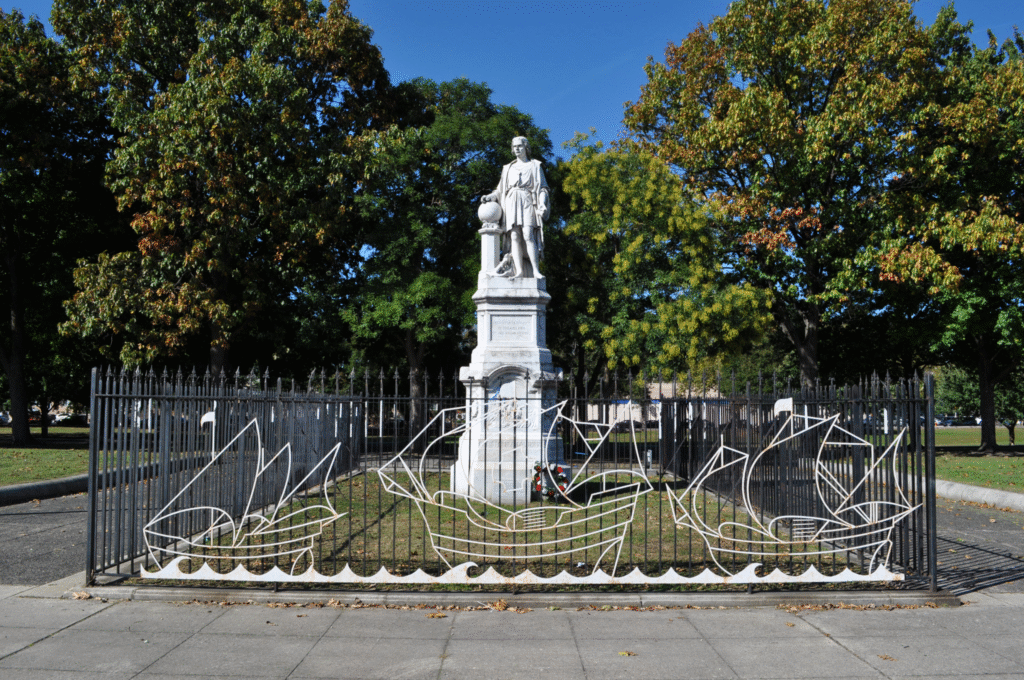
The Monument was made by Emanuele Caroini in 1876. Emanuele was a talented sculptor and made the monument for the Centennial Exposition, which was an event to mark the 100th birthday of America and to display industrial, technological, and cultural progress. The monument would cost $18,000. The monument would later be moved to Marconi Plaza in Philadelphia. The reason for the move was to symbolize immigrant pride and anti-Italian discrimination. The reason for the location was that the area where Marconi Plaza is located had a very heavily Italian-American population.
Giovannucci, Nicolino. “Statue of Christopher Columbus (Philadelphia).” Wikipedia, Wikimedia Foundation, 12 Jan. 2024, en.wikipedia.org/wiki/Statue_of_Christopher_Columbus_(Philadelphia). Accessed 15 Dec. 2025.
CC BY-SA 4.0
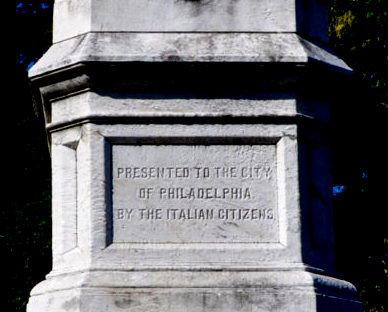
The Statue of Christopher Columbus in Philadelphia represents Christopher Columbus as a very important and prestigious historical figure, not only through his statue but also through his inscription. In the first image of the statue, Christopher Columbus is shown standing upright, dressed in his characteristic fifteenth-century clothes with his hand placed on the globe, and exploring objects like anchors and ropes placed around his legs. These characteristics and features definitely show his importance as an explorer and as a navigator, and also represent his adventure across the oceans and seas as a historical occurrence. It also displays an importance to people walking by the monument based on the vast size of the monument. His upright posture and his gazing out definitely show strength, determination, devotion to, and focus towards a goal. His posture also gives emphasis to his leadership and risk-taking characteristics in his adventures and actions, and activities. The inscription placed on the foot of the statue shows its presentation to society by Italian societies and therefore represents the statue to give emphasis to the Italian-American identity and pride as well. In this regard, the statue definitely gives emphasis to the historical occurrence of his adventure to America in 1492 and his subsequent contributions to the development of the United States of America as a nation, and therefore gives emphasis to his heroic characteristics as an explorer and his contributions to history and society through his actions and adventures, and activities.
Aloi, Bruno. “Emanuele Ronconi. Monumento a Cristoforo Colombo. Philadelphia. USA. 1876.” Comitato Nazionale Cristoforo Colombo, 3 Nov. 2022, www.cristoforocolombo.com/colombo-nellarte/emanuele-ronconi-monumento-a-cristoforo-colombo-philadelphia-usa-1876/. Accessed 15 Dec. 2025.
CC BY-SA 4.0
“Presented to the City of Philadelphia by the Italian Citizens,” which is written on the bottom of the monument of Columbus, explains the reason behind the establishment of the monument. This is evident since it is clear that, apart from being a monument to Columbus, it is also a monument for Italian Americans of Philadelphia, who show pride in who they are. This is because by presenting it to the city of Philadelphia as a gift it shows that Italian citizens look up to him, it is evident that it is a symbol of Christopher Columbus since it is presented by the citizens of Italy, who show reverence to Columbus. It is evident that this is a formal statement because of the language used. It means that there is a clear indication of a monument being raised in a show of reverence by others, in this case, to show some form of gratitude to a segment of society, which is the Italian Americans, who might have contributed greatly to society, along with Christopher Columbus, who is greatly cherished by them. Overall the inscription sends a message that the statue was meant to celebrate Italian Americans and their contribution to the city while also symbolizing Columbus as a historical figure for Italians.
When the monument was first made for the Centennial Exposition, it was widely accepted by most people, as Columbus was seen as the discoverer of the new land, and people were not as aware of his actions, his colonization, and his treatment of the natives. Also, when Emanuele Carolini made this monument for Christopher Columbus, he was highlighting the industrial and technological advancements of the voyage, as it is seen as part of American history. When the monument was moved to Marconi Plaza, it was widely accepted by Italian Americans and other European immigrants who faced discrimination and the Philadelphia community.
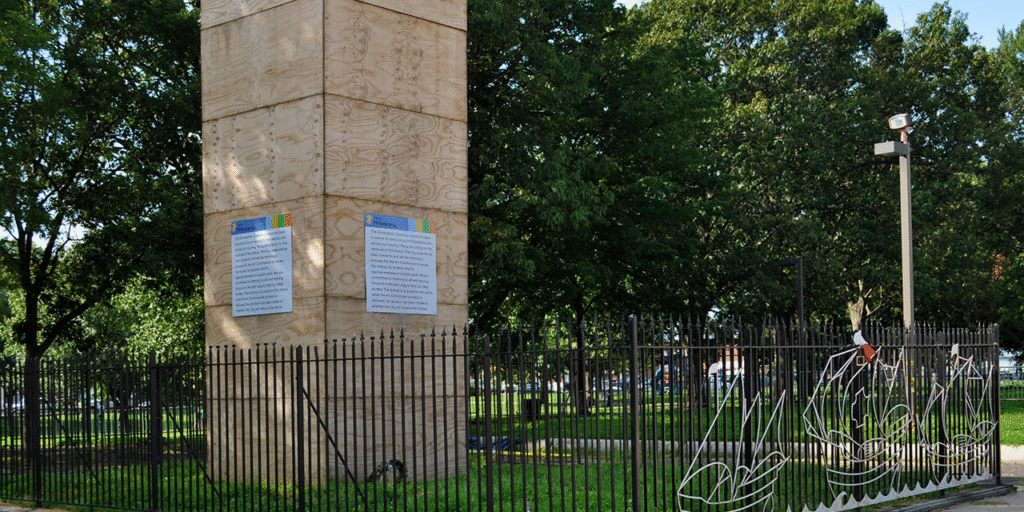
Although the monument was widely accepted when it was first made and moved to Marconi Plaza, views on the monument have drastically changed. Today, there is a wide range of stigma towards Columbus and his expeditions. Columbus was seen as the founding father of the “new land,” But now he as a person who committed mass genocide agaisnt natives for him and his fellow explorers for the personal benefit. Due to his actions, states across the country have changed holidays named after him, and many people believe that monuments of Columbus should be taken down because we should not memorialize somebody who has committed the actions he committed. A lot of the rising tension towards this monument specifically came after the death of George Floyd and the protests that followed his death for racial injustice. In 2020, Mayor Jim Kenney ordered the statue to be removed, calling it a matter of public safety. Although the city did not have legal rights to take the statue, Philadelphia decided to put a protective box around the statue. The city’s idea was to hope that the protective box would help de-escalate protests that were turning violent around the plaza. On December 9th, 2022, there was a court order to have the protective box removed. The Judge stated that “if the city disagrees with the statue’s ‘message,’ it could add a plaque explaining what is ‘more in line with the message the City wishes to convey.” Currently, the statue still stands, and there is no scheduled court date for a future plan of removal. I personally think the monument should be removed due to Columbus’s actions and how he treated the natives. As an Italian American, I think that, as a community, we can find a better person to memorialize. Although I understand where Italian Americans are coming from, that we are a symbol of pride and for anti-Italian discrimination, I think that Columbus is not the right person for that symbol. I also don’t agree with the judge’s decision about putting a plaque up. I think that in this case, a plaque does not do enough.
“Unboxing Day.” City Journal, 25 Mar. 2023, www.city-journal.org/article/unboxing-day. Accessed 15 Dec. 2025.
CC BY-SA 4.0
In conclusion, this paper shows background on Columbus, who he was, why the monument was made, and why the monument was moved to Marconi Plaza, what the views were on the monument when made, the present-day views on the monument, and why the monument should be removed. Although the statue once symbolized pride for Italian Americans, the modern views of Columbus’s colonization and violence toward native Americans do not get highlighted in this monument. For these reasons, although the monument still stands, the justification for the removal of the monument would be acceptable because it allows communities to acknowledge the history of Columbus, but better represent present-day values.
Work Cited
- “Unboxing Day.” City Journal, 25 Mar. 2023, www.city-journal.org/article/unboxing-day. Accessed 15 Dec. 2025.
- Bartosik-Vélez, Elise. New Nations and a Transatlantic Discourse of Empire.
- DiMattei, Ross, and Matt Petrillo. “Box Removed from Christopher Columbus Statue in South Philadelphia.” Cbsnews.com, 12 Dec. 2022, www.cbsnews.com/philadelphia/news/christopher-columbus-statue-south-philadelphia-court-ruling/. Accessed 10 Dec. 2025.
- Giovannucci, N. “File:Christopher Columbus Monument Boxed in Marconi Plaza Philadelphia PA (June 2020) (DSC 4035).Jpg – Wikimedia Commons.” Wikimedia.org, 27 Aug. 2020, commons.wikimedia.org/wiki/File:Christopher_Columbus_Monument_boxed_in_Marconi_Plaza_Philadelphia_PA_(June_2020)_(DSC_4035).jpg. Accessed 10 Dec. 2025.
- Perez, Walter. “Box Covering Philly Christopher Columbus Statue Gets Painted with Colors of Italian Flag.” 6abc Philadelphia, 11 Oct. 2022, 6abc.com/post/christopher-columbus-statue-marconi-plaza-south-philadelphia-indigenous-peoples-day/12312352/. Accessed 10 Dec. 2025.
- “Philly’s Battle of Columbus.” City Journal, 23 Mar. 2023, www.city-journal.org/article/phillys-battle-of-columbus. Accessed 10 Dec. 2025.
- Paul, Heike. “Christopher Columbus and the Myth of ‘Discovery.’” The Myths That Made America: An Introduction to American Studies, transcript Verlag, 2014, pp. 43–88. JSTOR, http://www.jstor.org/stable/j.ctv1wxsdq.5. Accessed 16 Dec. 2025.
- “Christopher Columbus.” The Illustrated Magazine of Art, vol. 1, no. 6, 1853, pp. 333–36. JSTOR, http://www.jstor.org/stable/20537998. Accessed 16 Dec. 2025.
- “The Centennial Exposition of 1876: An Evolving Cultural Landscape.” West Philadelphia Collaborative History – The Centennial Exposition of 1876: An Evolving Cultural Landscape, collaborativehistory.gse.upenn.edu/stories/centennial-exposition-1876-evolving-cultural-landscape. Accessed 15 Dec. 2025.
- Phila, www.phila.gov/media/20200717145301/Court-order-7-16-2020.pdf. Accessed 16 Dec. 2025. Staff, NBC10. “Court Orders Cover to Be Removed from Philadelphia Columbus Statue.” NBC10 Philadelphia, NBC 10 Philadelphia, 9 Dec. 2022, www.nbcphiladelphia.com/news/local/marconi-plaza-philadelphia-columbus-statue/2986317/. Accessed 15 Dec. 2025.

