
Who was Nathan Bedford Forrest?
Nathan Bedford Forrest was born in Bedford County, Tennessee, also currently known as Marshall, Tennessee, in 1821. However, once Indian lands in North Mississippi were opened for settlement, his family moved. As Forrest grew older, he made a large profit from selling real estate and slaves. He even owned a storefront on Adams Avenue in Memphis, Tennessee which at the time was a popular street for slave trading. In 1861, Forrest enlisted as a private soldier in the Western army and was quickly promoted to colonel in 1862. He proved his strengths as a leader through many fought battles and was promoted, yet again, to lieutenant general in 1865.
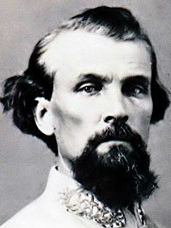
During Forrest’s military career, one of his most controversial battles was the Battle of Fort Pillow. While Confederate injuries and loses were reported as minimal, the logistics and death tolls of the Union side are unclear. Some reports say it was a typical battle led by Forrest and won by his troops while others say roughly 300 Union soldiers were killed amid an attempt to surrender. Of these 300 Union soldiers, most were reported to be black or members of the U.S. Colored Troops, some even former slaves of Forrest.
Towards the end of Nathan Bedford Forrest’s Confederate military life, he also became the first “grand wizard,” or major leader, of the Ku Klux Klan. The Ku Klux Klan, both then and now, can be defined as a group of white supremacists that violently targeted African Americans and their civil rights. However, Forrest did not have the highest authoritative position for long which led him to promptly leave the organization. Soon after he disbanded from the Klan and over a decade from the conclusion of the Civil War, Forrest passed away in Memphis, Tennessee at the age of 56 in 1877.
The History Behind the Monument
In 1901, private donations pooled together approximately $25,000 to commission Charles Henry Niehaus to design a statue memorializing Nathan Bedford Forrest. Most of the donations were funded by men working in white collar professions. Though the monument was designed in New York, it was built in Paris, France. In 1905, white residents of Memphis, Tennessee created a public park to act as a new resting place for Forrest’s remains, along with his wife’s. When the park opened to the public under the name “Forrest Park,” now known as “Medical District Park,” the monument was unveiled standing over Forrest’s new burial site.
The timing of Forrest’s monument being designed and built may seem harmless, but there are speculations as to why the monument was created at this time. Alongside Nathan Bedford Forrest’s monument, many other Confederate leaders were being memorialized and honored through statues across the south. However, racism and white supremacy were on the rise once again with Jim Crow Laws being enforced and the Ku Klux Klan expanding across the nation. Whether it was truly intentional or not, an uprise in Confederate monuments in predominantly black neighborhoods within a short period of time had spread the messages of intimidation and fear mongering.
What Message Does the Monument Send?
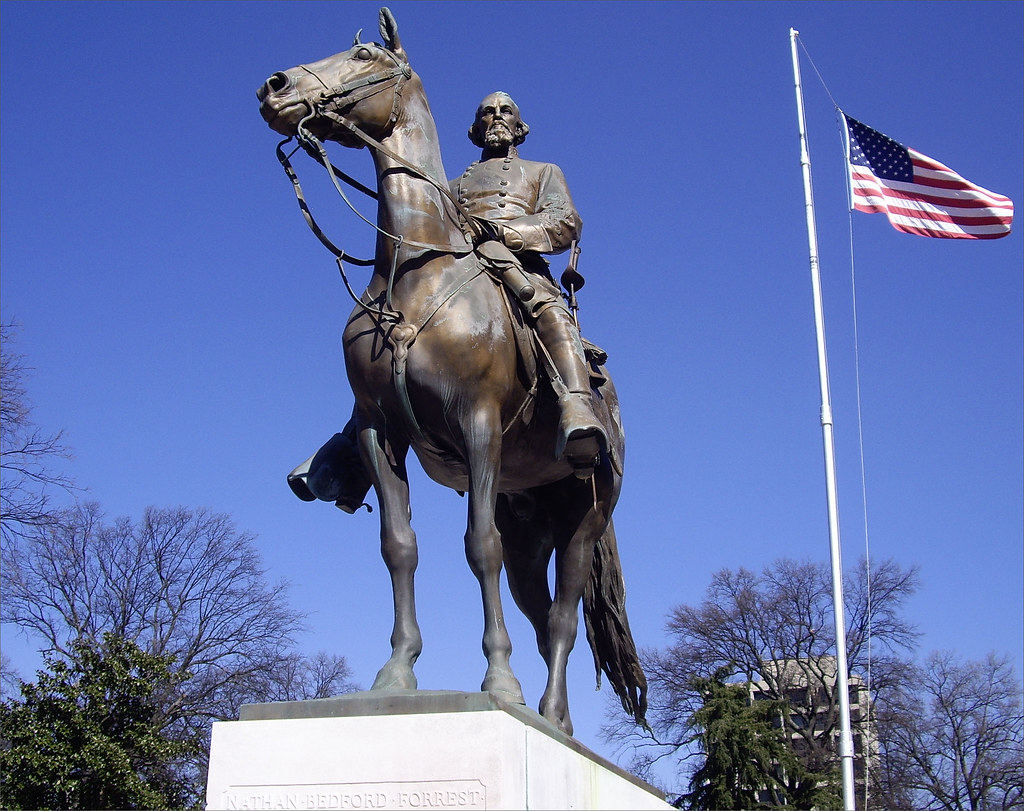
The Memphis monument portrays Nathan Bedford Forrest sitting tall on a horse and holding the horse’s reins. His head and face however are not facing forward; they both look slightly to his left. Depending on the angle at which the viewer is looking at the monument, it almost appears that Forrest is looking down on the audience. Despite Forrest overlooking the audience though, the design of the monument does not depict Forrest as the violent leader he was. As both hands are holding onto the reins, his weapons are stored in their respective casings, but the audience can interpret that Forrest has full control over his actions. Inscriptions can be seen on three of the four sides of the monument’s base. On the front and the right sides of the statue the audience can read biographical information such as his name, birth and death years, and military background, along with who erected the monument.
On the left side of the monument, the same side that Forrest looks out to, the following quote from Virginia Frazer Boyle is inscribed:
Those hoof beats die not upon fame’s crimson sod, But will ring through her song and her story; He fought like a Titan and struck like a God, And his dust in our ashes of glory.
Although the monument itself and most of the inscriptions do not portray a major message, this inscription implies that Nathan Bedford Forrest was one of the best military leaders to ever serve. The inscription also sends the message that Forrest’s brave and heroic legacy remains in the nation’s glory even decades after his lifetime. Aside from the inscriptions and monument itself, both Nathan Bedford Forrest’s and his wife’s gravestones are also nearby, reminding the audience that their remains were buried there too.
Past Views on the Monument
Forrest’s involvement in the Ku Klux Klan was becoming more public leading up to the unveiling of the new monument memorializing his legacy. However, most white Americans had still accepted the storyline that Forrest was a heroic military leader, and they did not care for his brief history with the Klan. Based on his farewell address from his surrender in 1865, some even saw Forrest as a peacekeeper, ignoring his history of owning and trading slaves and the controversial Battle of Fort Pillow. In his farewell address, Forrest said:
Soldiers, I have never on the field of battle sent you where I was unwilling to go myself, nor would I now advise you to a course which I felt myself unwilling to pursue. You have been good soldiers; you can be good citizens. Obey the laws, preserve your honor, and the government to which you have surrendered can afford to be and will be magnanimous.
Celebrations were held around the installment of the monument, as well as other monuments honoring Confederate leaders. At the time, many white southerners were coping with their defeat in the Civil War through their “Lost Cause” ideology. Rather than mourning on their loss due to military and political factors, they glamorized the battles they did win and turned the blame for the war over from slavery to states’ rights.
Present Day Views on the Monument
Though the Nathan Bedford Forrest monument was originally accepted and celebrated by many, views towards the monument began to change. Following the Civil Rights Movement in the late-20th century, and the national trend of removing monuments and memorials dedicated to Confederate leaders in the early-21st century, residents of Memphis were divided. Now, many residents were taking a stand that being a slave trader and leader of the Ku Klux Klan were not supporting reasons as to why Forrest should have a monument and park dedicated to him. This side of Memphis residents also saw a war criminal who led the apparent Confederate massacre of Union soldiers at Fort Pillow. One black native Memphian, Nick Hicks, was interviewed at a pop-up rally in support of removing the monument and stated:
When I look at that statue, I see terrorism, racism and white supremacy. It is blatant arrogance for it to be put in a public park, in the middle of a city that is majority black.
On the other hand, however, some residents of Memphis still supported the monument’s presence. Modern day supporters of the Confederate leader saw a misunderstood military genius who was misunderstood during the Civil War and had made a speech calling for racial reconciliation. Another native Memphian, Lee Millar, who is white and a local spokesman of the Sons of Confederate Veterans, was also interviewed about the possible removal of the monument, and he described that the monument “represents what it always has: honor and valor. [Forrest] was a great community man. He was an inspiration for everyone.”
Nathan Bedford Forrest’s great-great-grandson, Kevin Bradley, has also taken a stance against the removal of his great-great-grandfather’s memorial. He noted that the family lineage was opposed to the movement and removal of both the monument and Forrest’s remains. Bradley was also quoted saying:
Slavery was wrong, but that’s the way it was back in that history. George Washington owned slaves. Are you going to take him off the dollar bill? You cannot change history.
The Removal of the Monument
The original proposal to remove the monument was brought up in 2015 following a hate crime driven massacre at a church in Charleston, South Carolina in which six females and three males were shot. However, due to controversy and arguments both for and against the removal of the statue, a decision had not been made immediately. Despite efforts from both political figures and Forrest’s descendants though, the monument located in Memphis, Tennessee was removed in December 2017. After lengthy conversations, the city of Memphis had sold Forrest Park to a non-profit organization for the price of $1,000. With the park and its purpose now being in the hands of the non-profit, the statue was removed almost immediately after the deal had closed. Though the monument and Forrest’s remains were removed from the site, other plaques and monuments still stand in the park or nearby areas including two inscribed plaques in the park and a bust monument of Forrest in Tennessee’s state capitol.
Works Cited
Carney, Court. “The Contested Image of Nathan Bedford Forrest.” The Journal of Southern History, vol. 67, no. 3, 2001, pp. 601–30. JSTOR, https://doi.org/10.2307/3070019. Accessed 9 Dec. 2025.
EBSCO. “Birth of the Ku Klux Klan | EBSCO.” EBSCO Information Services, Inc. | Www.ebsco.com, 2023, www.ebsco.com/research-starters/history/birth-ku-klux-klan.
Gailor, Thomas F. “General Forrest.” The Sewanee Review, vol. 9, no. 1, 1901, pp. 1–12. JSTOR, http://www.jstor.org/stable/27528137. Accessed 9 Dec. 2025.
Moore, Kenneth Bancroft. “Fort Pillow, Forrest, and the United States Colored Troops in 1864.” Tennessee Historical Quarterly, vol. 54, no. 2, 1995, pp. 112–23. JSTOR, http://www.jstor.org/stable/42627193. Accessed 9 Dec. 2025.
“N. B. Forrest Camp 215 Sons of Confederate Veterans Historical Marker.” Hmdb.org, 7 Feb. 2023, www.hmdb.org/m.asp?m=82854. Accessed 9 Dec. 2025.
“Nathan Bedford Forrest Historical Marker.” Hmdb.org, 7 Feb. 2023, www.hmdb.org/m.asp?m=51510.
“Nathan Bedford Forrest III, Airman Historical Marker.” Hmdb.org, 7 Feb. 2023, www.hmdb.org/m.asp?m=82855. Accessed 9 Dec. 2025.
Press, The Associated. “A Confederate General’s Remains Are Being Moved out of Memphis.” NPR, 19 June 2021, www.npr.org/2021/06/19/1008371491/confederate-general-remains-memphis-moved.
Ruth, Michael. “Lost Cause of the Confederacy | EBSCO.” EBSCO Information Services, Inc. | Www.ebsco.com, 2023, www.ebsco.com/research-starters/military-history-and-science/lost-cause-confederacy.
Sanz, Alex. “Pastor, 8 others, fatally shot at church in downtown Charleston.” Spartanburg Herald – Journal, 18 June, 2015. ProQuest, https://www.proquest.com/newspapers/pastor-8-others-fatally-shot-at-church-downtown/docview/1689821850/se-2.
Tanfani, Joseph, et al. “CHARLESTON CHURCH SHOOTING; Charleston suspect tied to racist post; An online diatribe illustrates how its author’s views on race evolved over time.” Los Angeles Times, 21 June, 2015. ProQuest, https://www.proquest.com/newspapers/charleston-church-shooting-suspect-tied-racist/docview/1690027641/se-2.
Weller, Jac. “Nathan Bedford Forrest: An Analysis of Untutored Military Genius.” Tennessee Historical Quarterly, vol. 18, no. 3, 1959, pp. 213–51. JSTOR, http://www.jstor.org/stable/42621436. Accessed 9 Dec. 2025.
Yellin, Emily. “A General’s Final Stand Divides a Southern City: Memphis Plans to Move the Remains And a Statue of Nathan Bedford Forrest.” New York Times (1923-), 20 July, 2015, pp. 1. ProQuest, https://www.proquest.com/newspapers/generals-final-stand-divides-southern-city/docview/2074308481/se-2.
