
Background on the event and Hannah Duston
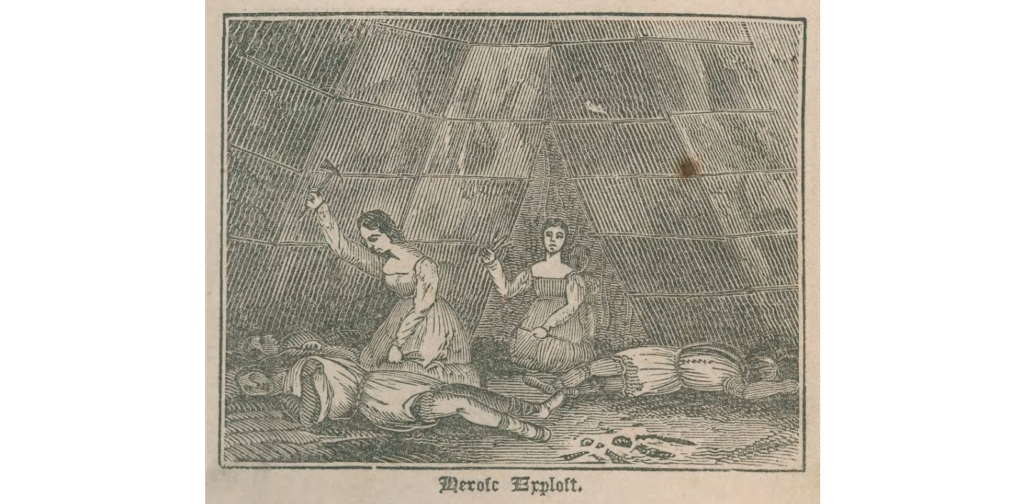
Hannah Duston was a woman from Haverhill, Massachusetts. At the time, she had twelve children, one of whom was an infant. On March 15, 1697 Thomas Duston -who was Hannah Duston’s husband- was working in the fields with eleven of the children. This is when he saw several Native Americans approaching him. He fled to retrieve his gun and to get his children to safety. It is said that guns were fired at him, and he returned shots although many historians do not believe this is accurate. While Thomas was doing this, Hannah Duston, her infant, and Mary Neff, who was their widowed neighbor, were inside the main house. The Native Americans came into the house and took the woman and the infant. Reportedly, the native’s took Duston’s infant and threw it against an apple tree, where it died. Then the natives set fire to the house and drove their captives into the woods, where they faced confusion and were disoriented. The native’s forced the women to travel north for around two weeks, where they faced severe cold weather. Once the group came to the island in the meeting of the Merrimack and Contoocook rivers, they arrived at the natives’ camp. This is where the women met a fourteen year old boy named Samuel Leonardson, who was kidnapped a year and a half before Duston and Neff. While on the island, the natives had threatened their captives that they would have to run the gauntlet. The gauntlet was a run where there were two lines of Native Americans and a prisoner would run between the two lines. The prisoners running would be beaten as they ran. The younger native’s would throw their hatchets at the prisoner. In fear of this, Duston, Neff, and Leonardson would have to face this, so they decided to work together to escape. Leonardson asked one of the younger tribe members named Bampico how one could kill someone else with one strike, as well as how to scalp them. Bampico answered, and the three waited until all of the natives were asleep to make their move. Quietly Duston, Neff, and Leonardson killed all ten of the natives with a fatal blow. At first, the three had left the wigwams without any evidence of their escape. They decided to return to the wigwams and scalped all ten natives and took the scalps and a tomahawk with them. They then took a canoe and floated down the Merrimack as long as they could and then walked the rest of the way to Haverhill on the left side of the river.
Who Built the Monument and Why?
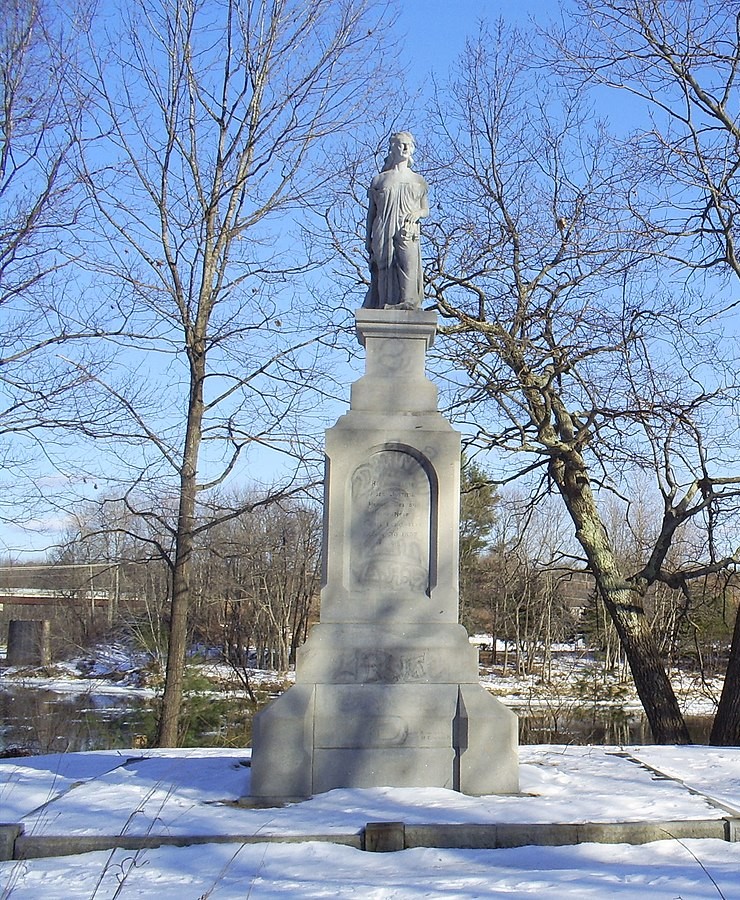
The Hannah Duston Memorial stands on the island where the Merrimack and Contoocook rivers meet in Boscawen, New Hampshire. This is the exact location of where Duston killed the Native Americans. The monument was erected in 1847 after the story had gained new light due to Cotton Mather’s official narrative. This story also made it official that the natives were the ones who killed Duston’s infant. The memorial is 25 feet tall and shows Duston in a flowy gown, in one hand a tomahawk, and in the other the scalps of the Native Americans she killed. The statue is made from Concord Granite and over time has lost many features. This memorial is one of the first memorials built showing a woman in the United States. The inscription on the memorial was created by the biggest donner of the memorial. This man was later put into an asylum, adding to the question of if the inscription and memorial itself was an accurate depiction of the story. The monument cost about $6,000 and was designed by William Andrews. The memorial was built by Andrew Orsolini, James Murray, and Charles H. Andrews. The idea of the memorial was presented by Robert B. Caverly, Eliphalet S. Nutter, and Reverend Nathaniel Bouton. On June 17, 1874, the land and memorial were given to the state and accepted by Governor James A. Weston. During the memorials unveiling, a large group gathered, and there were many speeches given by distinguished men. The memorial was built to remember the heroism of Hannah Duston and the bravery she showed while escaping the Native Americans.
What Message does the Monument Send?
During the time that the memorial was built, Native Americans were facing the repercussions of westward expansion. After the Lewis and Clark Expedition, the concept of Manifest Destiny was popularized. Manifest Destiny is the concept of the US having the right to expand and develop all of the land between the Atlantic and Pacific Oceans. The US government also encouraged the movement west. They did this by giving land to people. Because the government was giving Native American land to settlers, they had to find places to move the Native Americans to. This started with the Indian Removal Act of 1830, where the government started the relocation process of the Native. They moved the natives to unsettled territory in the west, where Oklahoma sits. The Indian Appropriations Act of 1851 confined the Native Americans to small plots of land. Then the Dawes Act of 1887 divided the reservations into tracts of land for families and individuals. Also starting in the 1870s the US government started to send Native American children to boarding schools where they were not able to see their families, speak their native language, or practice cultural traditions. During this time, the US was trying to dehumanize the native population and make them out to be monsters. The story of Hannah Duston helped prove this point that natives were “savages”. Cotton Mather wrote the official narrative of Hannah Duston, which is controversial because Mather was a puritan. He believed that the establishment of colonies was a direct intervention of God to save the territory from the Devil. This can be assumed that he was hinting towards the Devil being the native population because he had a strong hatred for the natives. The memorial then proved to the US that the natives were bad and they should be rid of them. But now the memorial is seen as a sign of controversy. The message of the memorial was originally to show that the Native Americans did not belong in society, and further manipulated the opinions of citizens hearing about this story.
What did People Think of the Memorial When it was Built?
During the 1870s there was a major discussion of Native Americans. The US was trying to expand west into native territory. US citizens and the government did not want the Native Americans there. They believed natives were uncivilized and should be removed. Around the time that the Hannah Duston Memorial was built, the story of her heroism and bravery was being told across the country. There were biographies, magazines, and children’s books written about her story. There was also a mountain dedicated to Duston. Many people approved of what she had done and thought she did the right thing. When the memorial was built, though, there was some criticism. Many believed the memorial was very explicit showing her holding the tomahawk and Native American scalps. They thought it was very gruesome to depict such an act, even though they approved of the story. The inscription was also widely criticized. The west side stated “Heroum gesta Fides Justitia Hannah Duston Mary Neff Samuel Leonardson March 30, 1697. Mid-night.” The East side stated, “March 15, 1697, 30 The War-Whoop Tomahawk Faggot and Infanticides were at Haverhill. The ashes of the campfires at night, and ten of the tribe are here.” And the south side stated, “Statua 1874. Know ye that we with many plant it: In trust to the tide of men may never can’t it. Nor mar nor sever: That Pilgrims here may heed the mothers, That truth and faith and all the others, With banners high in glorious colors May stand forever.” Many people thought that the inscriptions were vulgar and unnecessary. Although this was the case for some, the majority of people thought the memorial was powerful and showed who the Native Americans truly were.
What do People Think of the Memorial Today?
In today’s world, the Hannah Duston Memorial brings much controversy. New Hampshire state representative David Nagel has brought much attention to the memorial in the past few months. Nagel had been biking past the memorial and decided to stop and read the inscription.
I kind of went into shock when I saw it. The more I learned, the worse it got.
David Nagel
When he did he was horrified to learn of the story behind the memorial. Nagel is now filing legislation to remove the memorial. On the other hand, New Hampshire state senator Tim McGough, believes that the memorial should not be removed because it is a symbol of survival and not racism. Nagel states that he has worked with the Native Abanaki people and that they have different perspectives. They believe it is a symbol of hatred. In 2020, before the memorial was seen by Nagel, the New Hampshire Bureau of Historic Sites convened an 11-member committee to discuss the need for further historical context to the memorial. They did not want to remove the memorial but only wanted further context to the situation of the time and how colonists and natives interacted. The committee, though, has not met since August 2021. Although Nagel wants the removal of the memorial, the Town of Boscawen wants the memorial to stay where it is. The Boscawen Select Board wrote a letter to Nagel noting the history of its creation and that they do not believe in demolishing interpretations of history that can make us uncomfortable. Not only this, but the memorial is also one of the first and oldest memorials dedicated to a woman in the US. They also claim that there is often little reference to women’s roles and sacrifices in this period of time. Nagel responded to this by saying that it is a state matter and not a town matter since the memorial is state property. Even though he had stated this, he also mentioned that he would be fine with adding commissions with historically accurate information to the memorial to help people realize how offensive the memorial is to the Native Americans. Boscawen encourages Nagel to withdraw his legislation before it is discussed and voted on in 2026. Nagel responded by claiming he will consider the request. Many in the area believe that they should educate the general public on the historical situation instead of erasing it because it is offensive.
Resources
Brave hannah duston. (1875, September 12). New York Times. Retrieved December 15, 2025, from https://www.proquest.com/docview/93474467/BBCD4F2F49FF4F47PQ/1?accountid=8117&sourcetype=Newspapers.
Caverly, R. B. (n.d.). Heroism of Hannah Duston, together with the Indian Wars of New England. Retrieved December 15, 2025,.
Cotton Mather. American Battlefield Trust. (n.d.). https://www.battlefields.org/learn/biographies/cotton-mather
Curtis, W. E. (1909, May 9). Another monument. The Sunday Star. Retrieved December 15, 2025, from https://www.loc.gov/resource/sn83045462/1909-05-09/ed-1/?sp=12&q=hannah+duston+monument&r=0.385,-0.006,0.365,0.286,0.
Dustin, D. (2025, October 29). Opinion: Let’s not erase Hannah Duston from NH history. Concord Monitor. https://www.concordmonitor.com/2025/10/29/my-turn-hannah-duston-monument-controversy/
Heroic Exploit. (1860). The Library Company of Philadelphia. Retrieved December 15, 2025, from https://digital.librarycompany.org/islandora/object/digitool%3A127085.
Michaud, C. (2009). Hannah Duston Statue. Wikimedia Commons. Retrieved December 15, 2025, from https://commons.wikimedia.org/wiki/File:Hannahdustin_statue.JPG.
Sexton, A. (2025, October 13). State representative files legislation to remove Hannah Duston Memorial in Boscawen. WMUR. https://www.wmur.com/article/david-nagel-hannah-duston-statue-nh/69021165
Story of hannah duston. (1874, June 25). The New Hampshire Gazette. Retrieved December 15, 2025, from https://www.loc.gov/resource/sn84023142/1874-06-25/ed-1/?sp=8&st=image&r=0.028,0.033,0.4,0.314,0.
U.S. Department of the Interior. (n.d.). The expedition’s impact on indigenous Americans (U.S. National Park Service). National Parks Service. https://www.nps.gov/articles/the-expeditions-impact.htm
Wisniewski, E. (2025a, October 14). Bill calls for removal of Hannah Duston Memorial, the first publicly funded statue in NH. New Hampshire Public Radio. https://www.nhpr.org/nh-news/2025-10-14/hannah-duston-memorial-first-publicly-funded-statue-boscawen-nh
Wisniewski, E. (2025b, October 23). Boscawen opposes removal of Hannah Duston Statue. Concord Monitor. https://www.concordmonitor.com/2025/10/23/hannah-duston-statue-controversy/


