


To the Heroes of the Battle of Stalingrad
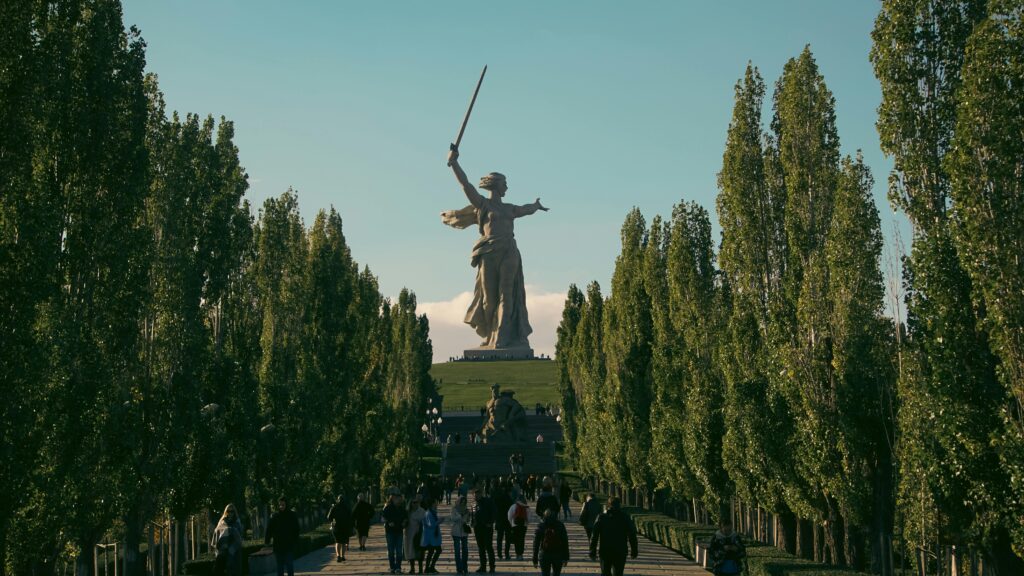
“Photo by Ozan Güvenç : https://www.pexels.com/photo/sky-people-tree-sculpture-14186461/“
Historical Context
The Motherland Calls memorializes the Soviet Union’s victory in the Battle of Stalingrad, one of the most significant and devastating battles in the Second World War. Fought between August 1942 and February 1943, the Battle of Stalingrad marked a decisive turning point on the Eastern front. It had resulted in the defeat of Nazi Germany’s Sixth Army and halted the German advance into Soviet territory. The battle came at an enormous human cost, with estimates of total casualties of military and civilians exceeding two million.
Rather than commemorating a single individual, The Motherland Calls monument honors the collective sacrifice of the Soviet people during what is known in Russia as the Great Patriotic War. The statue represents the “Motherland,” a symbolic female figure embodying the nation itself. Her raised sword and commanding posture evoke both the urgency of wartime mobilization and the moral duty of citizens to defend their homeland. In this way it is seen that the monument frames the war not only as a military conflict but as a national struggle for survival.
The location of the monument reinforces its commemorative purpose. It stands on Mamayev Kurgan, a hill that has witnessed some of the craziest fighting during the Battle of Stalingrad. Control of this location shifted repeatedly between Soviet and German forces, and the ground itself became a symbol of relentless combat and sacrifice. Thousands of soldiers died fighting over the hill, and many are buried there today making the site both a battlefield and a graveyard.
By memorializing the Battle of Stalingrad through an allegorical figure rather than a realistic depiction of soldiers or generals, The Motherland Calls emphasizes emotional and symbolic memory over specific historical detail. It invites viewers to remember not only the outcome of the battle, but the collective endurance and loss that defined the Soviet wartime experience.
Родина-мать зовёт!
The Motherland Calls!
Who helped build it?
The Motherland Calls was designed by a Soviet sculptor called Yevgeny Vuchetich, one of the most prominent monumental artists in the Soviet Union during the mid-twentieth century actually. Yevgeny was known for creating larger scale war memorials that emphasized different themes like heroism, sacrifice, or collective strength, themes that also happened to align closely with Soviet ideology. He had previously worked on major commemorative projects including the Warrior Liberator statue in Berlin which had celebrated Soviet victory over Nazi Germany.
The engineering of the monument was led by Nikolai Nikitin, he was a structural engineer renowned for his work on ambitious Soviet construction projects which in his case included later involvement in the Ostankino Tower in Moscow. The collaboration between Vuchetich and Nikitin allowed The Motherland Calls monument to achieve both its dramatic artistic form and its unprecedented size. When completed in 1967, the statue was the tallest free standing statue in the world, a distinction that helped to underscore the Soviet Union’s desire to demonstrate technological and artistic superiority.
The monument was commissioned by the Soviet government and constructed as the central feature of the Mamayev Kurgan memorial complex. Its completion coincided with the 25th anniversary of the Battle of Stalingrad, a deliberate choice that reflected very much the political and cultural priorities of the time. During the Cold War, Soviet leaders placed great importance on commemorating World War II as a foundational moment in national identity. Public memory of the war served not only to honor the dead but also to legitimize the authority of the Soviet state by emphasizing its role as the “defender” and “savior” of the nation.
Building The Motherland Calls monument in the 1960s had also reflected a broader Soviet trend toward monumental memorials that conveyed ideological messages through scale and symbolism. At a time when the Soviet Union sought to reinforce patriotism, the monument presented the victory at Stalingrad as a shared national achievement rather than the result of some individual leadership. By elevating the concept of the “Motherland” above any single figure, the monument reinforced a sense of collective loyalty and wartime sacrifices as both necessary and noble.
Visual Analysis
The Motherland Calls conveys its message primarily through dramatic visual symbolism. The statue depicts a female figure striding forward with her sword raised high, her body extended in motion rather than standing at rest. This dynamic posture suggests urgency and action, reinforcing the idea of a nation mobilized in defense of itself. The open mouth of the figure implies a call to arms, directly engaging the viewer in the historical moment being commemorated.
The use of a female figure draws on longstanding Russian and Soviet traditions that personify the nation as a mother. This symbolism frames the war as both a national and deeply personal struggle, emphasizing emotional loyalty and moral obligation. At the same time, the figure’s monumental scale transforms maternal imagery into a representation of power and resolve. And being elevated above the surrounding landscape, the monument overlooks the former battlefield of Stalingrad with the raised sword and commanding stance asserting dominance over the terrain.
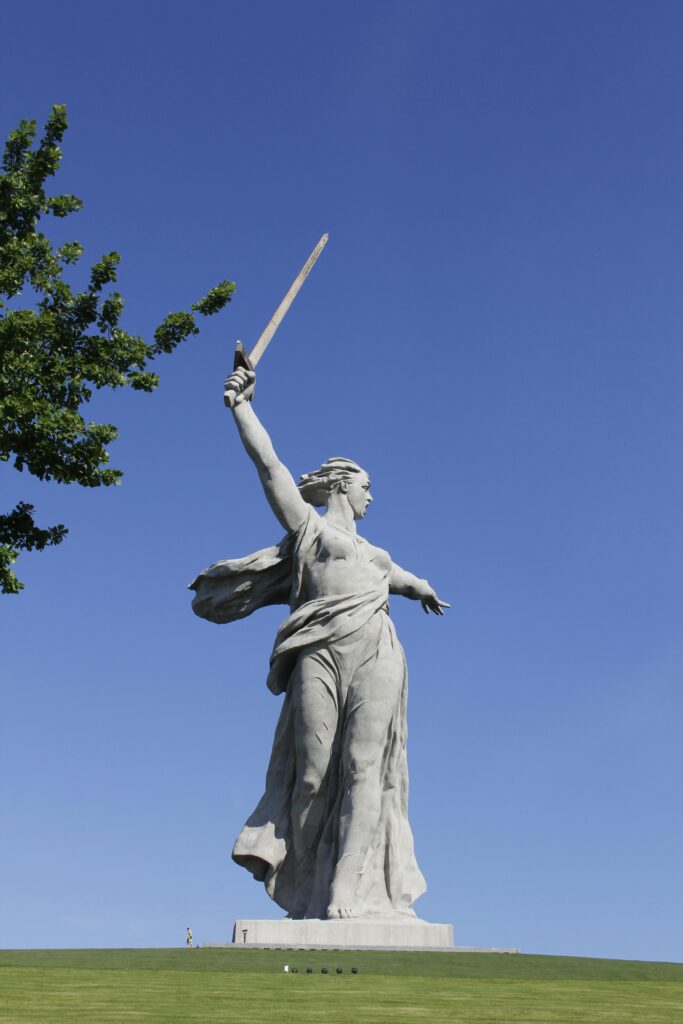
Photo by Ilya: https://www.pexels.com/photo/stone-monument-against-blue-sky-8869139/
Public Reactions – Then vs Now
Then
When The Motherland Calls was unveiled in 1967, public reaction within the Soviet Union was overwhelmingly positive and closely aligned with the state’s official narrative of World War II. The monument was widely presented as a triumphant symbol of Soviet endurance and victory, particularly highlighting the Battle of Stalingrad as the defining moment of the Great Patriotic War. State controlled newspapers, speeches, and commemorative events framed the statue as a long overdue tribute to the immense sacrifices made by Soviet soldiers and civilians during the conflict.
For many Soviet citizens the monument resonated deeply on a personal level. Nearly every family had been affected by the war through loss, or displacement of some sort. The scale and emotional intensity of The Motherland Calls reflected collective grief as much as national pride. The monument provided a focal point for mourning and remembrance, particularly because it stood on a site where thousands of soldiers had died and were buried. Public ceremonies and anniversary commemorations held at Mamayev Kurgan reinforced the statue’s role as a sacred national space rather than an artistic object.
At the same time, the monument functioned as a powerful tool of Soviet propaganda. Its unveiling took place during the Cold War when monumental art was frequently used to project the themes of strength, unity, and superiority. The Motherland Calls supported a state approved interpretation of history and while different perspectives on the war existed privately, they were largely absent from public discourse due to censorship and political control over historical memory.
Now
In contemporary Russia The Motherland Calls remains a widely respected national monument and a central symbol of remembrance for not only the Battle of Stalingrad but a broader experience of World War II as well. Public commemorations, particularly those associated with Victory Day, continue to emphasize the monument’s role in honoring collective sacrifice rather than political ideology and as a result the statue has retained public support across generations.
Following the collapse of the Soviet Union, the monument’s meaning has shifted subtly from a tool of state propaganda to a symbol of historical memory. While its origins are firmly rooted in Soviet era narratives, many viewers today interpret the statue primarily as a tribute to wartime suffering and endurance. Unlike monuments dedicated to individual political leaders or contested historical figures, The Motherland Calls commemorates something much bigger than all that and most likely because of this, calls for its removal are rare. Instead, present day discussions emphasize the importance of contextualizing the monument within a broader historical framework that acknowledges both heroism and loss. In this case The Motherland Calls continues to function as a living monument with one whose meaning evolves while its physical presence remains intact.
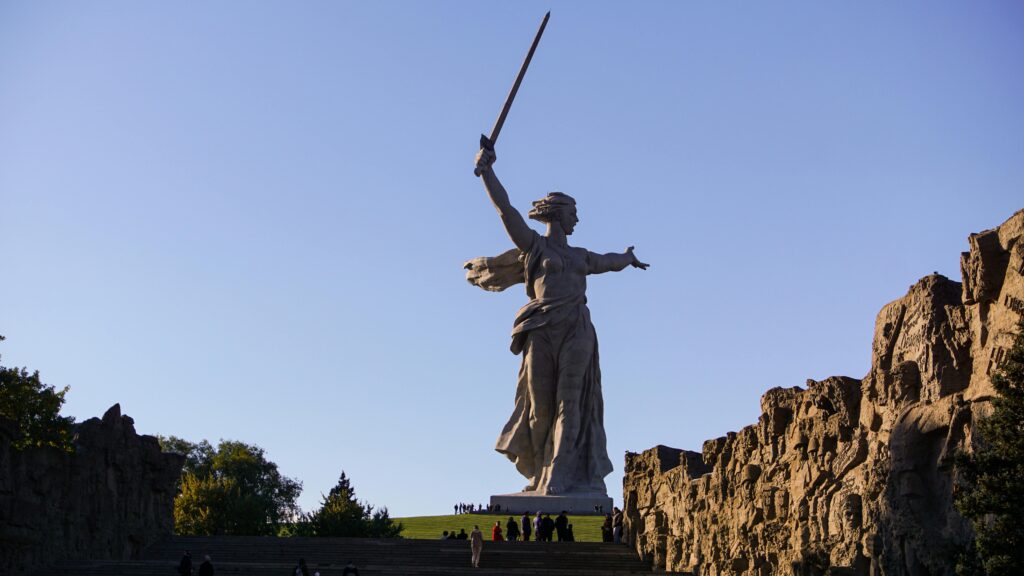
Photo by Ozan Güvenç : https://www.pexels.com/photo/statue-of-woman-with-sword-14186465/
References
Palmer, S. W. (2009). How Memory Was Made: The Construction of the Memorial to the Heroes of the Battle of Stalingrad. The Russian Review, 68(3), 373–407. http://www.jstor.org/stable/20621047
Limbach, R. (n.d.). Battle of Stalingrad. https://www.britannica.com/event/Battle-of-Stalingrad
By, A. S. (1996, Dec 25). Today’s battle of stalingrad: Trying to collect a paycheck: New battle of stalingrad: Trying to collect pay. New York Times (1923-) Retrieved from https://www.proquest.com/newspapers/todays-battle-stalingrad-trying-collect-paycheck/docview/109607376/se-2
Ponomarev, S. (2017, Nov 16). After 75 years, russia recalls stalingrad battle. New York Times (1923-) Retrieved from https://www.proquest.com/newspapers/after-75-years-russia-recalls-stalingrad-battle/docview/2463621822/se-2
Smith, M. (n.d.). Mother russia—The motherland calls! Global World War II Monuments. Retrieved December 16, 2025, from https://worldwariimonuments.org/items/show/22
Hellbeck, Jochen. “Stalingrad.” Google Books. Google, n.d. Web. 15 Dec. 2025.
Battle of stalingrad. (2025). In Wikipedia. https://en.wikipedia.org/w/index.php?title=Battle_of_Stalingrad&oldid=1326991336
The motherland calls. (2025). In Wikipedia. https://en.wikipedia.org/w/index.php?title=The_Motherland_Calls&oldid=1315941595
“Battle of Stalingrad: Research Starters: EBSCO Research.” EBSCO. n.d. Web. 10 Dec. 2025

