
Who does Mount Rushmore memorialize?
Mount Rushmore memorializes a total of four United States presidents. These include George Washington the first U.S president (born in 1732, died 1799), Thomas Jefferson the third U.S president (born 1743, died 1826), Theodore Roosevelt the 26th U.S president (born 1858, died, 1919), and Abraham Lincoln the 16th U.S president (born 1809, died 1865). Each of these presidents represent the birth, growth, development, and preservation of the United States. Each of them represents something different; George Washington serves as both the nation’s founding father and the leader of the revolutionary War, symbolizing the nation’s birth. Thomas Jefferson is a symbol of the nation’s growth since he approved the Louisiana Purchase and wrote most of the declaration of Independence. Theodore Roosevelt, who is renowned for his contributions to conservation and the building of the Panama Canal, represents the nation’s progress. Finally, Abraham Lincoln is a symbol of the nation’s survival during the Civil War and his attempts to maintain its unity.
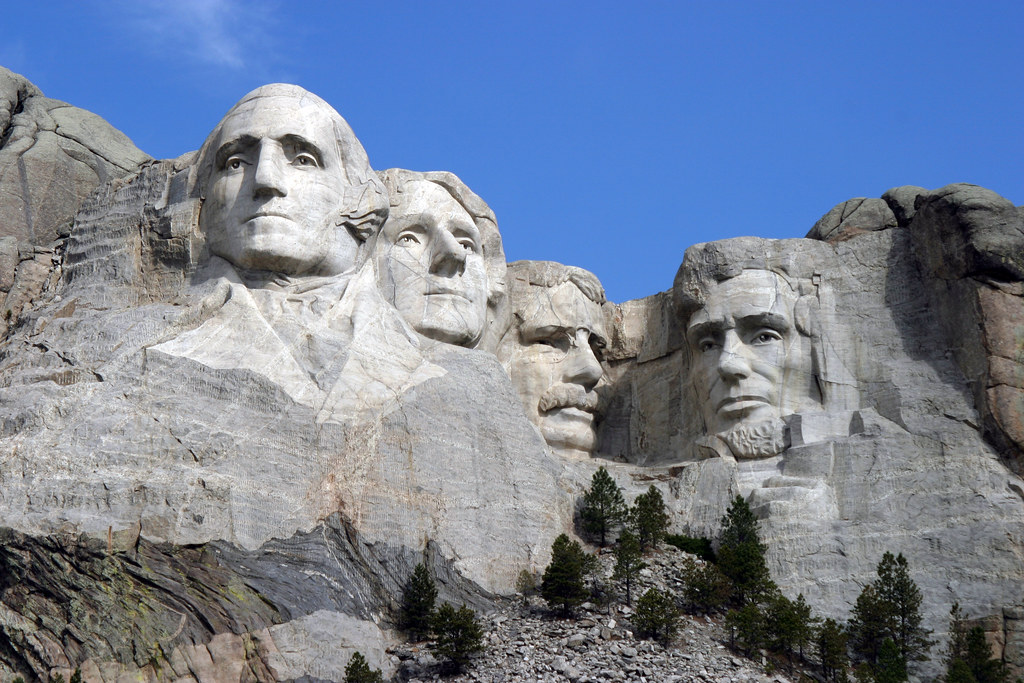
“06.04.03 Mount Rushmore Monument” by dean.franklin is licensed under CC BY 2.0.
Who built it?
Between 1927 to 1941, sculptor Gutzon Borglum and about 400 workers constructed Mount Rushmore to represent the establishment, growth, preservation, and unity of the United States. Don Robinson, a historian from South Dakota, originally intended the project to draw tourists, but Borglum altered the plan to include the four presidents. To build a monument that would “bear witness to the great things the nation accomplished,” Borglum selected the four presidents to symbolize significant events in American history. It was built in the early 1900s to draw tourists to South Dakota. A historian Don Robinson came up with the proposal in the hopes that a monument would increase tourism in the state, particularly after witnessing the success of a similar initiative in Georgia.

“Gutzon Borglum” by Thomas Hawk is licensed under CC BY-NC 2.0.
The history behind Mount Rushmore
This monument is a massive granite sculpture carved into the Black Hills of South Dakota. As Gutzon Borglum sculpted the Mount Rushmore monument, he couldn’t do it alone and was assisted with the help of about 400 workers. Borglum chose these four presidents to represent the nation’s birth, growth, development, and preservation. Each face is about 60 feet tall, making the monument one of the largest sculptures in the world. The original purpose of Mount Rushmore was to attract tourism to South Dakota and to create a national symbol that celebrated American democracy and leadership. The project was funded mostly by the U.S. federal government and was completed after Borglum’s death in 1941 by his son, Lincoln Borglum. Although Borglum originally planned to carve the presidents’ upper bodies, funding and time limitations stopped the project at just the faces.
The message behind it
On Mount Rushmore, the four presidents are shown as brave, legendary founders and significant American leaders. By carving their 60 foot faces into a mountain, the memorial communicates permanence, magnificence, and commitment. It suggests that these people are the epitome of American progress, growth, and democracy. Mount Rushmore promotes national pride and creating legends while paying respect to the presidents who shaped America. But beyond its patriotic appearance lie layers of discrimination, conflict, and contentious history.The monument honors four presidents who are seen as key leaders in U.S. history. Together, they represent the idea that strong leadership and democratic values shaped the nation and helped it survive major challenges. The Birth and Foundation of the United States is shown through George Washington. He represents the creation of the nation and the success of the American Revolution. His presence sends the message that the United States was built on independence and self-governance. Growth and Expansion of the Nation is seen through Thomas Jefferson, a president who symbolizes American expansion, especially through the Louisiana Purchase. This promotes the message that the country was destined to grow westward and become a continental power. Unity and Preservation of the Nation is resembled through Abraham Lincoln who represents the survival of the United States during the Civil War and the fight to end slavery. His inclusion sends the message that the nation values unity, sacrifice, and freedom. For many Native Americans, the monument also sends a painful message about ignored history and broken treaties, since it was carved on sacred Lakota land. To them, it represents conquest rather than freedom.
Present views versus past views
Many Americans viewed the construction of Mount Rushmore as a patriotic monument honoring the country’s development and the accomplishments of its presidents. During a period when the nation sought unifying symbols, particularly during World War I and during the Great Depression, it was seen as a symbol of national pride. It was regarded as a significant architectural accomplishment by tourists and government officials. However, because it was carved into sacred ground that had been seized from Indigenous people, it was criticized even at the time by the Lakota Sioux and others. In the past, there was little public awareness of Native American concerns. For many decades, the concerns of the Lakota Sioux and other Native groups were largely ignored by the general public. The sacred nature of the Black Hills and the issue of broken treaties were not part of mainstream discussions about the monument. It was seen as a major achievement for boosting tourism in South Dakota. Many people viewed it positively because it brought jobs, national attention, and economic growth to the region. Unlike in the past, there is now much greater public awareness that Mount Rushmore was built on land sacred to the Lakota Sioux. Many people today recognize the monument as a reminder of broken treaties and the mistreatment of Native Americans. Some people see Mount Rushmore as controversial because of the historical actions of the presidents depicted and the way the land was taken. Protests and debates continue over whether the monument should be celebrated, altered, or reinterpreted. Mount Rushmore still attracts millions of visitors each year, but people now view it with more complex emotions. For some it is inspiring, while for others it represents injustice, showing that its meaning is no longer one dimensional. Many people today hold mixed views about Mount Rushmore. Some still see it as a powerful national symbol that represents important U.S. presidents and key moments in American history. Others view it more critically, pointing out that the monument was carved into the sacred Black Hills, land taken from the Lakota Sioux despite treaty promises. As public understanding of Washington, Jefferson, Roosevelt, and Lincoln has evolved, especially regarding slavery, Indigenous rights, and racial attitudes, interpretations of the monument have also shifted. Due to these issues, debates continue about whether the monument should remain as it is, be reinterpreted with more context, or whether the surrounding land should be returned to the Lakota. To study the monument further, students like myself can use resources such as the National Park Service, Library of Congress archives, Lakota tribal publications, the 1868 Fort Laramie Treaty text, academic books on the Black Hills, and documentaries from sources like PBS or the National Museum of the American Indian.
What message does it send?
A complex and powerful message about American identity, leadership, and national values is conveyed by Mount Rushmore. Essentially, the monument symbolizes the United States’ respect for capable presidential leadership and the idea of advancement through democracy. The four presidents George Washington, Thomas Jefferson, Theodore Roosevelt, and Abraham Lincoln carved into the mountain represent significant points in American history including the country’s birth, growth, expansion, preservation, and development as a major world force. Together, they convey a message of solidarity, resiliency, and the conviction that exceptional people have the power to influence a country’s destiny. A traditional story of American glory is also reflected in the monument. Mount Rushmore highlights values like freedom, independence, and perseverance by building these leaders in stone. It is a patriotic representation that inspires pride in the nation’s accomplishments and political structure for many Americans. The sculpture’s size supports this idea by implying that the country’s principles and history are enduring, powerful, and deserving of remembering. However, Mount Rushmore also conveys a more complicated and controversial message. The Black Hills, which are sacred to the Lakota Sioux and were seized from them in violation of treaty agreements, were imprinted with the monument. As a result, Mount Rushmore may also represent colonialism, westward migration, and the exclusion of Native American perspectives. The lack of Indigenous viewpoints in the monument’s narrative draws attention to the histories that have historically been given priority and those that have been disregarded. Mount Rushmore therefore conveys two messages. On one hand, it honors democratic principles and American leadership. On the other, it represents unresolved issues related to representation, property ownership, and historical injustice. The monument now promotes contemplation on the value of criticism as well as national pride.
Does it still remain?
Since Mount Rushmore was carved on Lakota Sioux land that was taken after treaties were broken, some argue that the monument should be destroyed because it represents injustice and colonization. As some of the presidents represented backed policies that hurt Native Americans and other oppressed people, others think it should be reexamined. The question of whether honoring these individuals outweighs the historical suffering associated with the land’s possession and use is at the heart of the removal controversy.
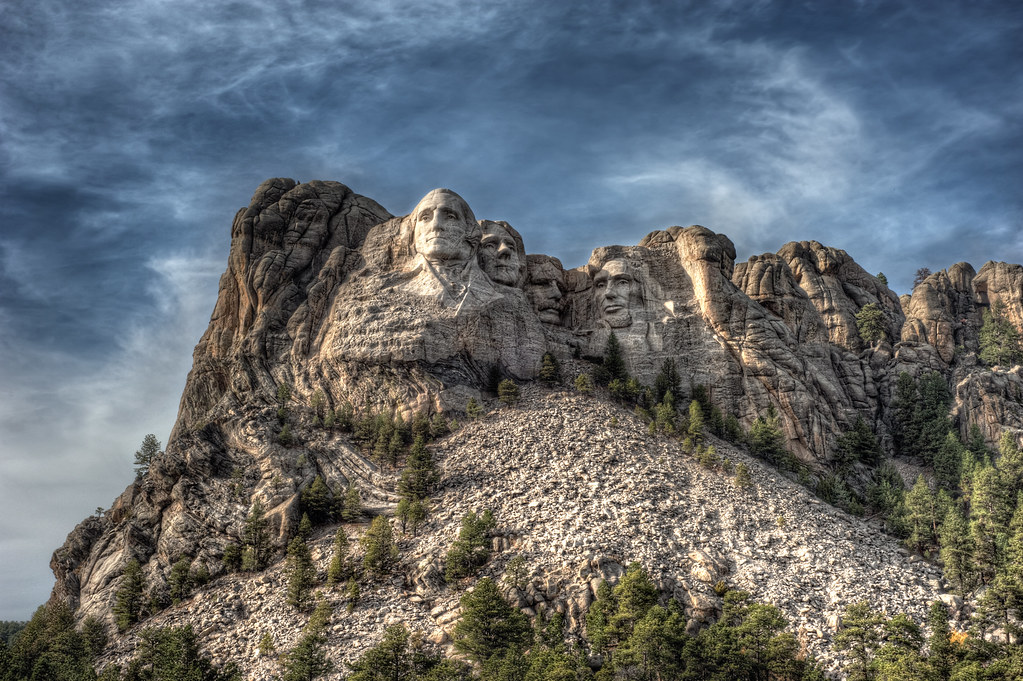
“351/365” by ShutterRunner is licensed under CC BY-NC 2.0.
References
Borglum, Gutzon. “Gutzon Borglum.” Encyclopaedia Britannica, Encyclopaedia Britannica,
www.britannica.com/biography/Gutzon-Borglum.
“How Was Mount Rushmore Built?” Encyclopaedia Britannica, Encyclopaedia Britannica,
www.britannica.com/art/How-Was-Mount-Rushmore-Built.
“Mount Rushmore National Memorial.” Encyclopaedia Britannica, Encyclopaedia Britannica,
www.britannica.com/topic/Mount-Rushmore-National-Memorial.
“Mount Rushmore National Memorial.” National Park Service, U.S. Department of the Interior,
www.nps.gov/articles/000/mount-rushmore-national-memorial-501080.htm.
NDN Collective. “NDN Collective Calls for Closure of Mount Rushmore and for the Black Hills to Be Returned to the Lakota.” NDN Collective, ndncollective.org/ndn-collective-calls-for-closure-of-mount-rushmore-and-for-the-black-hills-to-be-returned-to-the-lakota/.
Robertson, Tatsha. “The Strange and Controversial History of Mount Rushmore.” National Geographic,
www.nationalgeographic.com/history/article/the-strange-and-controversial-history-of-mount-rushmore.
“The Black Hills and the Lakota.” PBS NewsHour, Public Broadcasting Service,
www.pbs.org/newshour/app/uploads/2013/11/blackhills_08-23.html.
“Why These Four Presidents?” National Park Service, U.S. Department of the Interior,
www.nps.gov/moru/learn/historyculture/why-these-four-presidents.htm.
“Mount Rushmore’s Untold Carving History and Controversy.” The Kid Should See This,
thekidshouldseethis.com/post/mount-rushmore-untold-carving-history-and-controversy.

