
Public monuments shape how you encounter history. You learn through space, material, and placement. You do not receive facts alone. You experience meaning through design and location. The National Holocaust Monument in Canada stands as a national effort to preserve memory of genocide and to force reflection on responsibility. This case study explains who and what the monument memorializes, why Canada built the monument, what messages the design sends, how people responded when the monument opened, and how people think about the monument today. You read this as someone implicated in public memory, not as a distant observer.
Who and what the monument memorializes
The National Holocaust Monument memorializes the Holocaust. The Holocaust refers to the genocide carried out by Nazi Germany and collaborators during World War II. Nazi ideology defined Jewish people as enemies of the state. Government policy targeted Jewish people for elimination. Six million Jewish men, women, and children were murdered.
The Holocaust also harmed other groups. Roma communities faced mass murder. Disabled people were killed through medical programs. Political opponents faced imprisonment and execution. LGBTQ+ people faced arrest and death. These crimes occurred through law, administration, and enforcement.
Genocide did not happen through disorder. Genocide relied on rules, documents, and obedience. Police enforced orders. Rail systems transported victims. Factories produced tools of murder. Ordinary citizens participated or remained silent.
The monument also honors Holocaust survivors who later lived in Canada. Many survivors arrived without families or homes. Many carried physical and psychological trauma. Canada became a place of rebuilding for people who lost everything.
When you stand at the monument, you confront loss and survival together. Memory includes death and endurance. Ask yourself why survival deserves recognition alongside mourning.
Historical background you need
The Holocaust began after the Nazi Party took power during 1933. Antisemitic laws removed Jewish rights. Jewish people lost citizenship. Jewish businesses faced seizure. Jewish children faced removal from schools. Public life became closed.
Ghettos confined families in cities across Europe. Crowding caused hunger and disease. Deportations followed. Mass shootings killed entire communities in forests and fields. Camps enforced forced labor. Death camps turned murder into an organized system. Trains delivered victims. Gas chambers killed thousands each day. Crematoria erased bodies.
The war ended during 1945. Allied forces liberated camps. Survivors faced illness, grief, and displacement. Many had no homes to return to. Entire towns no longer existed.
Canada played a role before and after the war. Canadian immigration policy restricted Jewish refugees during the 1930s and early 1940s. The ship MS St. Louis carried Jewish families fleeing Germany. Canada denied entry. Many passengers later died in Europe. After the war, Canada accepted survivors and displaced persons.
Memory forces you to hold both refusal and refuge together. Ask yourself how nations face past choices.
Why the monument exists
For decades, Canada lacked a national Holocaust monument. Local memorials existed in cities and communities. Museums preserved testimony and artifacts. A national site in the capital did not exist.
Survivors and descendants pushed for recognition. Advocacy grew during the early 2000s. Laura Grosman led organizing efforts. Members of Parliament supported the campaign. MP Tim Uppal introduced legislation. Parliament passed the National Holocaust Monument Act during 2011.
The law required a permanent memorial in the national capital. The law emphasized public access and education. The site would serve as a place for remembrance and learning.
Planning and construction followed over several years. The monument opened in Ottawa during September 2017.
Timing matters. Survivors aged. Firsthand testimony faced disappearance. Antisemitism persisted across societies. Denial spread through online platforms. The monument responded to urgency.
Ask yourself why urgency grows when witnesses fade.
Who designed and built the monument
Architect Daniel Libeskind designed the monument. Libeskind carries family history connected to the Holocaust. His architectural work focuses on memory, loss, and absence. Design served remembrance rather than comfort.
The National Capital Commission managed the site and its placement near Parliament. Federal funding supported construction alongside donations from organizations and individuals. Advisory committees included historians and community members.
The design process involved choices about form, scale, and symbolism. Architecture served as language.
Ask yourself whether trauma belongs in public space.
Physical structure and visitor experience
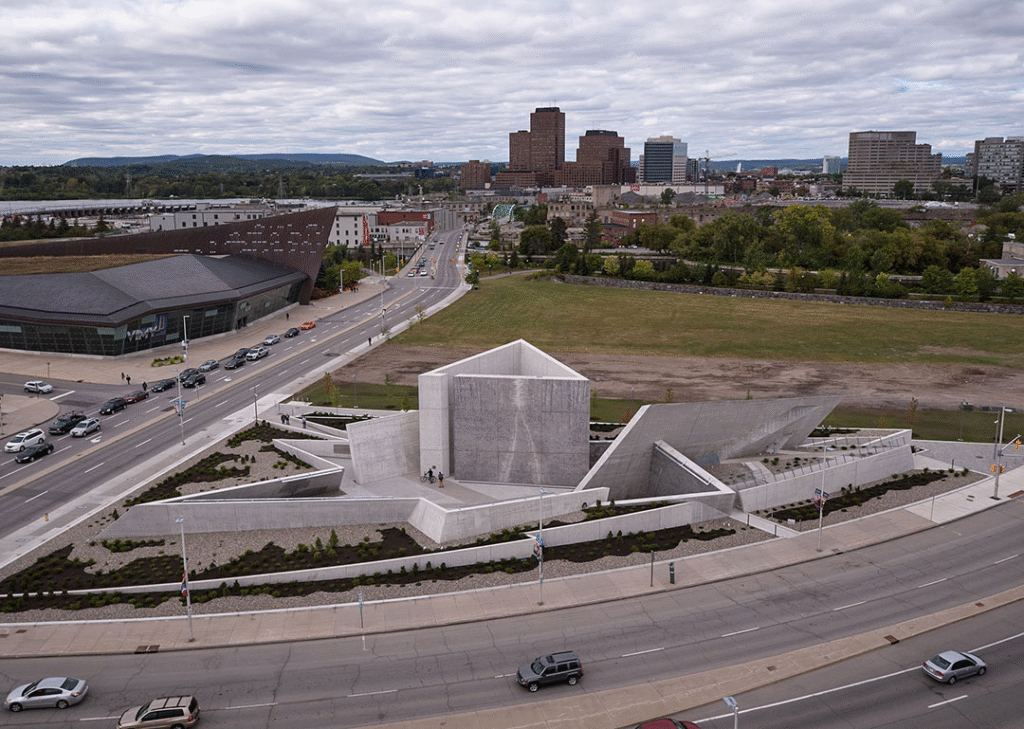
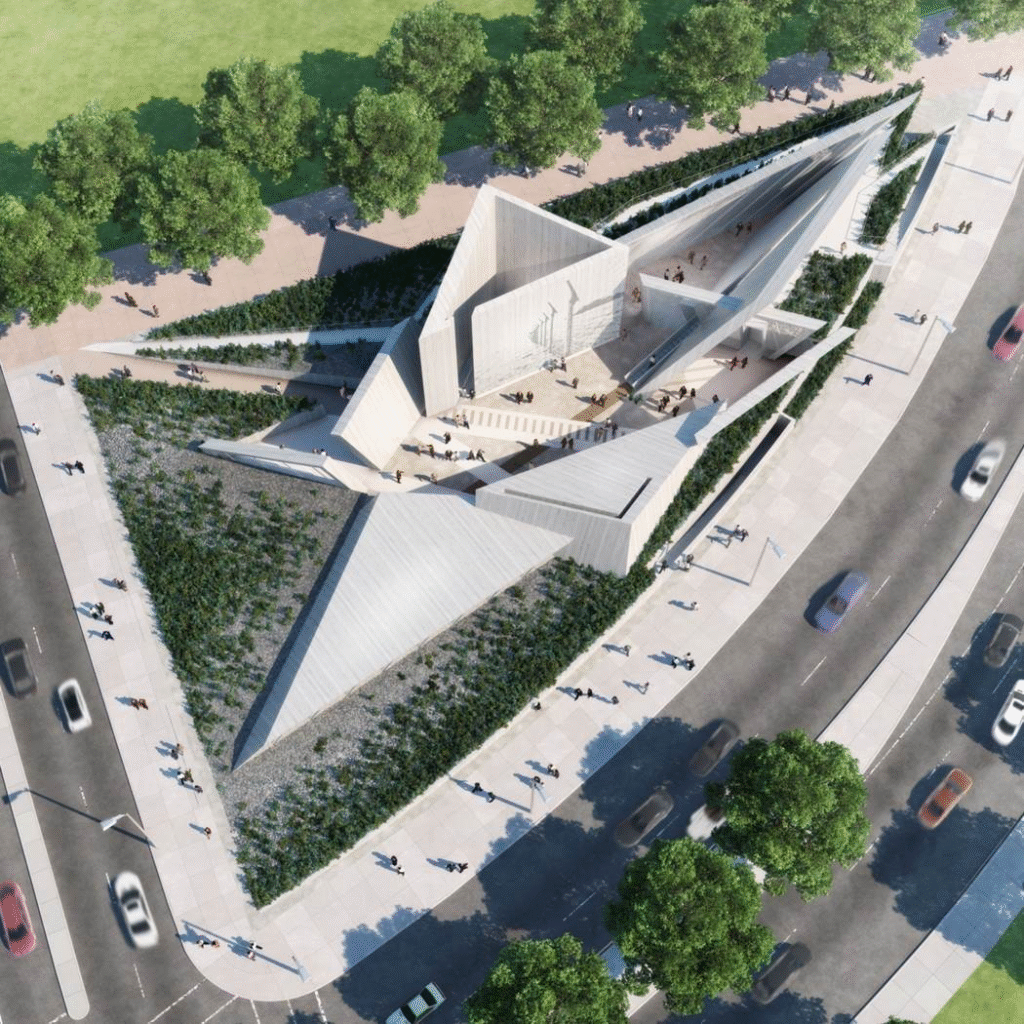
The monument consists of six large concrete forms. The forms rise upward and enclose interior corridors. The number six refers to six million Jewish victims. When viewed from above, the forms align into a star pattern.
You enter through a narrow opening. Movement follows controlled paths. Walls restrict vision. The city disappears. Sound changes as footsteps echo.
Concrete surrounds you. Height closes space. Light enters only from above. The space limits choice and directs attention.
The design shapes your body and pace. You slow down. You look upward. You notice silence.
Ask yourself how architecture guides emotion.
Symbolism within the design
The star pattern references the Star of David. Nazi policy forced Jewish people to wear yellow stars as tools of identification and exclusion. The monument transforms the symbol into structure and permanence.
Concrete carries weight. Weight reflects burden. Height reflects authority. Narrow corridors reflect confinement. The open sky reflects survival.
A central corridor aligns with Parliament’s Peace Tower. The sightline connects memory with state power. Government once enabled genocide. The government also protects rights.
The monument communicates without decoration. Memory links with responsibility. Democracy requires defense.
Ask yourself what duty follows remembrance.
The inscription controversy
The monument opened with a dedication plaque. The plaque referred to victims of the Holocaust. The text did not name Jewish people. Public reaction followed immediately.
Jewish organizations expressed concern. Survivors expressed pain. Scholars and journalists debated language. Universal wording erased specificity. The Holocaust targeted Jews as Jews. Naming matters in public memory.
The chair of the advisory council issued an apology. Authorities removed the plaque. A revised inscription followed. The new text explicitly named Jewish victims.
The correction addressed harm and restored trust for many visitors. The episode revealed tension between universal messages and historical accuracy.
Ask yourself who controls language in public space.
Public reaction at the time of opening
Political leaders attended the unveiling ceremony. Survivors and descendants stood beside officials. National media covered the event. Coverage focused on the inscription rather than the architecture.
Many welcomed the monument as overdue recognition. Educators praised the educational role. Architects discussed form and symbolism. Critics questioned clarity and language.
Debate overshadowed ceremony. Memory collided with politics. Words shaped reception.
Ask yourself how public trust depends on naming truth.
Education and public use
The monument functions as an educational site. Schools organize visits. Teachers use the space to discuss genocide, antisemitism, and human rights. Annual ceremonies mark Holocaust Remembrance Day.
Survivors speak during events. Youth programs guide visitors through the site. The monument operates as an open classroom.
Learning occurs through experience rather than lecture. Space reinforces lessons.
Ask yourself what stays with students after leaving.
Vandalism and antisemitism
The monument has faced acts of vandalism. Graffiti has appeared on walls. Police investigated each incident. Jewish organizations condemned attacks.
Vandalism reflects ongoing antisemitism. Memory sites attract hostility. Education provokes reactions.
Protection remains necessary. Remembrance draws resistance.
Ask yourself why memory unsettles hate.
Public perception today
Today, the monument stands as Canada’s national Holocaust memorial. Annual ceremonies continue. Public discussion centers on antisemitism, denial, and education. The plaque controversy remains part of the monument’s history.
Views about the Holocaust remain grounded in historical evidence. Denial persists in fringe spaces. Education counters distortion.
The monument supports awareness and dialogue. The monument demands attention.
Ask yourself how denial grows when memory weakens.
Should the monument face removal
Public monuments face reevaluation when values shift. This monument commemorates genocide. The historical record remains clear. The controversy involved wording rather than purpose. Correction addressed the issue.
Removal would erase public memory. Removal would silence survivors. Removal would weaken education.
Memory requires care rather than erasure.
Ask yourself what disappears when remembrance disappears.
Meaning for Canada
Canada once denied refuge to Jewish families. Canada later accepted survivors. Canada now marks remembrance in the national capital.
The monument stands near Parliament. Location links memory with law. Law once enforced exclusion. Law protects rights today.
You stand between concrete walls and government buildings. Space connects past actions with present responsibility.
The monument asks something of you. Remembrance alone does not stop hatred. Action follows knowledge.
What role will you take after leaving the site?
Reflection
The National Holocaust Monument communicates through space, form, and correction. The monument memorializes victims, honors survivors, and confronts national history. The monument shows how memory enters public space. The monument shows how language shapes trust. The monument shows how design directs experience.

