
Background of the Event
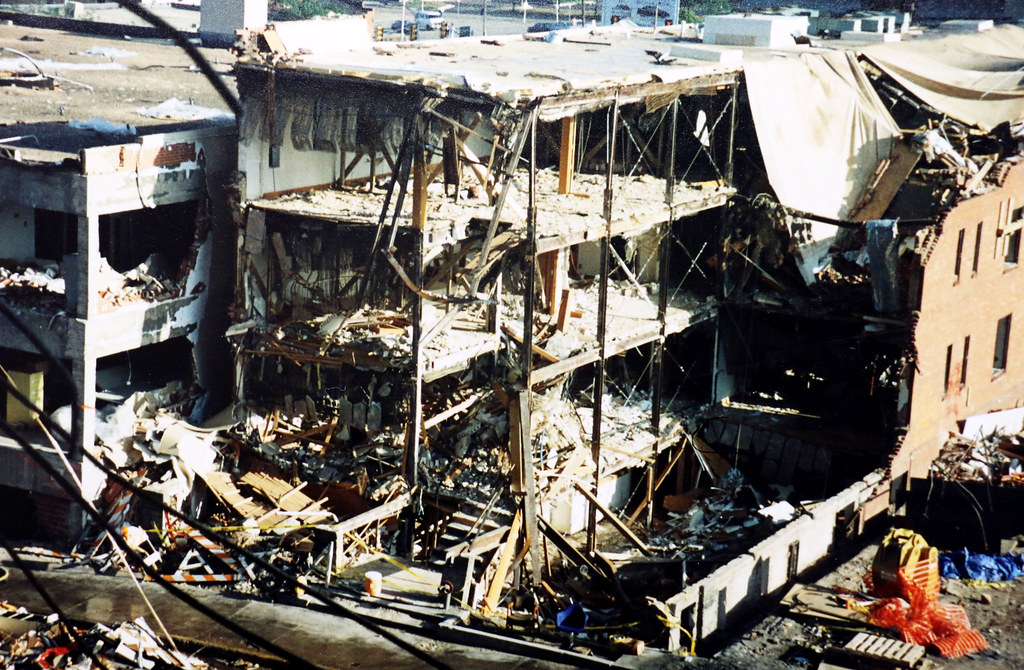
On April 19, 1995, the lives of many people would change, and for some, would end. At approximately 9:02 in the morning, a bomb was set off in the Alfred P. Murrah Federal Building, a federal building in downtown Oklahoma City. The bomb was so big that nearly 300 buildings nearby were damaged. That day, 168 people died, including 19 children, and hundreds were injured. This was an attack on innocent people and an attack on the peace that was once in downtown Oklahoma City.
The man who was responsible for this attack was Tommy McVeigh, an ex-army soldier and security guard. McVeigh parked a rented Ryder truck in front of the building, where the bomb was placed, and he hid away in his getaway car. After the bomb went off, he fled the scene to escape. Later that same day, he was arrested by an Oklahoma State Trooper after his getaway car was found to be license-plateless. McVeigh also tried to conceal a weapon he had while driving, which caused more attention from the State Trooper. When the FBI got hold of who he was, they found out that he was arrested 90 minutes after the bombing. The FBI would later uncover that McVeigh was not alone in one of the worst domestic acts of terrorism in American history. McVeigh was accompanied by Terry Nichols, who helped build the bomb, and Michael Fortier, who knew about the bomb but failed to inform the government.
Who Built the Memorial & Its Significance
Husband and wife Hans E. Butzer & Torrey Butzer were chosen to design a memorial for the Oklahoma City bombing in 1997. Both architects, Hans, focusing more on landscape and agriculture, and Torrey, focusing more on art and design, created a memorial that meant “then and now and tomorrow (Hans E. Butzer).” As they were living in Germany at the time of designing the memorial, they drew inspiration from both European and American standards in the purpose of a memorial. Although they wanted to create a visually pleasing and abstract memorial like the Europeans, they also sought something that would allow people to interact with it and invite them to reflect on their emotions and thoughts.
Very few memorials are built near the tragedy of where the event took place, so they felt that it was best to create something around the area that depicts what the bomber’s goal was. It also allows people to connect more with the memorial, reflecting on the moment and the emotions happening at that time. When there are interactive sections in a monument, people tend to connect more with the event and the lives that were lost. The field of empty chairs allows people to walk among them and remember the lives of those who were lost. The reflecting pool allows people to look at it, touch it, and connect with their emotions.
This memorial brings peace to a tragic event that took away the innocence of an area that once had it. The Butzers wanted to create a memorial that remembered the lives that were lost, but also remembered that there was once peace before the tragedy, and that it can still be restored if one just listens and connects with what they are feeling during that time.
Our hope was that the Memorial design could reflect the specifics of a moment in time. – Hans E. Butzer
Layout of the Memorial
Each part of the memorial was carefully planned out and thought through to have a message within the architecture and location of each section. With some sections still the same as the day of the event, and others built to remember those whose lives were lost and to send a message, the memorial invites everyone who visits it to soak up the time that they are there.
When it comes to remembering those whose lives were lost in the bombing, the Field of Empty Chairs is located across from the reflecting pool and the museum. 168 chairs are placed in nine rows, the rows representing the nine floors of the federal building, and the chairs representing each person who lost their lives on that floor. The smaller chairs represent the lives of children who were taken away. The Survivor Wall is located on the East end of the memorial, with more than 600 names of those who’ve survived the bombing
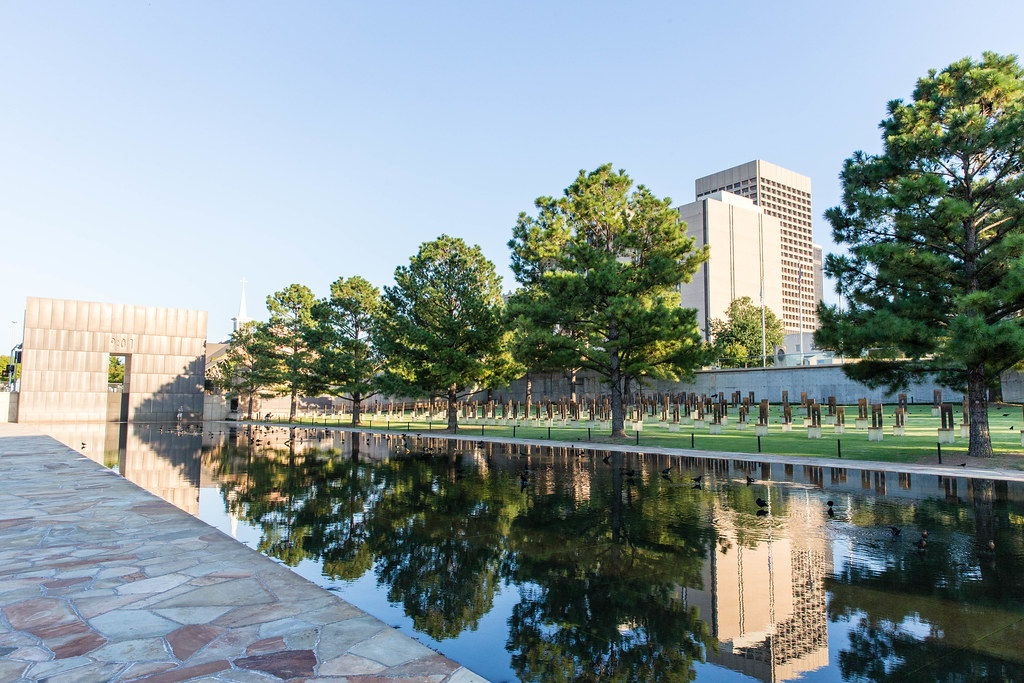
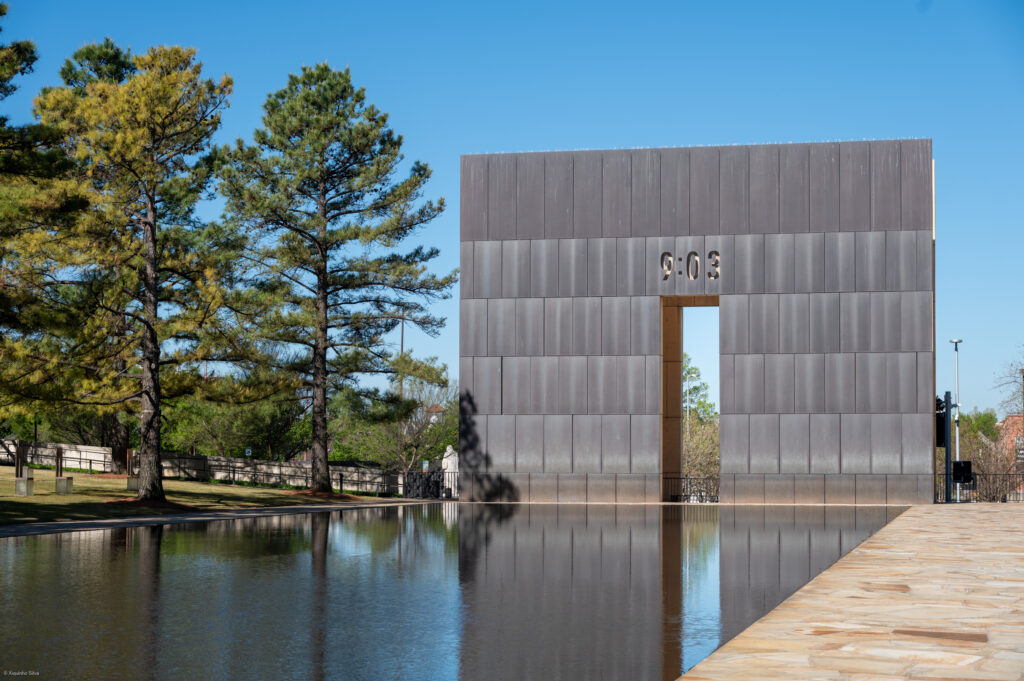
In the center of the outdoor memorial, there are two important entrances to take into consideration. The gates of time, both located across from each other between the reflecting pool, with one gate labeled 9:01 and the other one labeled 9:03, symbolize the innocence before the bombing and then what happened after. As people explore the outdoor memorial, they reflect on what they are feeling, connect with the memorial, and find peace before they leave through the 9:03 gate. The Reflecting Pool allows people to find calmness, have quiet thoughts, and be at peace, reflecting on change.
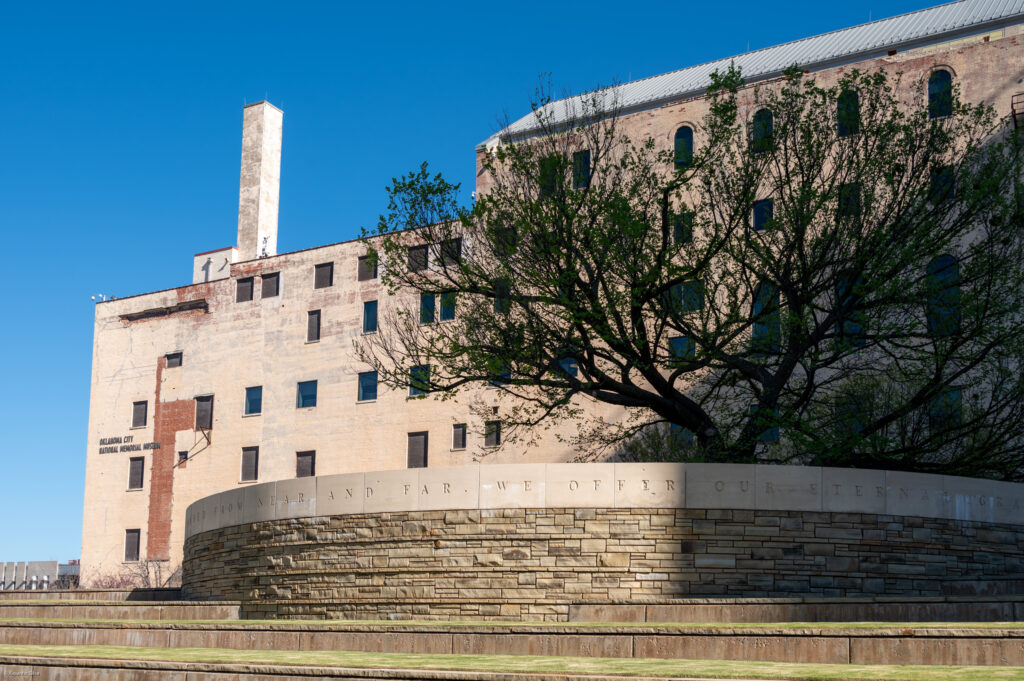
The Survivor Tree is a symbol of bouncing back after a traumatic event, as it was one of the trees that was untouched after the bombing took place. It now stands inside the memorial for people to look at and take inspiration from it. The Survivor Tree is surrounded by flower and nut trees. This area, also known as the Rescuers’ Orchard, symbolizes protection over the Survivor Tree, and is also a thank you to rescuers and volunteers who helped that day, and continue to help on.
The museum, journal record building, and children’s area are also a part of the memorial, but what makes this outdoor memorial symbolic and touching to some people is the areas talked about above, which allow people to walk along and feel impacted by the memorial.
Thoughts on the Memorial
(Past thoughts)
In the beginning, families of victims, residents of Oklahoma, and the public were curious to see how a memorial for this horrific event that happened in 1995 would be approached. With inspiration from Europe, features with hints of the event’s tragic roots, and the symbolization that is carried throughout the memorial, the Butzers created a memorial that the public deeply admired, and it is proof that good overcomes the bad.
On April 17, 2000, almost five years after the anniversary of the bombing, people lined up to see the opening of the Oklahoma City Memorial. “It’s not the way I pictured it. It’s been so cleaned up and made into such a monument that you don’t get a feel for the devastation until you look across to the Journal Record Building. ” – Kristin Welbaum, a visitor from Minneapolis. With some not knowing how to summarize their feelings on the memorial, there are others, such as Monica Swink, an Oklahoma City resident, who’ve said, “It’s one of those things that will be burned in your mind forever. And that’s why it’s so nice to have this calmness.”
(Present time)
Coming back to the present time, the public has this memorial in their hearts, as it not only reminds them of the lives that were lost but also brings them peace from a horrific event. “I am glad our son and his wife celebrated their marriage in Oklahoma City because the Memorial there gives me hope that he and his wife will inherit a world of goodness that can be tarnished, but cannot ever be destroyed.” – Ralph Gaebler, The Imaginative Conservative. Gaebler had also said that “The Memorial is extremely moving”, reflecting on how the memorial allows people to interact and feel in different ways. Jeff & Crystaly, Our Changing Lives, have said, “We found that by the end of our visit, the overwhelming message was one of overcoming.”
The overall thoughts about the memorial from people in the past and present times have been positive. The Oklahoma City Memorial reminds people of how much can change within a second of time. The gates of time and the survivor tree invite people to think more deeply about the meaning of overcoming, and how to find the good in an event so tragic in American history. The public enjoys and connects with this memorial because it not only invites them to think, but also to interact with the memorial, which allows them to connect to the event and their emotions in the moment.
The Memorial’s Message
The events of what happened on April 19th, 1995, were something that changed America forever. 168 lives were lost that day. The Oklahoma City National Memorial takes the horrific events that happened and turns them into a matter of reflection, enabling peace to come after a tragic event. The symbolization seen throughout the memorial, and the way people connect with their emotions and interact with the memorial, is something that brings out the positive from a negative situation. It reminds people that peace can still be restored, and that positivity can still be seen through the bad. The purpose of the memorial is not only to remind people of the event and the lives that were lost, but to still reassure them, and hope that coming together as a community and shining a light in a dark situation can turn into good. It is a beautiful reminder that the good is more powerful than the bad in the world.
References
Crystal, Jeff &. “Survivor’s Spirit – Oklahoma City National Memorial & Museum.” Our
Changing Life, 27 Mar. 2024, www.ourchanginglives.com/survivors-spirit-oklahoma-city-national-memorial-museum/.
“The Encyclopedia of Oklahoma History and Culture.” Oklahoma Historical Society,
www.okhistory.org/publications/enc/entry?entry=OK026. Accessed 14 Dec. 2025.
Gaebler, Ralph. “On Visiting the Oklahoma City National Memorial.” The Imaginative
Conservative, 1 Nov. 2024, theimaginativeconservative.org/2024/11/visiting-oklahoma-city-national-memorial-ralph-gaebler.html.
“Gibbs College Dean Discusses Memorial Building Design.” The University of Oklahoma,
www.ou.edu/news/articles/2025/april/gibbs-college-dean-discusses-memorial-building-design. Accessed 14 Dec. 2025.
“The Memorial.” Oklahoma City National Memorial & Museum, 13 Feb. 2024,
memorialmuseum.com/experience/the-memorial/.
“The Memorial.” Oklahoma City National Memorial & Museum, 13 Feb. 2024,
memorialmuseum.com/experience/the-memorial/.
“Oklahoma City Bombing | Federal Bureau of Investigation.” Oklahoma City Bombing,
www.fbi.gov/history/famous-cases/oklahoma-city-bombing. Accessed 15 Dec. 2025.
“Oklahoma City National Memorial.” BAU_Butzer Architects and Urbanism,
butzerarchitects.com/oklahoma-city-national-memorial-more-info-1. Accessed 14 Dec. 2025.
“The Yale Daily News, 17 April 2000.” Yale Daily News Historical Archive,
ydnhistorical.library.yale.edu/?a=d&d=YDN20000417-01.2.33&srpos=2&e=——-en-20–1–txt-txIN-oklahoma%2Bcity%2Bmemorial%2B——-false. Accessed 14 Dec. 2025.
“The Yale Daily News, 22 April 1996.” Yale Daily News Historical Archive,
ydnhistorical.library.yale.edu/?a=d&d=YDN19960422-01.2.8&srpos=1&e=——-en-20–1–txt-txIN-oklahoma%2Bcity%2Bbombing——-false. Accessed 14 Dec. 2025.

