Trigger Warning: Discussions of Death and Grief
The day before beginning Lost in Translation, I stood in my grandma’s hospice room and said goodbye to her for the last time. All I wanted was for time to stop. Afterward, I drove the three hours from Pennsylvania to Connecticut to go back to school. I tried to do work for class as if everything was normal. It wasn’t. My grandmother died the next day, and I began reading. As much as I wish I could have approached this text from a neutral place, I couldn’t. I was suspended in new grief, weighed down by extreme guilt, and moving through life as if something inside me was about to split open.
Describing my Experience
I could not stay in the narrative for long stretches. My attention slipped constantly. Some phrases would hit me sharply, and then I’d drift away. I continuously reread the same lines without absorbing what they said. I almost felt porous. The boundary between the book and my own thoughts was very thin. Sometimes I was intensely inside the language, and then other times I was elsewhere entirely. Everything felt fragmented. It was as if the words kept pressing on part of my skin that had been scraped raw and I couldn’t hold a consistent distance from them.
Classifying my Experience
I think my experience was a mix of mind wandering, identification, and dissociation. Mind wandering is described in the experiences glossary as “having thoughts unrelated to a specific task.” I found myself drifting away from the text often, with my thoughts floating into my own memories and emotions. At the same time, I experienced identification, which is described as “recognizing, in a character’s experience, a conflict that you have experienced.” Despite the differences in our external experiences, the internal emotional conflict she described closely resembled my own. There were also moments where I felt as if the narrative and I were not fully in the same space. This was the dissociation, which is described as the “sense of detachment from what is happening.” This made the reading kind of immersive and strangely unreal at the same time.
Features Prompting my Experience
Parts of Hoffman’s writing made my experience immediate and overwhelming. When she wrote:
When the brass band on the shore strikes up the jaunty mazurka rhythms of the Polish anthem, I am pierced by a youthful sorrow so powerful that I suddenly stop crying and try to hold still against the pain. I desperately want time to stop, to hold the ship still with the force of my will. I am suffering my first, severe attack of nostalgia, or tesenota—a word that adds to nostalgia the tonalities of sadness and longing.
-Hoffman p. 4
The words themselves made the emotion feel like it was cutting into me. Maybe it was more like stabbing. The word pierced caught me. That was it. The emotion pierced me in the way a fishhook pierced my foot when I was five. It was scary, sudden, sharp, and impossible to ignore. That’s what the grief has felt like. Hoffman’s description of wanting to hold time still mirrored my own desperate wish to freeze the moments before my grandmother’s death. For days afterward, I found myself repeatedly revisiting the few minutes where I said goodbye to her. The way Hoffman frames the sorrow physically made it impossible to stay detached.
Later, the dreamlike passage bout Baba Yaga deeply unsettled me.
Each night, I dream of a tiny old woman—a wizened Baba Yaga, half grandmother, half witch, wearing a black kerchief and sitting shriveled and hunched on a tiny bench at the bottom of our courtyard, way, way down. She is immeasurably old and immeasurably small, and from the bottom of the courtyard, which has become immeasurably deep, she looks up at me through narrow slits of wise, malicious eyes. Perhaps, though, I am her. Perhaps I have been on the earth a long, long time and that’s why I understand the look in her eyes. Perhaps this childish disguise is just a dream. Perhaps I am being dreamt by a Baba Yaga who has been here since the beginning of time and I am seeing from inside her ancient frame and I know that everything is changeless and knowable.
-Hoffman p. 6
The repetition of perhaps and the dreamlike uncertainty created a strange sense of instability. It mirrored how unreal everything has felt since my grandmother’s death. It was unsettling because I could see myself in it. I thought about how everyone used to say I looked just like her, how she introduced me to so many things I love, and the trips to the mall where I first felt like a “big girl” pushing my baby cousin in her stroller. Many of my habits are borrowed from her. Many of my physical items are literally borrowed from her. The entire shelf in the closet of my bedroom at my parents’ house is filled stuffed animals from my childhood that I drew and begged my grandmother to make.
Recognizing these parts of myself in her memory is comforting but also sickening. It feels like a way for her to live on, but I’m worried I imagined our closeness. I don’t know that others would validate it. I feel more lost and anxious about the future, which is shocking considering how lost and anxious I already felt because I am graduating at the end of this semester. When I found out I was accepted into graduate school after my grandmother died, my first thought was that I couldn’t go. How could I go if she wouldn’t know? Hoffman’s uncertainly mirrors this confusion. Her own uncertainty amplified mine, along with the feeling that nothing will ever feel right in the same way it did when my grandmother was alive.
Hoffman describes walking home:
I am walking home from school slowly, playing a game in which it’s forbidden to step on the cracks between the slabstone squares of the pavement. The sun is playing its game of lines and shadows. Nothing happens. There is nothing but this moment, in which I am walking toward home, walking in time. But suddenly, time pierces me with its sadness. This moment will not last. With every step I take, a sliver of time vanishes. Soon, I’ll be home, and then this, this nowness will be the past, I think, and time seems to escape behind me, like an invisible current being sucked into an invisible vortex. How can this be, that this fullness, this me on the street, this moment which is perfectly abundant, will be gone?
-Hoffman p. 16
I felt that same sharp awareness of time vanishing. My mind drifted to how quickly my grandmother worsened, and how fast the moments I wanted to hold onto disappeared. The slow rhythm of the passage gave me space to think about my own sense of helplessness. The words didn’t just describe the feeling of time passing, but made me feel it. I floated between the narrative and my own memories.
Narrative Technology
The first narrative technology I noticed was the I Voice, which is “a narrator who speaks in the first person.” As part of the audience, I was placed directly into Hoffman’s consciousness. There is no distance between her feeling and mine, as the I Voice bridges the gap between the narrator and reader. This is why her longing to stop time was not observational, but felt personally and physically by me.
Her use of poetic language, described as something that “rearranges usual speech so that we slow down and notice things we wouldn’t notice otherwise,” intensified this effect. Using words like “pierced” and images like “an invisible current being sucked into an invisible vortex” gave shape to emotions that were otherwise hard to define. Because the language is sensory and concrete, I could attach my own grief to the imagery. Instead of just understanding her sadness, I felt my own through her metaphors.
The narrative technology that most shaped my experience was soliloquy, which is “a narration technology that allows readers to hear the inner conflict of an individual character.” Throughout these passages, Hoffman spoke directly through her internal reflections. The narrative is built around her thoughts, memories, and questions about time, identity, and emotion. Because the story unfolds through this interior voice, I, as the reader, was placed inside her private mental space.
“Ghost” Technology
Another narrative technology prompting my experience was Grief Releaser, which is a plot technology that “abandons the usual forward momentum of plots in favor of a drifting, eddying, dilating story that provides us with time to acknowledge heartache and dwell upon memories of our loved ones lost.”
The slow meditation on walking home uses pacing as a kind of emotional technology. The narrative lingers, stretches a single moment, and fixates on the idea that it will vanish. This slowing of time interrupts forward momentum and creates room for reflection. Because the scene dilates time so deliberately, it gave my own thoughts space to surface. Instead of moving quickly through the plot, I was suspended in my own awareness of time passing and of moments disappearing. This was a sort of echo of the fragile state I was already in.
While I think this section could easily be prompted by a different narrative technology, I wanted to acknowledge the impact my emotional state had on this narrative technology. In the specific passage on walking home, the Grief Releaser technology acts more like a “ghost” technology. I think of it as a narrative effect that exists in part within the text and in part within the reader, rather than being fully contained in the text itself. It is “haunted” by the reader’s emotional context. The walk-home passage, for example, might feel reflective or meditative to any reader, but it became a profound Grief Releaser for me because it mirrored my own grief, my awareness of time vanishing, and my sense of loss after my grandmother’s death. I recognize that Grief Releaser may not actually exist within this aspect of the text without my specific emotional state while reading.
Reading Lost in Translation shaped the space for my own feelings to surface, rather than merely showing me another’s. The narrative created the conditions that allowed my grief to enter and move through it. It gave me a mirror for my own emotional state and a way to recognize the depth of my loss. Even though I initially felt paralyzed by my grandmother’s death, questioning whether I could go to graduate school without her knowing, I’m still moving forward and will be starting my master’s degree in the Summer I Term. Revising this reflection nearly two weeks later, after her posthumous services, I do not feel better, and the sting of her absence remains, but I do feel clearer. I can see how her influence shapes my actions, my values, and my identity. Reading Hoffman helped me acknowledge that clarity amidst grief. The narrative didn’t erase my pain, but it gave me a lens to understand it. And in that understanding, I have a way to carry her memory with me as I shift into the next chapter of my life.
Works Cited
Experiences Glossary. https://wonder-cat.org/experiences/. Accessed 28 Feb. 2026.
Hoffman, Eva. Lost in Translation: A Life in a New Language. E. P. Dutton, 1990.
Technologies by Element of Narrative. https://wonder-cat.org/technologies. Accessed 28 Feb. 2026
Featured Image
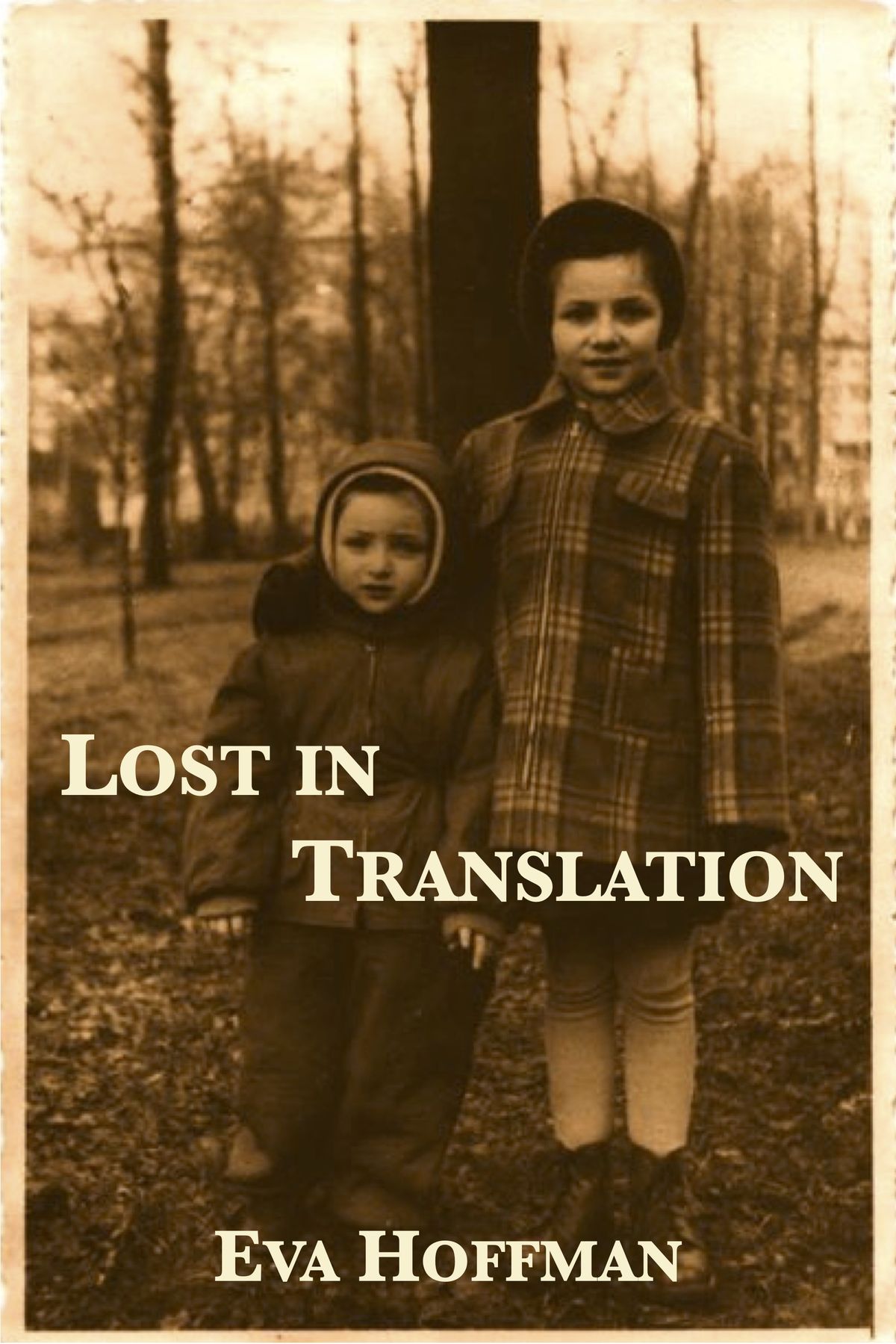
Lost in Translation: A Life in a New Language, by Eva Hoffman. Penguin Books, 2012. E-book edition. All Rights Reserved.