My Experience
When picking the next piece of literature to read, I wanted to try to move away from Mexican immigration stories. As my connections there are already quite strong. When I came across the description of What Strange Paradise, I knew that it would be a good change of pace. It would broaden my perspective on immigration, as my connection to Syria and the Mediterranean is limited. However, as I read, I felt a sense of togetherness in Amir as we traveled from before to after. As El Akkad wrote about the surrounding areas and the effect of colonization within those areas, it reminded me of Mexico.
Classifying My Experience
The best way to describe my experience would be connection. WonderCat describes connection as “Feeling linked or bonded to others in community”. Reading this novel, though it is fictional and I am far removed from the community it is written about, I couldn’t help but feel connected to what El Akkad was showing the reader. Strangely, it feels as though I am not supposed to relate to it. That El Akkad is asking the reader to step back and reflect on how widely affected people are by colonization, almost asking to think of others before ourselves.
Features Prompting My Experience
There are a few passages that resonated with me. Moments that El Akkad was allowing the reader to step back and understand. Almost spoon-feeding the reader some important lessons to understand.
He knew the reason his mother watched these shows had nothing to do with the storylines. Instead she focused on mouthing and reciting the actors’ words, bending and flattening the vowels just so. And he knew the accents of the actors sounded common and vulgar to her, but if she ever hoped to avoid the immigrants’ markup, every last trace of home in her voice had to be wiped clean. She needed to sound like the place in which she hoped to restart her life.
Sometimes when Amir listened to his mother talk with the other women who lived nearby, women who had fled from the same place she had, he heard them say that what really mattered were other things: the color of one’s skin, the country of one’s birth, the size of one’s inheritance. But his mother always argued that what mattered most was to speak in a way that mimicked the majority tongue, to sound exactly like them. And even if those other things mattered more, this was all she could change.
~ El Akkad
This first passage is what first had me feel this great sense of connection to Amir and his family. It highlights how many immigrants feel. The feeling of needing to assimilate so one is recognized as belonging, not as an “other”. I am able to connect to this with my parents. My mom often asks me to only speak to her in English so that she, too, is able to speak like other Americans. I remember asking my mom to chaperone my school field trips when I was younger; however, she often was afraid the children in the classroom would make fun of her accent.
A year had passed since they’d settled in Alexandria. It was a place sick with the ruins of colonial beauty. The new condominiums stood on the graves of the classic British and French and Italian villas, which stood on the graves of the Mamluk palaces, which stood on the graves of the Ottoman mosques, which stood on the graves of the Greek and Roman temples, which stood on the graves of myriad nameless and ancient villages long ago swallowed by the sea. Everywhere these identities warred and the warring produced no victorious identity, no identity at all, only the sense of manifold incompleteness, the universal aftertaste of conquest.
~ El Akkad
Describing the surrounding area, El Akkad provides the reader with something to reflect on. As I was reflecting, I thought to myself, “Wow, the land beneath our feet has gone through so many kinds of people and cultures”. This made me think of Mexico, as when I am there, it is abundantly clear that the land has been influenced by many previous indigenous peoples, as well as colonization from the French and Spanish.
Once, years earlier, Amir’s father told him that none of this started with bombs or bullets or a few stupid kids spray-painting the slogans of revolution on the walls. It started with a drought. You come from farmers, he said, and five years before you were born the earth turned on us, the earth withheld. We are the products of that withholding. Every man you ever meet is nothing but the product of what was withheld from him, what he feels owed.
Don’t call this a conflict, Amir’s father said. There’s no such thing as conflict. There’s only scarcity, there’s only need.
~ El Akkad
This passage truly spoke to me, and I am sure with many others. As for most immigrants, most people do not want to leave home; they do not want to leave the place they know. However, in many circumstances, people have to leave in order to resolve scarcity in their lives. Wanting to better not only their own lives but also those of their future children as well. I am a child of immigrants, and I can only begin to understand what this meant for my own family. I am a product of their sacrifice, and I am the one to reap the benefits.
Narrative Technologies at Play
I feel as though the technologies that play here are a combination of an opportunity to observe and poetic language. Opportunity to observe is described as “constructing a story in which characters display many emotions, perhaps unpredictably, encouraging the viewers or readers to observe and recognize the emotions they are experiencing,” while poetic language is described as “rearranges usual speech so that we slow down and notice things we wouldn’t notice otherwise”. I feel like a combination of both of these could perfectly describe what is happening in the passages above, as El Akkad is using his writing to make the reader slow down and notice things going on in the area through Amir. As a reader, they would have no previous knowledge of what is happening without the narrator specifically calling out these ideas. El Akkad is pushing for us, the reader, to recognize what is happening around us as the story unfolds.
Featured Image
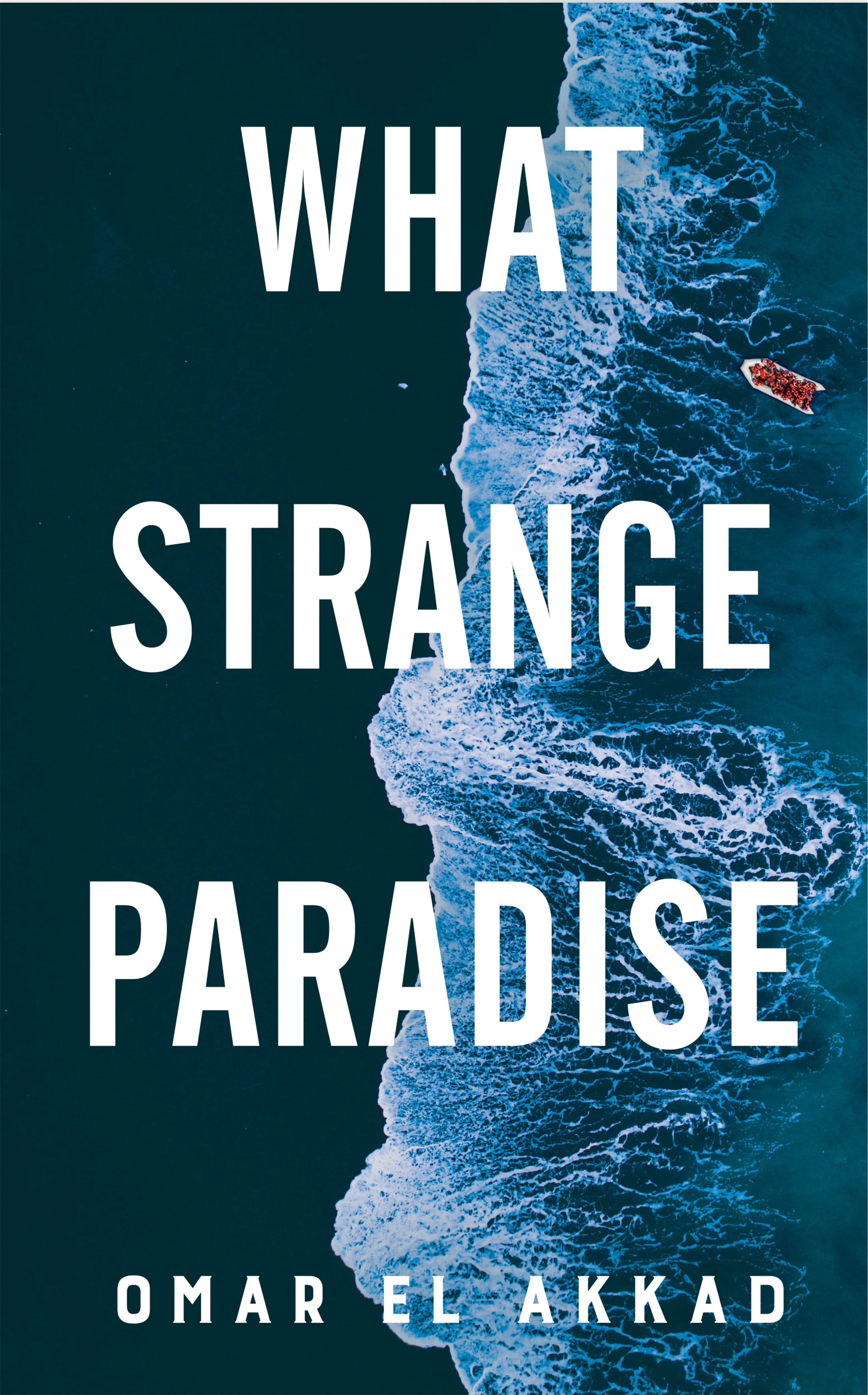
Cover Art. What Strange Paradise. Alfred A. Knopf. All Rights Reserved.