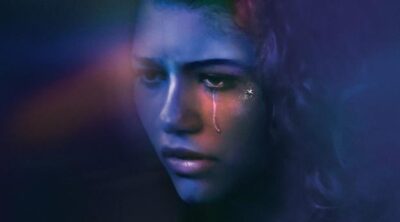
Assuming you’re not a complete rock, you’ve consumed some kind of fiction; a book, a movie, a TV show, something so good you couldn’t stop. How did that make you feel? When it ended, did it stick with you, replaying in your head for hours, maybe days? The best stories always have a message, and if they’re done right, you don’t just understand the point, they pull you into agreeing with it. Now compare that to nonfiction. Have you ever been so captivated by reality, by a report or documentary, that you couldn’t stop thinking about it afterward? I haven’t, that’s for sure. And that’s exactly why fiction is king when it comes to showing oppression, it doesn’t just tell you what’s happening, it makes you feel it.
You Don’t Read It, You Feel It
Nonfiction can describe oppression. Fiction makes you live it.
When you read a history book about systemic inequality, you get dates, statistics, and scholar jargon. Dry. Forgettable. Bs. But when you follow a main character like Katniss Everdeen through a world designed to crush them, something clicks differently in your brain. You’re not observing suffering from a distance, you’re trapped inside it with the protagonist, feeling the walls close in.
That’s not an accident. It’s purposeful. The best fiction writers build oppressive systems so believable that by the time the character breaks under the weight of them, you feel the pressure too.
Three Stories That Prove the Point
One Piece – The Crime of Knowing Too Much
Eiichiro Oda has been writing One Piece for over 25 years, in the manga buried underneath all the plot chaos and ridiculous Devil Fruits is one of the finest portrayals of systemic oppression ever put to paper. The World Government doesn’t just oppress, it erases. Whole countries get their histories deleted from the record. Whole countries get deleted, literally. Entire societies are classified as less than human so the powerful can sleep at night.
You never read a pamphlet about that or a history book like that. You read the main character, Monkey D. Luffy protects his crew from it. Nico Robin, a crew member, spent her entire childhood running from assassins because she had the audacity to read history. By the time you understand what the Void Century actually means, you’re not just mildly opposed to censorship, you’re furious about it. That’s the difference between fiction and reality.
Red Rising – Born Into Chains You Can’t See
Pierce Brown’s Red Rising takes oppression and bakes it into the literal architecture of society. Reds are the color born at the bottom, kept ignorant of their own exploitation, and conditioned to believe their suffering is noble by the golds at the top of the food chain. Sound familiar? It should.
What makes it land harder than any sociology, philosophy, psychology textbook is that you become Darrow. You feel the betrayal of finding out you’ve been a slave your whole life. You feel the floor fall out from under you when the truth hits. No report has ever made me feel personally betrayed by a class system. Red Rising does it in the first fifty pages.
Parable of the Sower – Oppression That Feels Like Tomorrow
Octavia Butler wrote Parable of the Sower in 1993 and somehow made it feel like she was reading a newspaper from this freaking week. Lauren Olamina navigates a destroyed America where global warming suffocated everyone, leading to poverty, and a loss of all laws. Something completely believable down the path we’re heading.
Butler doesn’t cite sources. She doesn’t need to. She just shows you a speculative world and lets you sit with the discomfort of recognizing pieces of it on your own. That’s a trick no non fiction novel can pull off.
What the Research Actually Says
Academics have caught on to what us readers already know instinctively. Alina Tacu, a scholar from Alexandru Ioan Cuza University, wrote the paper “Blurring the Line Between Fiction and Reality: Margaret Atwood’s Use of History in The Handmaid’s Tale”. Analyzing Handmaids tale, a work of speculative fiction set in Gilead, which portrays a government so controlling it seized the United States and rebuilt it from scratch around one thing, stripping women of their rights, their names, and their bodies. The government reduced women to their biological function, to make children, and nothing more. Tacu argues that Atwood’s emotional and connective power comes from making her dystopia believable, making the oppression in the novel impossible to dismiss as pure fantasy. The horror sticks because it has stuck, somewhere, to someone, in real life. Tacu’s analysis makes the case that this blurring of fiction and reality isn’t unintentional, it’s the whole point. It’s what makes the reader unable to put it down, and unable to shake it afterward.
Even Reddit Gets It
Real people, not scholars, not critics, just readers. They say the same thing when they talk about these books online.
You don’t need a PhD to feel this. Regular readers figured it out in the comments section.
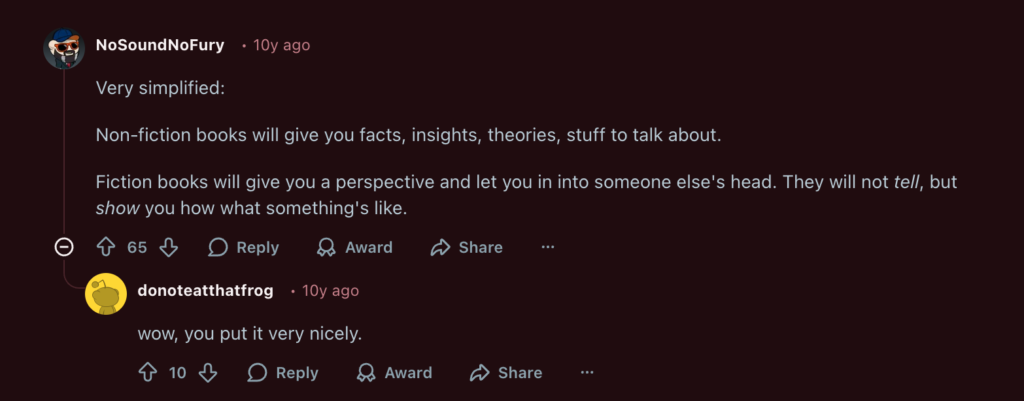
A Reddit user NoSoundNoFury put it simply; nonfiction hands you facts, insights, and theories, stuff to think about. Fiction does something different. It lets you inside someone else’s head and shows you what something is like rather than just telling you. Sixty-five people upvoted that and another commenter just replied “wow, you put it very nicely.” Hard to argue with that.
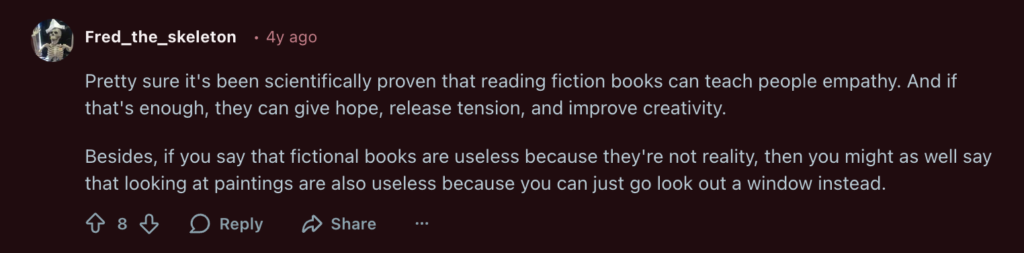
Then there’s Fred_the_skeleton, who pointed out that fiction has actually been scientifically shown to build empathy in readers, and pushed back on the idea that fictional stories are useless because they aren’t real. Yeah sure he’s a random guy with no credible sources or reasoning, but he represents us, the reader. His analogy is perfect; saying fiction is worthless because it’s not reality is like saying paintings are pointless because you could just look out a window. The value isn’t in the literal accuracy. It’s in what it does to you.
That’s exactly the argument. Two random people on the internet, no academic credentials, just readers, and they nailed it.
These aren’t academics making a theoretical point. These are regular people saying; this story made me understand something I never did before. That’s the whole argument, right there in the comments section.
So Why Should You Give A F?
Because oppression doesn’t survive in the abstract. It survives because people either don’t know about it, or they know but don’t feel it enough to care.
Statistics don’t make you care. A well told story does.
One Piece makes you rage at erasing. Red Rising makes you feel betrayed by a rigged system. Parable of the Sower makes you scared because it’s too close to real. No documentary, no report, no academic paper has ever done that with the same consistency, the same reach, or the same staying power.
Fiction isn’t the easy path to understanding oppression. It’s the best one.
Now go read something that makes you uncomfortable. That’s the whole point.
Featured Image Attribution:
Featured image: “Bearings” by Thomas Allen. Used with permission. All rights reserved.