One of the communities I belong to is the community of professors in higher education. And one of the problems this community faces is the fact that students often don’t read the things we assign.
Why Does This Matter?
This is actually a more complicated question to answer than it seems at first. It probably depends quite a bit on the things assigned in a course. Students might not read chapters from a textbook in an economics course, but that might not hinder their learning. I tend to think that if students aren’t reading a textbook, it’s probably because the professor is lecturing on the same material and they don’t think they need to read the textbook. And maybe that is actually true in the case of economics or microbiology or something like that. There are concepts they need to understand, and the reading is meant to help them understand them.
Getting Specific
I need to clarify that I’m specifically interested in the fact that students don’t read the creative works that I assign in my literature courses. There’s a pretty significant difference between literature and a typical textbook. When someone reads a creative work like a novel, or a short story, or a poem, or even watches a film, they’re going to have a unique experience because of the way story (narrative) functions. I want my students to actually read the literature I assign rather than skipping the experience by looking for a summary or relying on what can be gleaned from class discussion. Everyone will experience a story differently and the experience is skipped if you don’t actually read. Imagine shared fake photos from a vacation they never took. That seems a little bit like pretending to read literature when you haven’t actually read it.
Breaking Down The Problem
So, now I know I’m dealing specifically with the fact that students don’t always read literature that I assign. What are some of the parts of this problem?
Time
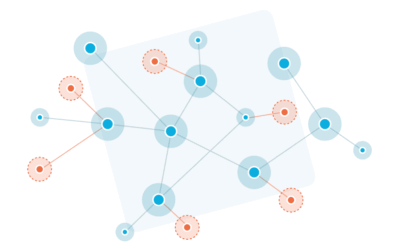
Some students might want to read, but might not be able to find quiet time or space to really get it done. For these students, I want to encourage making time for reading (that is, thinking of it as a leisure activity instead of homework) and I also want to encourage reading in all sorts of different formats. Audiobooks make it possible to read while driving or doing chores, reading on a cell phone also makes it possible to read on the go. This is something I want to encourage and one way of doing this is to track what students are reading, when they’re reading, and how they’re reading. I want to create a visualization of this data that can grow each semester (and I want more faculty than just me to invite their students to share data so the visualization can get more and more representative of the students population).
Motivation
One obvious component of this problem is that fact that some students aren’t interested in the class and therefore aren’t genuinely motivated to read. I wrote about this last week in a blog post for a literature course I’m teaching. In it, I explain all of the ways I’ve tried to encourage students to read. Ultimately, though, each strategy can’t solve the issue of students who are not genuinely interested. And it turns out it’s really hard to be interested in something you didn’t choose. This realization comes from Angus Fletcher, an English professor at Ohio State whose book, Wonderworks, has led to a big breakthrough in my thinking on this issue. Maybe the problem is that students don’t want to read things that are assigned. Fletcher explains a lot of his main ideas from the book when interviewed for this podcast:
I think Fletcher makes a persuasive case that assigned reading is a significant part of the problem. English professors are making literature less enjoyable by assigning specific texts and guiding students through the process of interpretation, but he doesn’t really offer a solution to the problem.
Recommendations
If assigned reading is the problem, the next step would seem to be removing reading lists from literature courses. But if we do that, how will students decide what to read? This is going to be the biggest challenge to solve, but I’ve got an idea in the works. I started by reaching out to Fletcher to ask him how he practically solves the problem of assigned reading, and this has started a collaboration. He’s excited to work with me to figure out how to make his ideas practical in the classroom. My idea on this front is to create resources to help faculty recommend specific stories to students based on their interests. The start of the semester will involve students selecting a writer that they love (whether that person has created a novel, a poem, a song, a film, or something else). It’s then the professor’s job to make recommendations to that student based on things that genuinely interest them.
That sounds like a lot of work, right?
I agree.
I’m trying it this semester and I’ll keep you all posted on how it’s going. As I test this out, I’m going to be identifying more parts of the project and bringing more disciplines and methodologies into the mix.
Works Cited
Faulkner-Hogg, Ryan. Curious Worldview Podcast. 27, https://open.spotify.com/show/61wcpA8fkOQCAGrOfHgkig. Accessed 19 Jan. 2024.
Fletcher, Angus. Wonderworks. Simon and Schuster, 2022. www.simonandschuster.com, https://www.simonandschuster.com/books/Wonderworks/Angus-Fletcher/9781982135980.
Isbell, Mary. “How We Read.” Modernisms, https://unewhavendh.org/modernisms/2024/01/02/how-we-read/. Accessed 22 Jan. 2024.