Introduction
After reading Fair and Lovely by Scaachi Koul, I was completely blown away. I had one of those moments where you need to sit and think for a while afterwards to properly process what you’re feeling. As an English major, I have to read a lot for classes. I thought that by now I would feel less surprised by works like this, but my astonishment continues to be just as strong. Koul elicits gut-wrenching internal torment in a way that has you marveling in her technique.
I discovered this piece through my Narrative Nonfiction class, and it was actually my first taste of the genre. This piece is very narrative-heavy, with the author’s family members and herself being distinguished characters. This structure read through like a short story, which made my experiences similar to reading a piece of fiction.
Fair and Lovely is a personal essay by Scaachi Koul, who is not an immigrant herself but is the child of Indian immigrant parents. This essay focuses on Koul’s realization that colorism and racism heavily impacts her life. Within the narrative scenes of both India and Canada, the author learns that she both had disadvantages and privileges being both naturally Indian and somewhat white-passing. She also gains new and complex perspectives about race as she grows up and observes her young niece who has a different experience than her. Koul’s essay is the first I’ve seen go into depth of the nuance to colorism and racism. This surprised me, because it’s not a topic I see talked about let alone written so well. Like Koul says towards the end of her story:
Our inability to talk about race and its complexities actually means our racism is arguably more insidious.
Koul, page 73
Understanding and Classifying my Experience
Above all, I was in awe of Fair and Lovely. As an English major, it’s hard for me to read something this powerful and not feel like I was just hit by a bus. And then peel myself off the street to dissect it. I have never read anything before this that has so successfully captured a very complicated topic: A child of immigrant parents who is learning how to see herself and the world around her through the effects of generational and societal racism. Koul’s narrative works with skillful potency. One large theme of the narrative’s arc is how she compares her race to her niece’s, in both the context of how they and their family view themselves and how the world sees them. This concept is constantly bouncing back and forth, and brings new and nuanced challenges while the characters visit India and come back to their home in Canada. This kept me on my toes the entire time while holding incredibly intense tension. Here’s a quote I love about Koul’s niece:
Her race is the footnote instead of the title . . . her race seems tangential to her existence, hardly something she examines but, rather, something the rest of us have put under a microscope from the minute she started gestating in her mom’s insides.
Koul, page 62
Koul’s niece, who is nicknamed Raisin, is half white. Raisin has pale skin, light brown hair, and blue eyes. But she also has Indian heritage and an Indian name. Koul realizes that Raisin’s relationship with her race is all the different from her own. Earlier in the essay, Koul reflected on how overtly aware she was of her race even at an early age, but it didn’t fully click with her until kids started to make racist comments to her which permanently soured her relationship with herself. Raisin being able to pass as white and live without much influence of her heritage means she didn’t have to think about her race. However, Koul’s Indian family praises Raisin for her desirable features. She has inherent privlege that Koul finds herself being envious of. Even within their own culture, Raisin is seen as being more “acceptable” for being lighter.
This devastating realization sets readers up for an opportunity to observe. In this moment, I felt like I took a mental back seat and watched the gears turn in the author’s brain to make sense of what she was realizing. This was her discovery of the kind of carnal presence colorism has, with a description of Koul’s family wondering what Raisin will look like before birth.
I was eighteen when she was born and I objectively knew whiteness wasn’t better, and yet, weren’t we lucky to have a little white girl whose life would never resemble our own.
Koul, page 62
This is an incredibly uncomfortable truth, and I think that this level of detail and discomfort is what allows a broad audience to understand Koul’s perspective. Being more personal in a piece like this creates more connection for the reader. The author mentions Raisin many times as a kind of anchor to the essay and a way to transition back into the personal narrative. Raisin functions as a kind of motif to further remind the audience of the nuances of race. I think that Raisin, above anything else in this essay, is the best way Koul conveys her message.
I experienced a lot of connection to this piece. I felt like I could be part of this world and gained a deep understanding of the author’s mindset. While I have not had the exact experiences of the author, I am half Filipino and have made several discoveries about colorism from in my culture too. This goes deeper than feeling simply morally obligated to confront our society’s underlying racism, but Koul gave me the takeaway that even a minority experience can be broadly related to. Like Koul, I also had a kind of “aha” moment in terms of realizing who I was when I was a kid. This quote summarizes that feeling when Koul went to summer camp:
One girl turned to me, flipping her long brown hair over her shoulder, and asked,
‘Why are you sitting with us?’
‘Why not?’ I said.
‘You’re brown.’
Ohh, I thought, so this is what it is. This was the difference felt but rarely spoken.
Koul, page 59-60
I can relate to the last sentence especially, of being able to feel something without having the words to explain it. It really puts into perspective how subtle racism can be, underlying every interaction we have. It doesn’t need to be explicitly said to be felt.
Overall, this piece changed something in me and made me think about things I hadn’t thought about before. I especially have never been able to put these kinds of things into words. I teared up at many parts of Fair and Lovely, because even though I can somewhat relate myself, this essay is written in such a way that anyone can be put in the shoes of the author and understand the complexities of identity. It touches on very heavy and uncomfortable topics, but Koul’s skill is why this is received so well.
Literary Devices that Prompted my Experience
Koul masters humor for this essay. In some examples, it mixes humor and discomfort together. This creates a dark sense of irony. This can create an uncomfortable tone, and Koul uses that to her advantage by evoking our curiosity with it. She creates a tone where it’s okay to be uncomfortable, and while there are more serious examples of discomfort, the irony eases readers into difficult emotions and make them ask questions. The very first line of this piece is dark humor, and is in my opinion a perfect first line because I really don’t think you can draw in an audience more than saying:
Like farts and the incorrect retellings of classic literature, racism is a lot cuter when it comes out of a little girl.
Koul, page 53
I love when authors lead with shock factor mixed with humor, because for me, that usually tells me I’ll really enjoy the rest of what they wrote. This first line instantly drew me into the rest of the story. It told me I was going to go on one hell of a ride with Raisin repeating the racism she heard around her as an impressionable child. Which is an awful thing, but it also reminded me of the innocent nature of kids. Adults have full agency and meaning of their words, but kids are just learning by who’s around them. So it would be more precise to say that Koul uses irony here to draw the reader in, since there is a huge contrast between these subjects. She succeeded in making me feel very uncomfortable, but simultaneously made me curious about the rest of the piece.
This piece maintains a constant stream of tension, with many moments much more intense than others, but Koul is able to keep readers invested with humor. This is a fantastic technique to make a piece like this less tense. It provides the perfect break from heavy topics.
I thought about how much money it might cost for a nose job . . . make the tip pointy like a ski jump. (White people love skiing; they’re always doing weird shit with snow).
Koul, page 61
This was one of few points in the essay where I did giggle out loud a little. Of course, an essay like this isn’t one that’s supposed to have you rolling on the floor the entire duration of reading it like something by David Sedaris. But having small jokes keeps the piece from being too heavy. If it’s too heavy, the reader is going to lose interest at some point. If this piece had no humor, it would be dark and depressing which can make readers feel bored. Koul is able to place her humor perfectly while maintaining the serious tone, for example this quote is of the author confronting the things she has wanted to do to erase her ethnic identity. This quote is very well-executed if you really think about it. Koul isn’t just poking fun at white people, she utilizes the joke to mock how she wanted to change herself. She is criticizing herself here for wanting to do something equally as stupid as whatever it is white people are doing with snow. Very, very smart use of humor. I find this style of writing it particularly impressive.
Reflecting on exactly how it made me feel and what techniques were used to achieve that only heightened my appreciation for Fair and Lovely. It says everything society is too scared to say. I believe we all need to re-examine our relationship with ourselves and identity. While this essay ends on a lighter note, the stream of tension isn’t lifted away. There is no one magical fix for these generational and systemic issues, but they need to be regularly revisited and maintained. Everyone deserves to be proud and comfortable in their own skin.
Works Cited
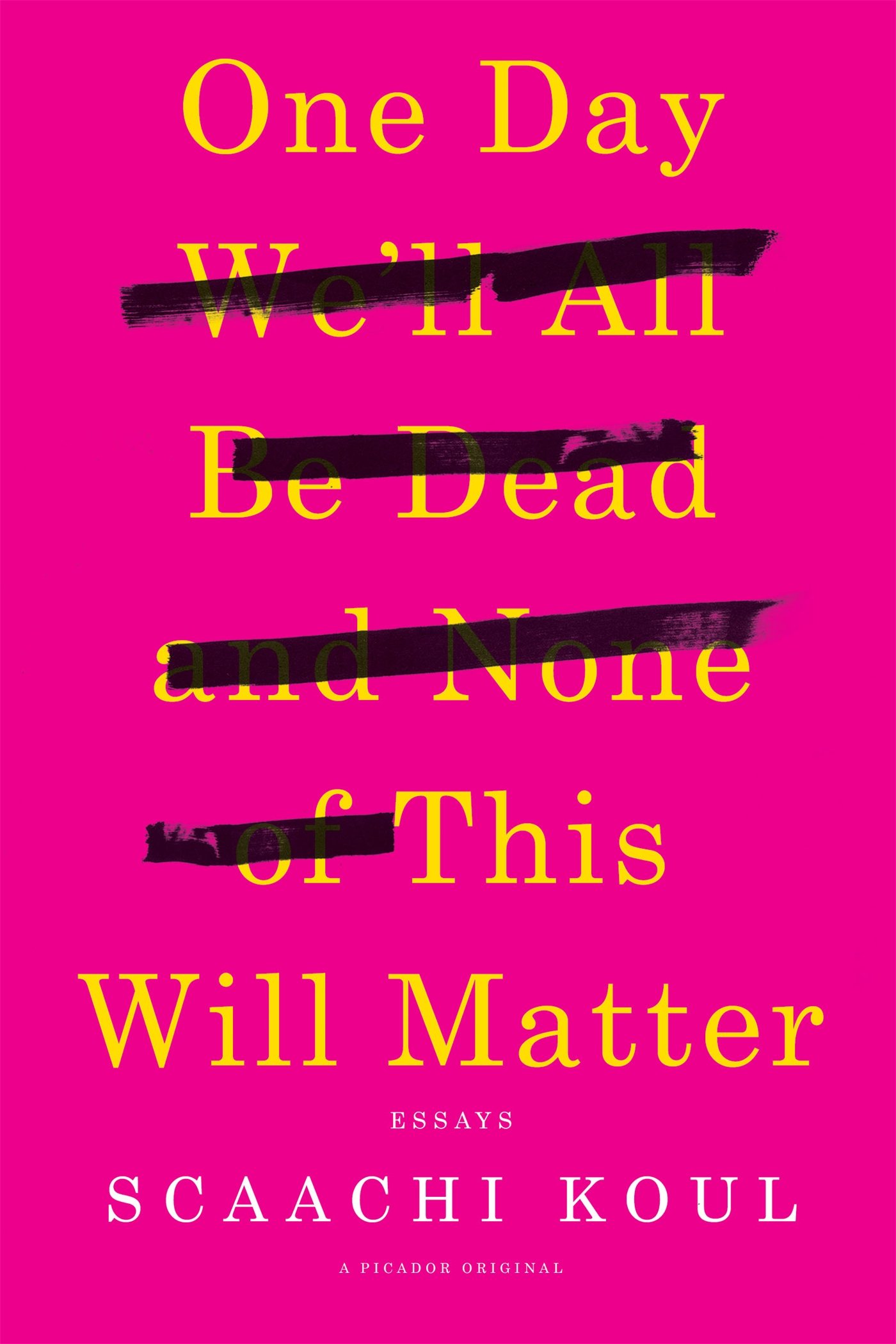
Koul, Scaachi. One Day We’ll All Be Dead and None of This Will Matter: Essays. Picador Books, 2017.
Featured Image
One Day We’ll All Be Dead and None of This Will Matter: Essays. Picador Books. All Rights Reserved.