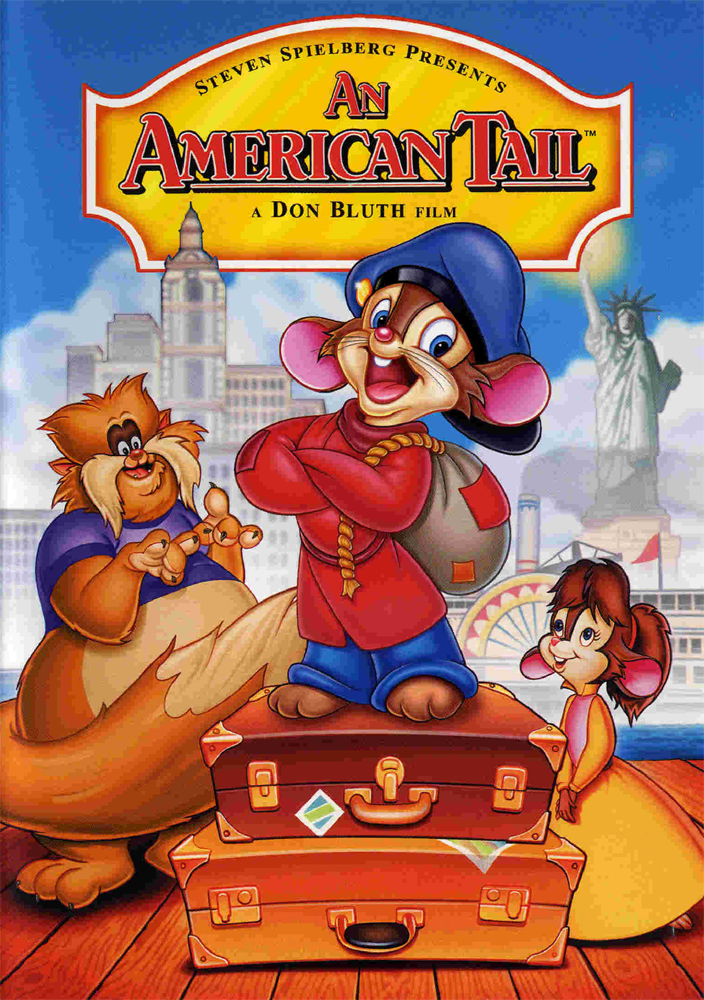
I shared on the first day of class my dilemma about this first assignment. Because I want to encourage you all to write about a story that had a significant impact on the way you think about migration, I’m writing my example post about an animated movie from my childhood: Don Bluth’s An American Tail (1986). This film is not the most sophisticated depiction of immigration, but that’s not what matters most. What matters most is that I think through how this movie made me feel SO SAD for a little mouse who got separated from his family in New York City.
My Experience
What I remember about An American Tail is that it made me cry. Fievel was a tiny little mouse and he got separated from his family on their ocean journey from Russia to the United States. Before rewatching the film, my recollection is that I mostly felt sad for Fievel. I was horrified that something so awful could happen to a child. I had a similar reaction to another Don Bluth movie: The Land Before Time (the scene when Littlefoot’s mom dies…oh boy…so many tears).
Classifying my Experience
I think the thing I felt was distress, which our glossary of experiences defines as “anxiety or mental suffering that you have not chosen.” I sat down to watch a movie, I was amused, and then I was crying. I know I had many other emotional experiences with the film, but that is the strongest one. I actually think a better term for the experience I had would be pity, which isn’t in our glossary, but is defined in Wikidata as “sympathetic sorrow evoked by the suffering of others.” “Distress” suggests that I suffered, but I really wasn’t suffering–I was just feeling for a character who was suffering.
Describing the Features Prompting my Experience
As I try to think about what prompted this experience of pity, the first thing that comes to mind is the plot. A young mouse is separated from his family, forced to fend for himself in a cruel world filled with dangers. I think it’s pretty common to have a vulnerable child in a story like this.
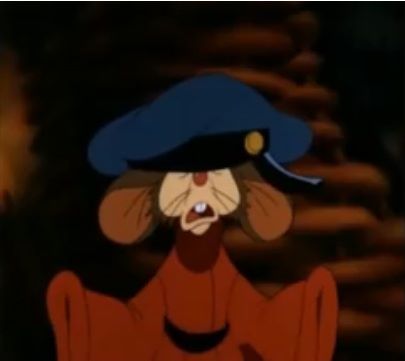
But it’s more than just the plot. It’s also the fact that Fievel is really really small. He gets a hat from his father that is way too big for him and he’s just a lot tinier than everyone he encounters. This is not to mention that he’s an anthropomorphized mouse. This movie is telling a human story with animals, something we see happening in countless stories for children.
Before rewatching the movie, I would’ve said that the feeling of distress or pity was caused by the song “Somewhere Out There.”
Rewatching the movie, though, I realized that the song is fairly hopeful. He sings it right after a new friend encourages him to hope that he’ll find his family. And then the song is actually a duet. As Fievel sings his sad song, his sister is also singing it. His parents think he is dead, but his sister believes he might be out there. Though I thought this song (the most memorable thing for me about the movie) was the source of pity, I actually don’t think it was. Instead, I think it was all the moments when Fievel seemed really alone and vulnerable. This happens at lots of moments, but most notably in the final scene of the movie, when it seems like he’s never going meet up again with his family. He looks the most small and cold and vulnerable in this scene.
But of course, the scene changes and he is reunited with his family, which prompted relief for me as a kid. Our glossary defines relief as “the easing of distress.” Honestly, though, watching this movie as an adult it felt pretty unsatisfying…most happy endings feel a little cheap because they seem unrealistic. I’d kind of like to see Fievel figure out how to make it on his own with courage and cleverness even if the worst is actually true. That’s what happens in The Land Before Time (Littlefoot’s mother is actually truly gone and he figures out how to push through that pain).
Determining the Narrative Technologies Prompting My Experience
After looking at the features and the glossary of narrative technologies, I’m not sure there is one yet to describe the thing that made me feel pity for Fievel. I think something like “Vulnerable Character” could be created, though. I just encountered it this week while watching Causeway, an incredible film about a woman processing trauma after a deployment in Afghanistan. Someone put the full opening montage of her recovery on YouTube. The two stories are very different, but they both feature powerful scenes in which a character seems completely weak and vulnerable. I explained above that the feeling of pity turned into relief at the end of the movie, and that relief was prompted by poetic justice, defined in the experiences glossary as “A plot technology of having good things happen to “good” people and bad things happen to “bad” people.” The cats were punished (except the totally adorable good cat, who helped the mice) and Fievel was reunited with his family. All will be okay. According to this movie.
Extra
I also have to mention something totally unrelated to the feeling of pity (so this is extra! you only need to think about a single experience in your post). When I rewatched the movie, I had an overwhelming sense that these mice have no idea how wrong they are about opportunity in America. This was most apparent in the song “There Are No Cats in America.”
The fact that there are many characters (the mice from all different countries singing this song) who believe that not only are there no cats in America, but the streets are paved with cheese. COME ON. And I think the experience I had while watching this was Self-Irony, which our experience glossary defines as “Recognizing that you resemble a character being satirized in a story. Because you recognize that you are not perfect, you are able to laugh at yourself.” As I listened to the mice sing, I thought of all of the times I’ve had overly optimistic expectations and I was able to chuckle at my own ignorance. We know that things are not going to go well for the mice, but they don’t know. This is prompted by Irony, which the technologies glossary defines as “Revealing a truth that a character (and also the reader) doesn’t see” or revealing that a character doesn’t see something that the reader can see (while nudging readers to notice what they are missing in their own lives).” My kids were hip to this irony too. My six-year old said “we definitely have cats in America.” And he is so right.
Featured Image
Poster for An American Tail. Universal Pictures. All Rights Reserved