My Selection Journey
When embarking on my selection journey for this week’s post I had a plan in place. I had gotten, after an abundance of struggle, a student library card that would allow me to check out books for the semester. I went to the library planning to get one of eight or so books that stood out to me from WonderCat and other word of mouth such as Ulysses. When I arrived at the library, it was quite busy and thus overwhelming as I was unfamiliar with the layout and unprepared for my search as I knew titles but had forgotten that books are arranged by author’s last name. However, I was able to do a quick search and gather the names of the authors whose work I was interested in. My efforts were futile as the library did not seem to have any of the eight books I had in mind, so it was time to adjust the plan.
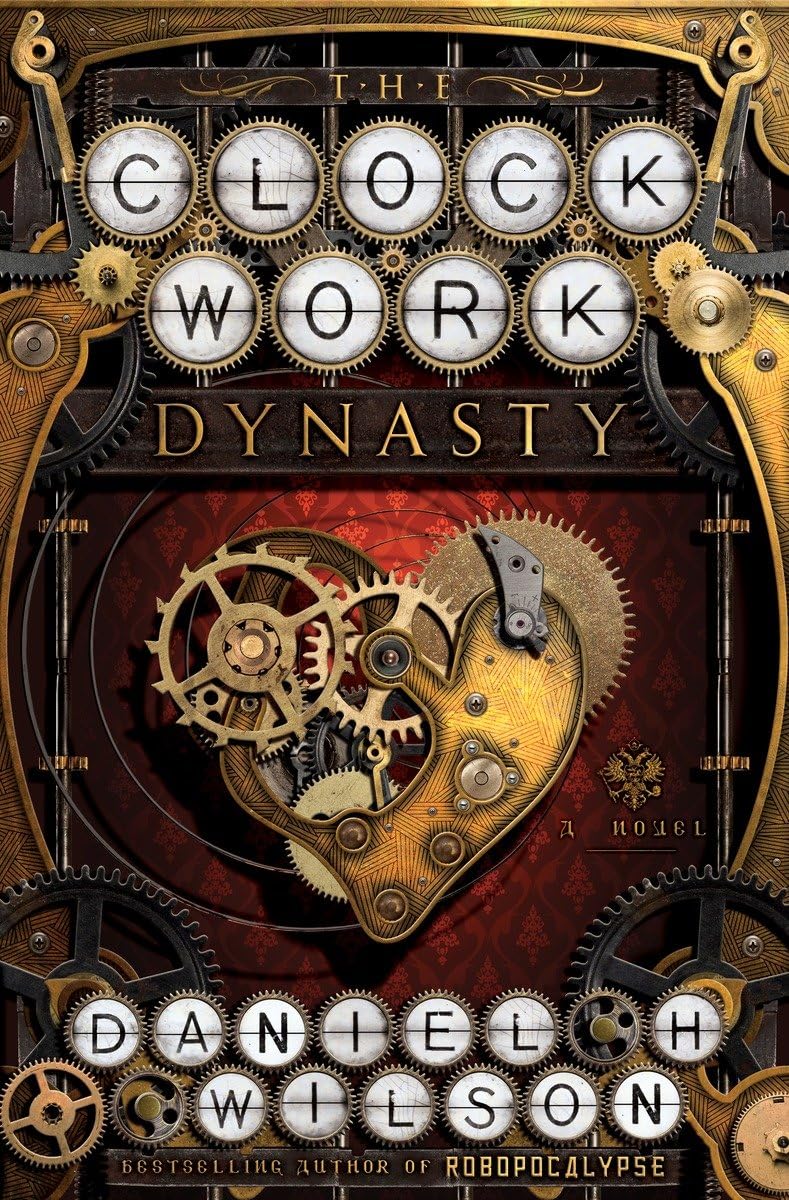
Flustered in aisles of books and crowds of adults I decided to go to the furthest shelf and begin selecting random books off the shelves. I picked up many books that looked enticing, some I put down because they were so far out of my interest and some I put down because they were too within my realm. I found the book Escape Room and lit up; this book was the inspiration for one of my favorite movies which I had never realized was based on a book. Of course I had to have it, so I checked this one out, but not before finding a book that was less of a cheat since I had seen the movie adaptation quite a few times already. After looking through a couple of murder mystery and romance books (things I would never read on my own time), I stumbled across a book spine that featured gears, catching my attention as I love the steampunk aesthetic. Picking the book off the shelf I found that it featured a heart made of gears as the focal point of the cover, titled “The Clock Work Dynasty” by Daniel H. Wilson. I had to do some research to make sure this was not a series, but to my pleasant surprise it appeared to be a one and done book. The book appeared to be a science fiction thriller, something I would not read on my own time, but was still enough to prompt curiosity and maintain my interest- a perfect pick. This is how I ended up going into the bookstore hoping I would find an acceptable Winnie the Pooh book and ended up with a story about machines coming to life and committing mass murder. Perhaps next time I will be able to find Winnie the Pooh or Ulysses.
Describing my Experience
The Clock Work Dynasty has filled me with paranoia and left me with suspended judgment. This story is separated into three sections of which I have only finished the first (15 chapters) so far. The book is complex with points of view, story worlds, and timelines shifting between Moscow in the early 1700s and the “present” in Oregon. As someone unfamiliar with the government structure and technology of Russia during this time, I initially faced a lot of confusion but caught on pretty fast. The story shifts from the life of a mechanician working to build and sustain automatons (essentially machines that mimic human beings which, in this case, are hyperrealistic and have cognition mechanisms programmed into them) in Moscow during the 1700s and a young automaton researcher Ms. June in the “present” who has been put in danger by her progressing findings. There are so many questions not yet answered, and I am eager to search the pages to discover more of the interworkings of this world where machines blend in with men. However, this story does not captivate me as much as my typical picks for books, movies, and songs do. There is no personal connection and thus no identification, leaving me a bit distant from the story. While the story is enjoyable, I would not yet deem it worth my time.
After 3 sections (55 chapters and an epilogue) equivalent to just over 300 pages, so much yet so little has happened. I finished the book! So, how has my experience evolved? Well, to begin, the story world expanded exponentially with going back as far as 3000 BC and across the world including through London, China, and India. The story goes back and forth between two narrators who both utilize the I Voice, Ms. June’s perspective is always the “present” version of the story, but the rest of the story is told by the automaton Peter. Peter, Pyotr, or Lu Yan (all names of the same automaton, varying with time period) was alive since before 3000 BC, died around that time, came back in the 1700s, and lived long enough to meet Ms. June in the present. In a complicated way, the story develops to become a story in the story with Peter featuring in both his own narratives as well as that of Ms. June. Throughout my journey through this book, my experiences were mostly consistent- paranoia, suspended judgement, and confusion all till the last page. Reaching the end, I would experience frustration and being wrong at the conclusion of the lengthy story.
Classifying my Experience
Just in scratching the surface of this book, I faced an abundance of experiences. First of all, I experienced being wrong as my expectations of the automatons as misunderstood machines who had to blend in amongst humans that disproved of them was inaccurate. While in the 1700s this was experienced briefly, it seems that the arc of this story is that these machines (automat) have become the villains of the story due to their desire for eternal life and fear of human disruption. The experience that keeps me flipping the page and determined to make it to the end of the story is my curiosity as there are so many questions left unanswered. Similarly, I am experiencing substantial suspended judgment, namely toward the automatons as in the 1700s they appear to be rather moralistic and sympathetic, but it appears that there might be a shift in their nature or at least some automat that are good while others are more evil. Even with those that appear more kind-heartened and moralistic, I am facing hefty skepticism.
Furthermore, I am still experiencing some confusion with the story world and various aspects of it such as the technology that allows the automat to think and feel. While reading I often face intense immersion which contributes to notable eustress and paranoia as the true strength, purpose, and motivation of the automat is unclear, but they are omnipresent. During one specifically intense scene I also experienced righteousness as a man, seemingly a burglar, attempts to rape a young automat modeled as a little girl (Elena), but gets frustrated by the discovery that she does not have the expected and required anatomy for such immoral actions.
Now that I have finished the book, I can declare that I experienced some level of confusion and paranoia throughout, mainly at the beginning, but even to the last page. As the pages dredged on, I experienced less immersion and rather had to battle some mind wandering as the book featured notable repetition and grew much less captivating. I would argue that the beginning of the book was far more interesting than the other sections/chapters. In fact, when reaching the end I experienced significant relief that the book was finally over along with a sober uplift and increased self-efficacy as this might be the fastest I have ever read a book, especially one of this length and I did so while incredibly busy with various other jobs, tasks, and classes. However, the actual contents of the story were lack luster and left me not only being wrong in many ways but also experiencing some frustration.
Features that Prompted my Experience
This story is quite difficult to quote as there is abundant description and needless details that, while they benefit the experience, are not fulfilling to quote. As the story goes on, this only becomes more prevalent with tens of pages of repetitive material that adds little to the story and lacks captivation. Nonetheless, the main source of my curiosity and confusion lies within the cognition of the main automaton (later named Peter). Peter, shortly upon creation/reanimation (it is a bit unclear whether the mechanician restored or created Peter) grew conscious of his place in the world.
And now I truly begin to understand that I am also a thing in this world. Not like the doll who is writing a few feet away with all the mindfulness of water choosing a path downhill. Something more. But also not the same as this fainting man, made of soft flesh. Somehow, I am. And, I tell you, I find it a strange thing, to be… From within this little world in my head, I am making decisions.
“The Clock Work Dynasty” – Daniel H Wilson (pg.15, chapter 2)
Peter’s notation of the evolution of his understanding and perception of the world around him is stunning and captivating, begging various questions and providing no answers. Peter continues his assessment, making further claims to what is present through his programming.
Somehow this knowledge is already in me. Half-formed body parts are also sprawled along the clutter. Chunky torsos filled with fine gears, supported by whalebone ribs and riddled with veins of India rubber. This place is more than a workshop… it is a womb
“The Clock Work Dynasty” – Daniel H Wilson (pg.15, chapter 2)
As Peter notes his own birth and its place of conception it becomes more clear what he is made of (whalebone ribs, gears, rubber), but emphasizes the question of how he already has so much understanding of the world. What is in him that provides him with the ability to think, speak, and make decisions? It is made clear that Peter is programmed to follow the Word aka “Pravada” which implants the purpose of truth and justice at the forefront of his consciousness, a value he is unable to deter from. However, how was this implant created? What is it made of? Is it possible to override the programming? There are infinite questions, and two sections of the book left.
After reading the following two sections the meaning of Pravada has expanded. Peter speaks of a need to follow a ruler, to have a master who will determine the justice that he will fight for. However, as he grows (goes through time, he technically cannot grow in any sort of traditional fashion), he becomes more enveloped in his word until finally choosing to defy it and come up with his own sense of justice. Peter expressed many emotions, but if he is a machine, where do these come from? Does Peter have a soul? How could that be made artificially? This is the greatest source of my curiosity and confusion.
“Peter has gone into hibernation, so he must be hurt badly. We can repair his body. But I cannot speak for his soul”
“The Clock Work Dynasty” – Daniel H Wilson (pg.149, chapter 27)
“Peter’s anima, the source of his power and reason, has been knocked loose of its cradle. The last of his energy stores have leaked away. His hibernation will last another few days, and then he will fall into the long sleep.”
“What can we do?”
“We have repaired his body, but it is not so easy to replenish his soul.”
“You’re talking about that thing in his chest, with the symbol?”
“Each automat has a unique anima- our mind, memories, and will.
The symbol written upon it is his true self, the Word he lives by.”
“Without the mind, the body is dust,” says Batuo.
“A vessel without its anima is but a husk– it cannot perceive or act. But when placed in the cradle of its own unique vessel, anima will express itself as…
automat.”
In a flashback to a war in India in 1751, Peter is even capable of experiencing remorse. Peter is able to identify what he deems justice, and what he deems unfair. Interestingly Peter appears to hold notable sympathy for animals, an unexpected characteristic of a literal killing machine. Peter killed countless people, most without sympathy. Yet, in this war Peter faced an opponent worth guilt and disappointment. Similar to Peter, I was also sad during this scene- I would not quite characterize it is an empathy generator, but it definitely pulled my heart strings and revealed more of Peter true nature.
Farther along the wall, a contingent of sepoy pikemen are closing in on our main gate, spurring gaudily decorated war elephants onward with jabs to their quivering flanks. The elephants are a horrific sight, faces wreathed in iron masks, tusks capped in gold, huge armored foreheads already butting into the wood of the gate. If they knock down the barricade, our camp will be flooded by thousands of enemy.
Time slows for me, the seconds counted off by the metronome of gunshots
Loading my musket, I steady my barrel with a steel grasp and fire a precise shot at the nearest elephant. I ignore the hundreds of human attackers and the splintering gate, targeting the beast’s tender ears, vulnerable to a lateral attack. My first few shots send the lead elephant rearing back in confusion, disturbing its brothers. The monster is graceful and intelligent, and a sadness settles over me as I keep firing.
The beast squeals and thrashes back, lungs heaving in its chest, its trunk dark with blood as it crushes the pikemen attempting to drive it forward. The attackers scream as they fall, writhing like insects under the weight of the panicked elephants, staggered by withering, ceaseless gunfire from the walls.
“The Clock Work Dynasty” – Daniel H Wilson (pg.153, chapter 28)
After this battle is when Peter begins to determine that he has been pursuing Pravada in the wrong ways and in the wrong places. A declaration is made that he will now follow his own Pravada/sense of justice and will not continue fighting in these meaningless wars.
As I journey through these worlds I am immersed in the eustress and paranoia, skeptical of everything and everyone. Who is an automat and who is not? Whose word can be trusted and whose is a well-conceived fallacy? Take Oleg, Miss June’s translator who attacks and threatens her.
“They are dying,” he says, voice muffled. “The long-lived ones will do anything to survive. They control everything. They know everything.”…
“You tried to kill me,” I say.
Oleg rolls off the bed and onto his knees. He looks up at me, hair wild, blood smeared on his face. Blue and red flashes of light from police cars outside roll off his gray skin. His hands are clasped together, as if he is praying.
“I tried to protect you,” he says. “You learned their name.”
“Whose name? I ask.
“You should run from here. They are coming.”
“Who!? Who is coming, Oleg!?”
“Miss June,” he says, tears in his eyes. “It’s the automat.”“The Clock Work Dynasty” – Daniel H Wilson (pg.44, chapter 7)
Again, there are so many questions left unanswered. How many human minions like Oleg do the automat have? How many automatons are there and how are they so mobile and undetected? Is something like this possible in the modern age?
Immersed in the complexity of the doll, I wonder again why people assume the most advanced technology is yet to come. Two hundred thousand years of human history lurk in the darkness behind us; unknown knowledge, gained and then lost. And then, just maybe, regained
“The Clock Work Dynasty” – Daniel H Wilson (pg.24, chapter 3)
Miss June poses a meaningful question here which perfectly puts into words my exact drawing to this book. As technology progresses with time and we see frightening developments in artificial intelligence, one must consider whether the science fiction stories that depict horrific consequences of advanced technology are plausible. Will science fiction become nonfiction, is it our future reality? Who is to say that every single person out of the billions on the planet are entirely, purely human? That there is not a single automat amongst us? While that is quite a radical conspiracy theory, it is not entirely far-fetched and, as Miss June indicates here, we often fail to give adequate credit to old forms of technology. The unthinkable has often become possible over the last centuries and humans should learn to expect the unexpected and to anticipate the impossible.
Finally, it is important to note that at this point in the story I have yet to determine which “side” I am on. Are the humans the victims in the scenario? Are the automat? Or is it not so simple? I imagine it is more complex than a black and white scenario with the automatons being mixes of good and bad, making it a game of differentiation. As such my suspended judgement is still at play. How evil are humans? This story does not paint them (us) in a positive light, it poses humans as a vile threat to the automat. For example, take the source of my righteousness– an outrageous scene depicting the horrors of man.
He squats next to her and whispers something.
I continue dragging myself forward. My dirt-stained cuirass crunches over stalks of grass as I pull myself over the periphery of the camp. But the rider is not listening for danger. He is pushing Elena silently onto her back, a forearm pressed to her neck. Untying her ankles, he roughly spreads her legs.
The man is grinning, teeth glinting red in the dawn.
I pick up a helmet as I pass the man’s sleeping mat. One urgent, broken lurch at a time, sliding through wet grass, I plant the metal bowl of it into the dirt and drag myself forward. The armored hat is made of steel, fur-lined and peaked in the middle.
“What?” the bandit exclaims, recoiling onto his knees as he finds nothing beneath her cloak but the cold anatomy of clockwork.
“What- what are you?”
At the last moment, he turns, his dark curly hair rusty in the morning light– eyes widening at the sight of my ruin, cheeks twitching in fright. I am rearing back on the remains of my left elbow, helmet lifted high in my good hand. The man is choking on a shout as I bring the helmet down.
The metal bowl glances over the bridge of his nose. His jaw snaps shut and he starts to fall, fear and blood mingling on his face. Elena kicks with both legs, sending the rider flailing onto his back with a grunt, the air knocked from his lungs.
I bring the helmet down again.
This time it lands with a wet crunch in the middle of the rider’s face. Again. A half dozen more times until I feel the skull crack and the grass is littered with teeth and blood and saliva.
I hear a gurgling scream from across the camp and see Elena is on her feet. Acting on an assassin’s instinct, she has freed her hands, tugged her stilettos free from the fallen rider’s pack, and pierced the hearts of his companions. In moments, there are no men living.“The Clock Work Dynasty” – Daniel H Wilson (pgs.79-80, chapter 14)
Until this, Peter and Elena were not portrayed as killers and had high morals, they had clear programming. Here, their programming still emphasizes the protection of one another and the value of justice. Who is in the wrong here, the automat or the bandits that attacked them and kidnapped the child among them? Or is it simply not that simple? Can the automatons be blamed for their actions if they are programmed to think a certain way and act in a specific manner as a result? How different is the automat from the human if the automat is capable of decision making based on values and lessons?
More light is shed on the true nature of the story world as questions begin to be answered. Ms. June is informed that the automatons used to be much greater in number but have dwindled recently due to the Worm Mother hunting and consuming them, leaving dozens or less left alive. Peter learned of this again in 1757.
“There is a war between ancients and we are caught in the middle of it. Leizu, mother of silkworms, is of the progenitor race–known to the ages of man, extending her life span by preying on other automat. Leizu wears the anima of the vanquished. If she finds you, she will consume your soul.”
“The Clock Work Dynasty” – Daniel H Wilson (pg.176, chapter 32)
Here, it appears the enemy is Leizu, but as time goes on it is revealed that things are not so black and white. Where there was once simplicity grows complicated as we learn of Peter’s true, original master Huangdi- Leizu’s husband and counterpart. Huangdi was in hibernation due to the loss of his anima, found and replenished by Ms. June under the command of Peter. I experienced being wrong as I did expected Huangdi to be a good character, a savior. Huangdi was meant to personify Yang and light, yet he became monstrous.
This is wrong. My master has betrayed us. He is feeding. Huangdi is standing now. His chest is open, his anima visible on its cradle as waves of light fall into it. He has drawn his divine blade, Xuan Yuan.
“The Clock Work Dynasty” – Daniel H Wilson (pg.280, chapter 50)
This battle is where things get muddy. What exactly occurred, I could not tell you. Ms. June and Peter won the battle by trapping and murdering Huangdi, Leizu, and both of their soldiers in a cave collapse…? A very odd way to end the story which provided no real satisfaction but did invoke some frustration. I read this and gained what exactly? Now that these automat are out of the way, the story comes to an end with a revelation.
The three of us form a triangle at the table. I find my voice sticks to the back of my throat as I realize that it’s really true–I’m a part of this hidden world.
And now, I’ve got the chance to save it.
“We found something in the necropolis,” I continue, clearing my throat.
Reaching into my purse, I pull out the sun disk. Elena regards it cautiously, running her eyes across the circular outline of the device.
“The breath of life,” she says, quietly.
“It’s not a legend, after all. This device recharged Huangdi’s relic and preserved his memory. And I think I can figure out how to make it work again.”
Elena leans back in her chair, thinking.
“We can do wonders with this, June… not only save ourselves but bring back the lost,” she says, and when she smiles there is a sadness in the curl of her lip. I am reminded of a certain glass coffin.
I offer a consoling smile, my eyes sliding to the side.
“You are my sister,” says Peter, his tone grave. “And I want you to be safe, but also… happy. I made mistakes, before. I have learned from them.”
As usual, Peter is not smiling. Hands flat on the table, he is concentrating on delivering the rest of his message. I can almost see the clockwork turning in his mind. He glowers, hesitating to speak.
Elena leans over and puts her small hand over his.
“Thank you, brother,” she says.
“I am not finished,” he says, reaching into his jacket pocket. Elena watches his hand, perplexed as he withdraws a crescent-shaped piece of metal.
Elena’s eyes fill with tears as she recognizes the symbol.
“Virtue,” she whispers. “You found her.”
Peter nods, placing Hypatia’s anima on the table between ceramic teacups and saucers and strange clay animals. Elena hesitantly picks it up, holding it in both hands. She turns it over and over, rubbing clay dust off with her thumbs.
She smiles, and tears spill over her cheeks.
I didn’t know automat could do that.
“The Clock Work Dynasty” – Daniel H Wilson (pg.308, chapter 55)
And so, it ends, rather abruptly. Hypatia is another automat who died long ago, a friend of Elena’s for a very brief time- only a few years before she lost her life to Leizu. Due to her minimal presence in the story, it provides minimal joy and a lack luster conclusion to a long story.
Attempting to Identify Technologies
The story clearly employs meta-horror strategies, emphasizing the fear and anxiety that should be felt when anyone around you could be a murderous machine capable of completely overpowering you from which you have no escape. These feelings are garnered through the soliloquy and I Voice of characters such as Miss June whose inner conflicts are splayed on the page as she is attacked by her translator and later by an unnamed automaton. Further, there are various vigilance triggers like this where an automat or simply the concept of such is used to impose fear and paranoia in the reader. Through these small disclosures of information that seem to prompt even more questions, the story builds suspense and maintains the reader’s attention and interest, possibly moving toward a red herring type of ending. I suspect that the story will end with humans like Miss June pairing up with automatons who do not follow the Mother Worm and rather value human life, justice, and truth like Peter. Time to see if I am right!
The story world for this book is both highly science fiction but also not so far-fetched depending on how radical one’s views are regarding the advancement and capabilities of technology. The world is seemingly not so different from ours for the average individual. However, for people like Oleg or Miss June who get caught up with the automatons, life is dangerous and fleeting. There seem to be five sides to the story, humans who are oblivious, humans manipulated into doing the bidding of the automat such as Oleg, humans with knowledge of the automat that forces them on the run such as June, automat who follow the Mother Worm and desire to live no matter the cost (including the mass murder of those who discover their true nature), and the automat who do not follow the rest, attempting to protect the humans from their fellow automatons. However, these roles are not fully developed, and most are only mildly introduced by the ending of the first section. For example, who or what is Mother Worm? This has yet to be addressed as she is only mentioned by name.
Additionally, this reality shifter of a book could also be thought of as a stretch where the modern robot, machine, or artificial intelligence is proposed as defying expectations and relatively coming alive. Is the story plausible or an enigma? I believe the answer is subjective.
For the ending, I was partially right. The next sections, while adding explanations, only complicated the matter. Mother Worm is an automaton named Leizu and her and her husband Huangdi were the rulers of the automat until he grew evil and attempted to consume all automatons. Leizu stopped her husband only to do the same thing some years later. Once Huangdi is resurrected they engage in a marital spat that turns into a full-fledged fight featuring human soldiers and beasts made of obsidian. Simple to say, stuff gets complicated. Peter seems to have misjudged Huangdi, resurrecting him in hopes of information, but rather restarting this war- an example of hamartia. However, there seems to be a lucky twist as Leizu and Huangdi magically die in a cave collapse? It seems almost as if the ending was not planned ahead and this was what the author was able to come up with, but it functioned nonetheless. How well it functioned is another story. Peter and June magically escaped the cave collapse and resurfaced with lost automatons’ animas as well as a trinket rumored to bring them back to life with their memories intact.
Originally the story appeared to manifest as an epic simile, taking some sort of thinking and feeling ancient style robot and offering it up as a metaphor for the human experience- namely, greed. However, after reaching the end, I do not believe the story was meant to act as a metaphor of the human experience. The story lacked any meaning that I could note, there was no lesson as would be in a parable, but rather a lengthy simple story that ended abruptly.
Clicking Into Place
Overall, this book was originally captivating through inspiring curiosity and paranoia. However, as the book went on, the immersion diminished with less paranoia and a dulling curiosity. Tens of pages of useless information led to mind wandering and the ending brought no closure or great discovery. The story was not a parable in any sense, and I was unable to identify with any characters, and I think that this is what I require to enjoy a story. While I did not enjoy the experience of the book itself, I have enjoyed the experience of finishing such a long book in such a short time, despite my displeasure. My preferences have clicked into place in my mind and I now have garnered a greater understanding of my preferences for literature. For the next assignment I will try something new, continuing to test the bounds of my interests!
Works Cited
Experiences Glossary – Story & The Brain. https://unewhavendh.org/story-and-the-brain/experiences-glossary/ . Accessed 10 Feb. 2025.
Technologies by Element of Narrative – Story & The Brain. https://unewhavendh.org/story-and-the-brain/technologies-by-element-of-narrative/. Accessed 10 Feb. 2025.
Wilson, Daniel H. “The Clock Work Dynasty” https://www.google.com/books/edition/The_Clockwork_Dynasty/0kE6DQAAQBAJ?hl=en&gbpv=1&pg=PT7&printsec=frontcover. Accessed 22 Feb. 2025.
Featured Image
Book cover of The Clock Work Dynasty. Doubleday. All Rights Reserved.