This is the second analysis-style assignment I’ve done on Buffy the Vampire Slayer. Last semester, I worked on a podcast episode that explored Buffy as the “monster” in the episode titled “The Gift,” and my own interpretation stuck with me in ways I didn’t expect. Coming back to the series has brought up some of the same discomfort I felt during my first watch of the first episode. I love the show, but I also relate to Buffy’s situation. Watching her struggle between who she wants to be and what she is expected to be feels uncomfortably familiar, especially knowing that, in the end, the choice is never really hers.
I first watched Buffy the Vampire Slayer when I was eight years old and was immediately a huge fan. Even at that age, something about the first episode unsettled me in a way I couldn’t explain. Over time, I lost access to the show, begged my parents for the DVDs, did not receive them, and eventually forgot about Buffy almost entirely. When I was reminded of its existence by a professor, I assumed I hadn’t actually seen most of the series. In October of 2025, I rewatched the show and realized that I had, in fact, seen most of it already. What stood out most clearly was the first episode, which I had somehow remembered every moment of.
My Experience
What I remembered feelingas a child, and felt again on rewatching, was discomfort with how Buffy’s identity was defined for her. In the first episode, Buffy moves to Sunnydale after issues at her old school and her parents’ divorce. She’s nervous for her first day of sophomore year at her new school, Sunnydale High, and expects everything to be normal. However, her new Watcher (a trained Englishman assigned to the Slayer to help direct them) is Sunnydale High’s librarian. He immediately labels Buffy as “the Slayer,” even though she, herself, says she is the “Vampire Slayer.” Vampires were only some of the monsters she faced, so “the Slayer” label technically made more sense. However, Buffy herself resists this imposed identity almost immediately, correcting her Watcher, Giles, when he calls her The Slayer
“Okay, first of all, I’m a vampire slayer. And secondly, I’m retired…”
–Welcome to the Hellmouth
That moment stayed with me because it is Buffy trying to redefine herself. What I see in Buffy’s conflict is similar to assimilation. While assimilation typically refers to immigrants adapting to the culture around them, Buffy faces a parallel struggle. She desperately wants to be a normal teenager, but is stuck internally with the “Vampire Slayer” and externally with “the Slayer.” Even in trying to be a normal teen, like everyone else at school, she can’t rid herself of her slaying identities.
Classifying my Experience
Emotionally, this produced a feeling of conflicted recognition (alternative name: interpretive uncertainty), which is not in our experiences glossary. I would define conflicted recognition as recognizing something meaningful or powerful in a story while simultaneously feeling troubled by it, especially when aware of injustice or imbalance, but unsure how the narrative expects you to respond. Even though I struggled, I didn’t reject the story. I loved it, but wasn’t fully comfortable with the identity construction and enforcement. I felt unsure how to evaluate the world of the show when Buffy is not allowed to define herself. I didn’t like a teenaged girl having her entire life decided for her. Even though I thought Buffy was the coolest character to ever exist, I didn’t think it was fair she had to be the Slayer. However, it wasn’t fair if Buffy was not the Slayer. Someone had to be the Slayer.
Describing the Features Prompting my Experience
Several features in the first episode prompted this experience, particularly in relation to identity and belonging. First, the misnaming of Buffy within the plot is central. The title “the Slayer” suggests a broad, all-encompassing role, but Buffy insists she’s the “Vampire Slayer,” and also that she’s retired from slaying. When Giles starts to explain Slayer tradition, Buffy interrupts with, “…the strength and skill to hunt the vampires to stop the spread of their evil Blah Blah Blah. I’ve heard it, okay?” showing her resistance to being defined by others (“Welcome to the Hellmouth”). In that same conversation, she tells him she’s done.
“Well, I have both been there and done that [slain vampires]. And I am moving on.”
–Welcome to the Hellmouth
The actual town of Sunnydale reinforces this tension. The town looks like a normal town, with a high school and an average community, but danger lurks beneath the surface. Buffy must balance ordinary life with her supernatural responsibilities, and, while trying to navigate, is caught between belonging and burden.
Narrative Technology
The narrative technology that most clearly produced this experience is Double Alien, which is defined in the glossary of narrative technologies as “a narration technology that shows a narrator making mistakes in judgment while encountering a new culture, but then struggling to decide which culture is best (the familiar becomes somewhat unacceptable and the unfamiliar becomes only somewhat acceptable).”
Even though Buffy isn’t the narrator, the Double Alien technology still applies. The audience experiences familiar culture, such as high school, suburban life, and authority figures, and sees it as flawed through Buffy’s perspective. At the same time, she encounters the unfamiliar culture of vampire hunting, prophecy, and Slayer tradition, which is equally restrictive. Even with Buffy having been a Vampire Slayer in her previous town, she faces a more intense, unknown supernatural world on the Hellmouth. The familiar (normal teenage life) becomes partially unacceptable, while the unfamiliar (Slayer duties) is only partially acceptable.
In addition, both Buffy and Giles misjudge situations as they navigate these worlds. Giles relies on tradition and classification, while Buffy resists the identity imposed on her without being offered a viable alternative. The audience is placed in the same position. As viewers, we are forced to evaluate systems that fail to fully account for lived experience. By positioning the audience in Buffy’s perspective, the show produces the same suspended judgment effect described by Double Alien: we are unsure which world is “better,” just as Buffy is unsure how to define herself between these competing cultures.
In addition to Double Alien, the show utilizes a narrative technology that can be referred to as Constrained Choice. Although Buffy appears to be faced with two opposing paths, neither option allows her meaningful self-definition. Choosing normalcy is impossible because of prophecy and supernatural obligation, while embracing Slayer tradition requires her to submit to an identity imposed by authority and history.
This creates a no-win narrative structure where resistance and acceptance both lead to loss. The audience, like Buffy, is unable to imagine a third alternative that would resolve the conflict. Alongside Double Alien, Constrained Choice traps viewers between two partially unacceptable worlds, which reinforces the sense of conflicted recognition. Rather than guiding the audience toward a clear moral or cultural preference, the narrative sustains tension by denying a fully just outcome.
Extra
I think the experience of conflicted recognition continues throughout the series. Buffy repeatedly navigates between the familiar world of school and the unfamiliar demands of being the Slayer, with choices that never allow her truly just outcomes. Many episodes present new challenges and complexities that prevent simple judgments, which keeps that tension alive. On a personal note, my mother bought me the Buffy the Vampire Slayer DVDs for Christmas this past year!
Works Cited
Experiences Glossary. https://wonder-cat.org/experiences/. Accessed 28 Jan. 2026.
Technologies by Element of Narrative. https://wonder-cat.org/technologies/. Accessed 28 Jan. 2026.
“Welcome to the Hellmouth,” written by Joss Whedon, directed by Charles Martin Smith, originally aired March 10, 1997, on The WB.
Featured Image
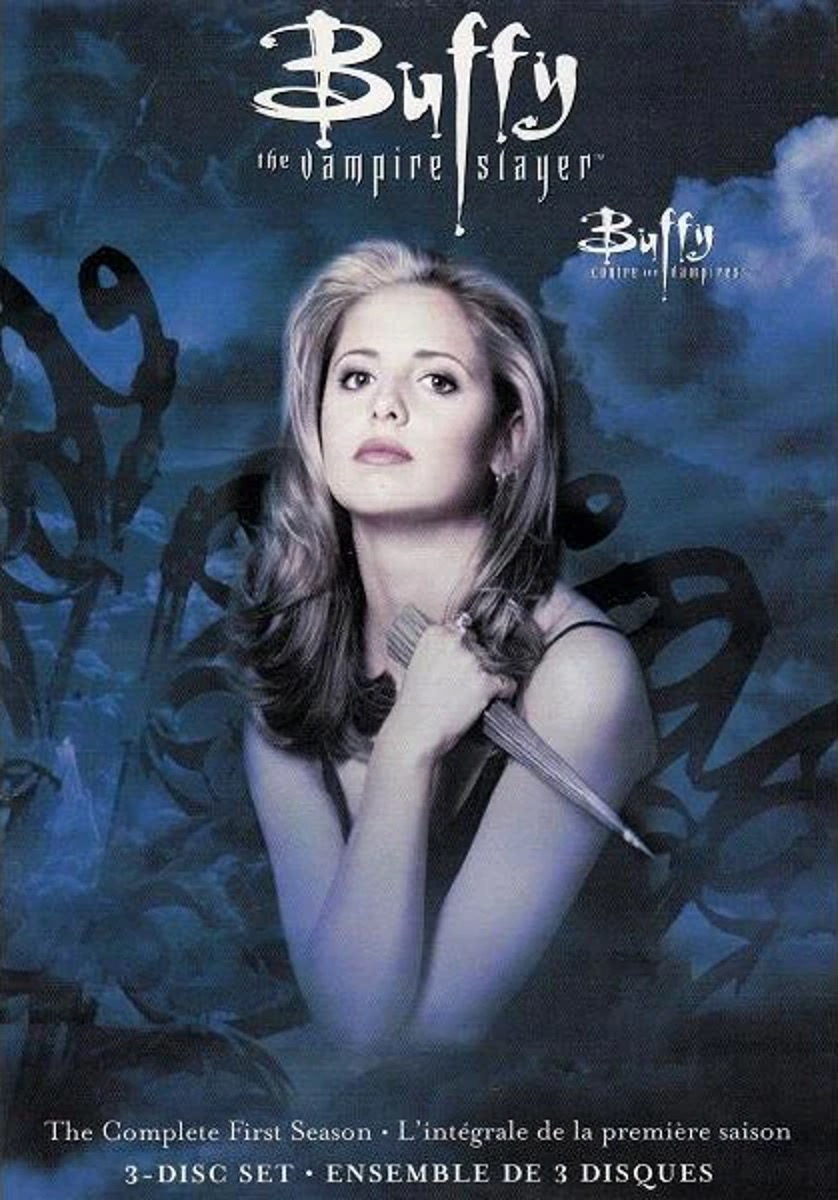
Season One DVD Cover Image for Buffy the Vampire Slayer © 1997 20th Century Studios. All Rights Reserved.