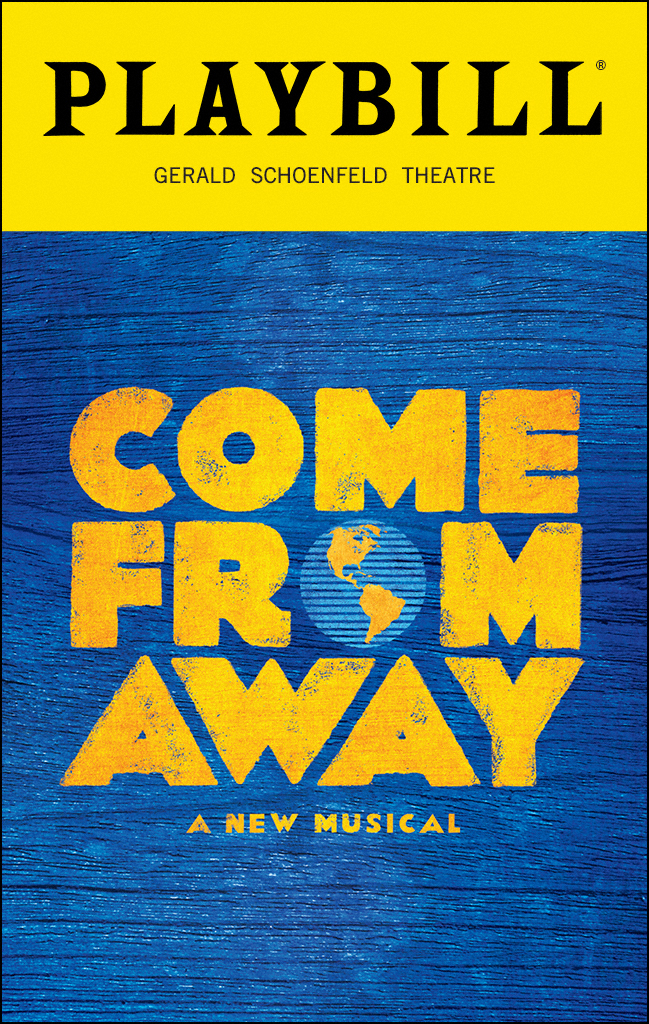
My Experience
Come From Away is a musical that opened on Broadway in 2017. Based off of a book: The Day the World Came to Town: 9/11 in Gander, Newfoundland by Jim Defede (2002), it tells the true story of a town in Newfoundland called Gander, where, after the events of 9/11, 38 airplanes carrying roughly 7,000 passengers had to make emergency landings. The characters are based on actual Gander residents, as well as the stranded “plane people” that they took care of. There are white characters, Jewish characters, Black and brown characters, gay characters, and even British characters—all portrayed by a very talented, but typically very small cast of about 12 actors! The choreography, direction, staging, etc. all work incredibly well to tell this story.
I first saw Come From Away just over a year ago, in January 2025. By some miracle, Sioux Falls, South Dakota made it onto the national tour’s list of stops; Sioux Falls is about an hour’s drive from my hometown, so my mom, aunt, and I all went to see the show! I’ve been a musician for most of my life, so it doesn’t take much for music to make me really emotional in some way or another. The music in Come From Away was so hearty and spirited in every sense of those words that I was completely engrossed in the story from the moment the actors stepped onstage. The musical made me laugh, it made me cry, and there were even a few moments that made me angry. The characters who were native-Newfoundlanders were wholesome, hilarious, and caring; the characters from places all around the world exemplified fear, panic, bravery, and hope.
Classifying my Experience
Since the musical follows quite a few characters, it’s kind of an emotional rollercoaster, but by the end, I was truly in awe of the story I’d just experienced. Awe is defined, in our experiences glossary, as “the feeling admiration or astonishment (wonder) mixed with fear or respect, often inspired by something that seems powerful.” Come From Away depicts a tragic and fearful story; the characters navigate prejudice, anxiety, and hopelessness, but their story culminates in an uplifting, yet realistic way. Although 9/11 was a terribly tragic event, Come From Away portrays the feelings of togetherness and hope that the aftermath brought to communities around the world, in addition to the hatred, fear, and hardship that so many people faced. That is what’s so powerful about this musical: the perseverance and the sense of community.
We hadn’t even made it home from the theater before I was searching Spotify for the Broadway cast recording; I was so eager to hear the music again and let it transport me back into Gander. I wasn’t alive during the September 11th attacks, but the nuanced storytelling of Come From Away helped me truly empathize with the stories of 9/11 that I’d been told all my life.
The Features and Narrative Technologies that Prompted my Experience
There were plenty of heartfelt moments during the musical that made me misty-eyed as I was watching it for the first time, but now, whenever I find myself listening to the album, I can’t even get through the opening number, “Welcome to the Rock,” without tearing up.
Ever since I was a little kid, I’ve always been incredibly affected by drums; it’s like I can feel the beat in my bones and in my heart, which is why this song immediately engrossed me. I truly felt enveloped in the world of this musical from the very beginning. This song mostly features the Gander residents. It sets the scene of this small town in Newfoundland, while also embedding the sense of community that can be found in a lot of small towns. The song enforces the setting in terms of both landscape and location, and cultural norms and character.
I’ve heard from almost everyone I know who’s old enough to remember 9/11 that everybody remembers where they were when they heard the news. In addition to establishing setting and characters, this song depicts the moment when each of the Gander residents we follow in the musical hears the news about the attacks. This immediately creates tension and helps move the plot forward.
But the reason it makes me so emotional isn’t the actual event of the attacks, it’s the overwhelming sense of togetherness and belonging that comes from the final ‘verse’ of the song:

I wish that image fit more nicely, but alas, it does not. This verse, in combination with one of the previous verses, in which the Newfoundlanders recount all of the challenges they’ve faced due to the (literal) nature of their home and they ways they’ve persevered, functions as a pivot into positive emotion; the lyrics welcome anyone who has “come from away” to find sanctuary with the characters who live in Gander. Various hardships are symbolized through lyrics such as: “welcome to the fog / welcome to the trees / to the ocean and the sky / and whatever’s in between;” “if you’re hoping for a harbor;” and “in the winter, from the water / through whatever’s in the way.” Because the forces of nature are generally unpredictable and suggest a wide variety of challenges to overcome, these lyrics effectively symbolize the assortment of events that could’ve possible lead someone to arrive unexpectedly in Gander.
Despite whatever hardships the “ones who have come from away” have faced that brought them to Newfoundland, the people of Gander express a readiness and willingness to welcome them and offer refuge and safety: “to the ones who’ve left / you’re never truly gone / a candle’s in the window / and the kettle’s always on;” “if you’re hoping for a harbor / then you’ll find an open door.” This is where the pivot happens. It’s already been established that a tragic event has occurred (the 9/11 attacks), but instead of entrenching the audience in the fear, desperation, and sadness that the accounts of 9/11 survivors and their families present, the musical endows the viewers with a sense of safety and kinship.
I could absolutely dive into every other song and come up with an analysis for each one, but I don’t know that anybody wants to read that, nor do I exactly have the time or stamina to write it. Instead, I want to point out that, as a whole, Come From Away presents its audience with the opportunity to observe and ultimately concludes with a pivot into positive emotion. As I mentioned before, this musical covers a lot of different characters and their stories. In doing so, it displays a wide range of emotions and encourages the viewers to observe and recognize them.
Hannah is a mother from New York City, whose son is a firefighter responding to the attacks. No one has heard from him; Hannah spends her entire visit in Gander afraid and anxious for her son, but she also finds a friend in Beulah, one of the Gander citizens.
Kevin and Kevin are a couple from Los Angeles. Kevin is anxious to get home and avoids exploring his new surroundings, meanwhile his boyfriend, Kevin, embraces the adventure and even becomes an honorary Newfoundlander. Their different responses put a strain on their relationship, which adds to the tension of whether or not they’ll be able to make it home.
Beverley, one of the pilots, is dealing with guilt, confusion, and fear: she had an entire plane of people counting on her and she can’t give them the answers they want; she finds out that one of her friends, Charles, was the captain of the flight that crashed into the Pentagon; and, after everything is over, people are afraid to fly, so there are no flights for her to pilot.
These are only some of the other stories featured in the musical, though each and every one presents viewers with opportunities to observe the different emotional responses the characters have to the traumatic events of and after the September 11th attacks. Despite the intense and varying emotions that both the audience and the characters experience throughout the musical, the story ends with a pivot to positive emotions. The Plane People are able to travel safely home, and those waiting for news of friends and family members finally get the answers they’ve been waiting for. Some relationships end, others blossom, and everyone walks away with a bigger capacity for empathy and generosity.
“Finale” takes place ten years later, solidifying the pivot into positivity. It’s music, lyrics, and cadence are reminiscent of “Welcome to the Rock” (the opening number), and it re-enforces the different takeaways the Plane People and Ganderites had from their experience. As a whole, Come From Away affirms the importance of community and places emphasis on the integral part of immigrants—“come from aways”—in building it. In a world of hatred, violence, paranoia, and prejudice, we have to hold tightly to hope, empathy, and community.
Featured Image
Playbill for Come From Away. Playbill Inc. All Rights Reserved.