



By: Kruti Shah
Let’s be honest… The moment professors mention “research paper,” almost all of us have the same instant response: panic, confusion, and a little bit of denial.
You can easily picture it: your professor nonchalantly announces the assignment, and all of a sudden, you are contemplating whether to read first, write first, or burst into tears first.
Most students don’t struggle with writing itself; rather, the primary strain comes from the reading phase that precedes it. It is in this phase that one needs to find a proper way of tackling research articles. Once this phase is understood, writing becomes much less intimidating and more systematic.
This article is intended to help guide the reader on how to strategically read research articles before you start your writing process. It is based on academic principles and my own experiences as an undergraduate and graduate student.
1. You’re Not Supposed to Know Everything at the Start
This is the biggest thing I’ve learned:
Research is not about starting with answers; it’s about discovering them.
You don’t need a thesis before you begin.
You don’t need to understand every article perfectly.
You don’t need to write beautifully on the first try.
You just need to start with curiosity and build from there.
2. Pause and Actually Think
This might sound obvious, but taking a small break to think helps more than you’d expect.
After reading a few articles, ask yourself:
- What did I learn?
- What seems important?
- What argument feels realistic for this assignment length?
Ideas hit differently when you give your brain a moment to breathe.
3. Start With a Purpose Instead of Pure Panic
In the past, I would open random research articles haphazardly, hoping something would make sense and inspire a thesis. Spoiler: it didn’t; rather, it made me feel more lost! Instead, what actually helps is to start with a clear sense of direction. Before opening or looking for any article, ask yourself:
- What is this assignment asking me to do?
- What am I curious about?
- What question do I want to answer?
You don’t need a perfect thesis right away, but having a general direction helps you not waste time and energy on irrelevant sources. For example, start by listing a few keywords or questions that pertain to your topic. You can then use these keywords to search in academic databases. This transforms random searching into a much more goal-oriented process.
4. Skim Like You Mean It
Nobody reads a 20-page research article straight through, not even researchers. Skimming is your best friend.
Look at the:
Abstract: a brief summary of the entire article, which includes its purpose and main findings
- Introduction: it gives background information, and it also explains the main research questions
- Headings: it shows how the paper is organized, which helps a lot to increase the readability
- Figures/graphs: visual representation of the resulting data from any experiments/surveys
- Conclusion: concisely summarizes the key findings and their significance
This helps you quickly figure out if the source is useful before you commit 30 minutes of your life to it.
5. Write Down Questions While You Read
One of the easiest ways to generate ideas is by simply paying attention to what confuses you or interests you. Start looking at confusion as your friend and not a bad thing…. It helps, I bet.
Ask yourself:
- Why did the author do this?
- What evidence is missing?
- What do I want to know more about?
These little questions turn into amazing paragraphs later.
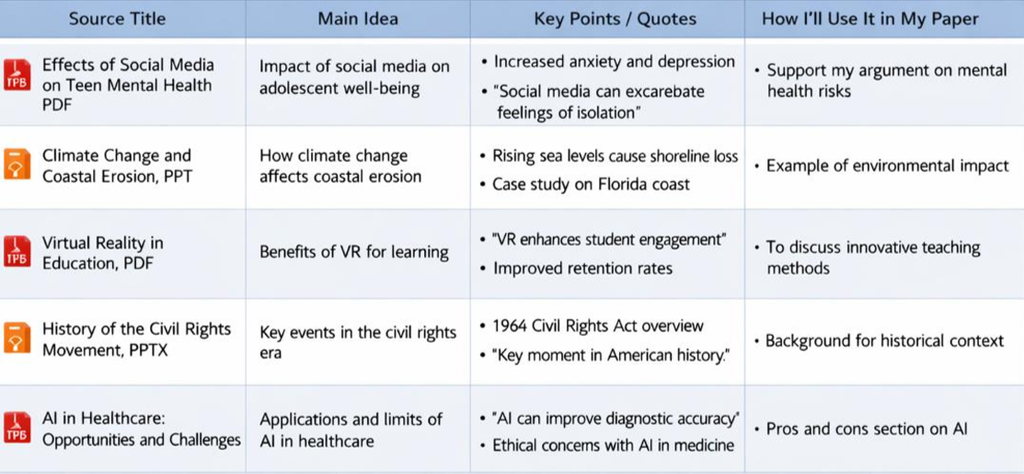
6. Make a Simple Source Map (Trust Me, It Helps)
In the past, I’d save articles with names like “PDF (1)” and then forget why I downloaded them in the first place.
Now I keep a quick list that includes:
- Main idea
- Key quotes
- How I might use it
- Any problems or limitations
This tiny bit of organization saves you so much time when writing your draft.
7. Don’t Just Read, Annotate
Reading an academic article without annotating often leads to forgetting key information quickly. Annotation actually feels like you are interacting with the text as you read. In my opinion, the best method is to print out the article and highlight important parts while annotating, or to use a computer tool such as Microsoft Word (Review > New Comment).
Mark:
- Important claims
- Definitions
- Quotes that stand out
- Questions you want to bring up in your paper
It doesn’t have to look pretty. It just has to make sense to you.
8. Use Library Resources (Don’t Overlook Them!)
One of the best resources that you have is your university’s library. The University of New Haven library offers access to quality and peer-reviewed research articles on its databases, which is far more reliable than just surfing the internet.
- Instead of doing general searches, you can try to search for articles specifically related to your topic using the library’s website.
- You can also check out everything using the link below for a quick search to find databases, journals, and articles on the university’s library website, as it will be the perfect guide for you to get started.
- This will not only save your time but will also increase the quality of your research.
Phewww… finally done
Once you get to know that a major part of the work actually lies before the writing, then research papers will not be that scary anymore. The initial stages of purpose, skimming, questioning, organizing, and taking breaks facilitate reading and make writing easier and clearer.
And honestly? They set you free from a huge burden.
Thus, the next time your professor gives you a research paper and your heart sinks slightly, tell yourself:
“I don’t need to start perfectly. I just need to start cleverly.”
You can do it!
