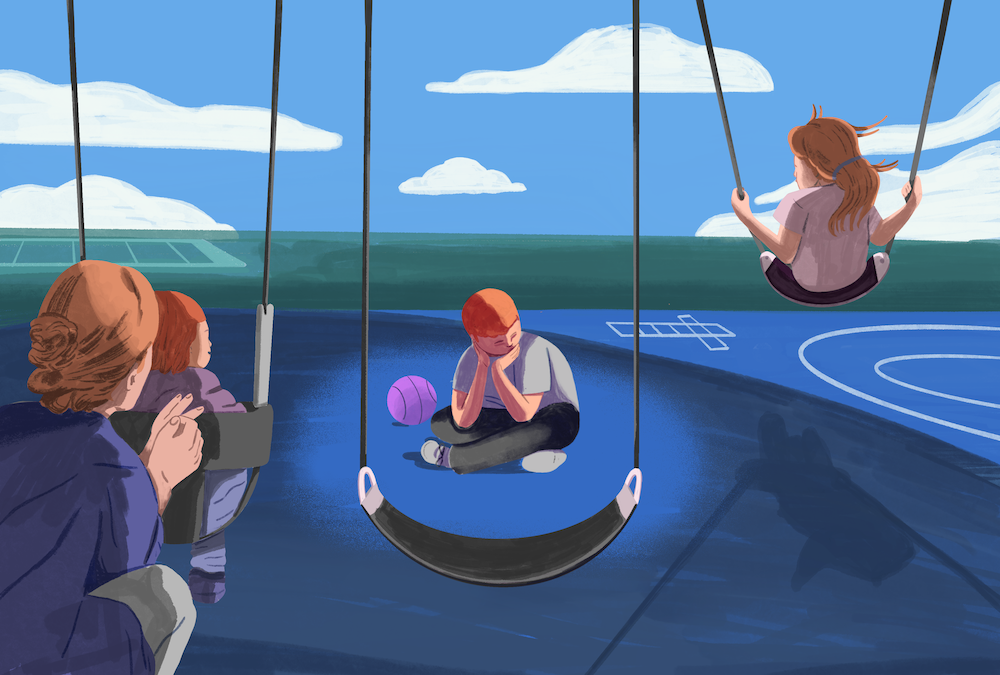
The transition from two children to three is a significant change. It alters most aspects of life, as a two-parent home will have the children as the new majority. If you are considering it for your family, several factors should be taken into account. I want to encourage you to think about the effects this could have on your current youngest regarding the chance of developing Middle Child Syndrome. This post will include theories, studies, and first-hand accounts from real middle children, sharing how it has shaped their lives for better and for worse, so that you will know how having a third child might affect the personality and behavior of your current youngest.
I am a middle child myself, sandwiched in between two brothers. Based on my experience growing up as both the only girl and being in the middle, I can relate to many of the experiences in the first-hand accounts below. This inspired me to research whether the order in which we are born actually affects who we are as a person. This led me to the theories and studies in this post.
Though children grow up in the same home, many believe each sibling has a different experience. This can lead to various personalities and behaviors. To understand Middle Child Syndrome, we must first grasp the history and significance of Birth Order Theory.
Birth Order Theory
Alfred Adler created the Birth Order Theory in 1964. He wrote a book entitled “Position in Family Constellation Influences Life-Style” to present his theories.
It is a common fallacy to imagine that children of the same family are formed in the same environment. Of course there is much which is the same for all children in the same home, but the psychic situation of each child is individual and differs from that of others, because of the order of their succession.
Adler
Adler’s theory of Birth Order was also used in an article entitled “Binge Drinking on a Historically Black University Campus.” This research has demonstrated a real effect on the lifestyles of siblings due to their birth order.
The purpose of this study was to examine binge drinking patterns reported by college students according to sibling birth order… Consistent with observations by Adler on alcohol abuse, data analysis resulted in significant differences between first-born and last-born participants with weekly drinks and binge frequencies. Last-borns reported a higher risk for alcohol-related behaviors than first-borns.
Laird et al.
A study entitled “The Relationship of Birth Order and Gender with Academic Standing and Substance Use Among Youth in Latin America” used many test models, including Adler’s Birth Theory. The researchers determined that being a firstborn, regardless of gender, created “a protective factor against substance use” and an improved academic standing compared to subsequent children. These tests in Latin America revealed a real difference across multiple categories of life based on sibling order. To close, they recommend more resources devoted to “understanding the importance of birth order and the strains and privileges of individual children within their birth order” (Horner et al.).
Middle Child Syndrome
Adler went on to explore the different traits designated for each child in a three-sibling set. The middle child is often considered more even-tempered, but at the expense of not fitting in as well. By feeling left out between the other siblings, many believe middle children feel neglected, leading to Middle Child Syndrome.
UCONN kids defined it simply, saying:
Middle child syndrome, a “syndrome” developed by pop culture, describes the overshadowing of middle children by their older and younger siblings. The syndrome is deemed a “hypothetical condition” by the American Psychological Association, given the lack of empirical evidence supporting it.
Robinshaw
Although it is not considered a real disorder, the phenomena surrounding it can have a real effect on children’s lives. According to Healthline, a health and wellness site, “middle child syndrome is the belief that middle children are excluded, ignored, or even outright neglected because of their birth order” (Werner). This is accompanied by the belief that these feelings can impact a person’s personality.
It is essential to consider your children’s behavior before having another. Certain traits and their relationship with you can be intensified.
Research has shown that middle children feel the least close to their parents and are less likely to discuss issues with them. A 2019 study by Lotte Elton, Melissa Palmer, and Wendy Macdowall found that last-born children were more comfortable talking to their parents about sex at age 14. Results showed that with over 15,000 participants, the data found that “17.8 percent of middle-born men found it easy to talk to their parents about sex, whereas 21.4 percent of last-born men found it easy” (Elton et al.). The data is statistically significant, suggesting that birth order may have a real effect on these relationships, particularly for middle children.
The studies presented throughout this post all demonstrate a real effect on personality and behavior based on birth order. This can lead to both positive and negative effects, especially for middle children.
First-hand Accounts from Middle Children
HuffPost compiled accounts of middle children. One post was called “I’m an Attention Seeker Due to Middle Child Syndrome.” It retells a person’s experience of jealousy toward a dog. The storyteller was the only girl and was always bothered by the constant attention her younger brother got from their mom. When she grew up, she and her boyfriend got a dog, and seeing them cuddle brought back those feelings from her childhood; her mom always took care of her brother’s every need (Evans).
Another post was “Perks of Being a Middle Child.” This one focused on the writer’s beliefs about the benefits of Middle Child Syndrome. She believed that her middleness led to her being neglected in areas like grades, but it had a positive effect on her life.
Generally, my parents focused so much more on my older and younger sisters, and grades were no exception. But this so-called neglect, nay, independence, allows me to make up my mind on things like my political, religious, and philosophical views, and ultimately diverge from what my parents had raised me to believe.
Cheng
She had room to think for herself because her parents were too busy to oversee her every move. She had her middleness to thank for who she is today.
Another middle child, Fredrick Steck, runs a blog where he shares his experience.
I rather enjoyed my position of anonymity and lower expectations.
Middle allows you to do things your older sister would have been put in the penalty box for days, but being middle it was just cute and funny. I am pretty sure it was not funny to the one who was first.
So, like the Army you never want to be the best or the worst you just want to fit comfortably in the middle —- life could be a dream sh-boom sh- boom.
Steck
I want to share one more experience of being a middle child. For some background, my older brother and I are only two and a half years apart, while I am eight years older than my younger brother. This led my mom and me to watch a lot of television together while my younger brother was a baby. Our favorite shows to watch were ABC TV14 sitcoms. She and I watched countless shows together, one of which was “The Middle.” This show followed the Heck family, consisting of a mother, a father, and three children. They had a big brother, a sister in the middle, and an age gap before the youngest brother, exactly like my family.
It can be hard to be the middle child, as you often feel left out, as both siblings around you require your parents’ attention for the different challenges that come with those ages. But the show made it feel special. There is a moment in the show when Sue, the middle child, describes the experience as one of love on both sides. I found this a wonderful way of looking at what some view as the worst position in the family.
Conclusion
The decision to add a third child to your life requires substantial thought on both the positive and negative effects covered in this post, as well as for your family’s finances and well-being. If you choose to add a third, it can have tremendous impacts on their personality and behavior well into adulthood.
I feel fortunate to have both of my siblings, but my little brother’s birth brought about a huge adjustment for the entire family. I have him to thank for my being a strong, independent woman, which I developed at a young age. In our case, independence gave me a sense of accomplishment, but not every child will react in the same way to newfound responsibility.
There is no right or wrong choice, as every family is different, so I hope this post encourages you to consider the personalities of the kids you already have before making the permanent decision to have more. I suggest you take the time to think about how much time you can devote to your current children before adding another.
Whatever you decide for your family is the best decision for you. Only you know your kids and how it would affect your specific household.
Sources
Adler, Alfred. “Position in family constellation influences life-style.” Readings in the theory of individual psychology. Routledge, 2007. 323-340.
Chan, Katharine. “Is Middle Child Syndrome Real?” Verywell Mind, Verywell Mind, 24 May 2023, www.verywellmind.com/is-middle-child-syndrome-real-7410121.
Cheng, Emily. “Why Being a Middle Child Isn’t so Bad after All.” HuffPost, HuffPost, 7 Nov. 2013, www.huffpost.com/entry/middle-child-perks_b_3885568?ncid=edlinkushpmg00000277.
ClipZone: Sitcoms. “The Heck Kids’ Emotional Moment | The Middle.” YouTube, 2025, youtu.be/AiAvL2XXfb4?si=_emKJxRCOpfW9qpV.
Elton, Lotte, et al. “Birth Order and Parental and Sibling Involvement in Sex Education. A Nationally-Representative Analysis.” Sex Education, U.S. National Library of Medicine, 27 Sept. 2018, pmc.ncbi.nlm.nih.gov/articles/PMC6377085/#abstract1.
Evans, Hope. “I’m an Attention Seeker Due to Middle Child Syndrome.” HuffPost, HuffPost, 5 July 2016, www.huffpost.com/entry/im-an-attention-seeker-du_b_7731984?%3Fncid=edlinkushpmg00000277.
Horner, Pilar, et al. “The Relationship of Birth Order and Gender with Academic Standing and Substance Use among Youth in Latin America.” Journal of Individual Psychology (1998), U.S. National Library of Medicine, 2012, pmc.ncbi.nlm.nih.gov/articles/PMC3375868/#abstract1.
Laird, Teresa G., and Andrea J. Shelton. “From an Adlerian Perspective: Birth Order, Dependency, and Binge Drinking on a Historically Black University Campus.” Journal of Individual Psychology 62.1 (2006).
Robinshaw, Kylie. “Middle Child Syndrome: Is It True?: UConn Kids (Kids in Developmental Science).” UConn KIDS Kids in Developmental Science, 17 Oct. 2022, kids.uconn.edu/2022/10/17/middle-child-syndrome-is-it-true/.
Singh, Kyli. “If You’re a Middle Child, You’ll Love These Stories.” HuffPost, HuffPost, 6 Apr. 2016, www.huffpost.com/entry/middle-child-syndrome_n_56fec5d7e4b083f5c607b0d3.
Steck, Fredric. “The Middle Child.” Fredric Steck: Life Lessons, Fredric Steck: Life Lessons, 15 Mar. 2021, fredricsteck.com/blog/the-middle-child.
Werner, Carly. “Is Middle Child Syndrome a Real Thing? Here’s What You Need to Know.” Healthline, Healthline Media, www.healthline.com/health/mental-health/middle-child-syndrome#the-science. Accessed 14 Sept. 2025.
Featured Image
Used with the permission of the creator. Featured image for “Is Middle Child Syndrome Real?” by Dennis Madamba. All Rights Reserved.