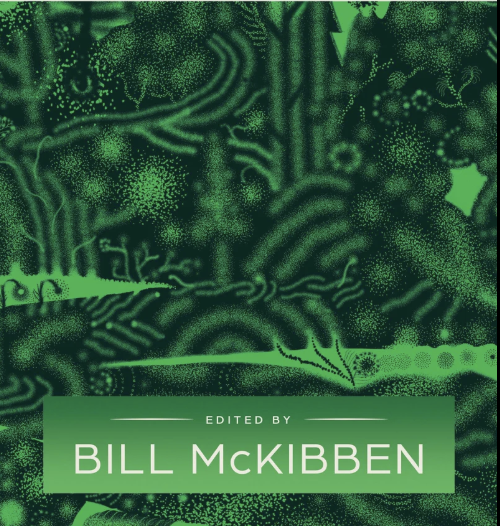
After going through what has influenced my life, I narrowed my interest down to the idea that the brain isn’t the only thing that does the thinking, it’s the nervous system as a whole and how the nervous system interprets information about the world around it. While creating my visualization, I took note of a chapter of a book I read that brought this new way of thinking about thinking to my attention. This book is called The Best American Science and Nature Writing 2024 edited by Bill McKibben and Jaime Green. Each Chapter is an article that McKibben read, and found interesting or inspiring.
What I Chose
For this assignment, I’m choosing to focus on the chapter What Plants Are Saying About Us, which was originally published on Nautilus by Amanda Gefter, because a part of the chapter opened my eyes to the idea that the nervous system thinks as a unit.
My Experience
While I was in early elementary school, I found that my favorite subject was science. Since then, just about everything I was willing to learn outside of the classroom was based on this subject.
This spring, as I was walking around a local bookstore, a green, funky-designed cover caught my eye. So, I picked it up, read the back, and realized that it had to come home with me. I immediately started reading The Best American Science and Nature Writing 2024 after finishing the book I was reading at the time. The first few chapters were incredibly interesting. One of the articles — Rogues of the Rainforest, written by Douglas Fox and originally published on bioGraphic — was particularly interesting. Fox wrote about Boris Bernal Vargas, a man from Panama whose job, along with others, is to count the amount of trees in certain plots of land for climate change research purposes. He explained that a species of vine called lianas were exceptionally invasive, and in many ways than just one, are contributing to the climate crisis.
A few chapters later, I arrived at What Plants Are Saying About Us. In this article, Gefter explains the idea that plants don’t just sit, look pretty, and photosynthesize for us, but in their own way, they think and react to their environment. Without reading the article, this may sound odd. But Gefter found research explaining how plants “think”. By blending the information she found, Gefter shared with the world the idea that, though plants don’t have a nervous system to give input for the brain to process, they have different ways to comprehend what is going on around them and what they need to do to stay alive. This idea was so fascinating to me, but more importantly, I thought a founding idea of this article was more captivating. This idea being that the brain isn’t the only thing that thinks, it’s the nervous system as a whole.
While reading the part of the chapter where Gefter explains how the nervous system thinks as a whole, I experienced Conversion which is defined as “the adoption of a set of beliefs, excluding those that were previously held”. This definition can be found in our glossary of technologies.
Features Prompting My Experience
If you’re curious, this is the exact piece of writing that caused me to experience conversion:
“The idea that the mind is in the brain comes to us from Descartes. The seventeenth century philosopher invented our modern notion of consciousness and confined it to the interior of the skull. He saw the mind and brain as separate substances, but with no direct access to the world. The mind was reliant on the brain to encode and represent the world or conjure up its best guess as to what the world might be based on, with ambiguous clues trickling in through unreliable senses…
Modern cognitive science traded Descartes’ mind-body dualism for brain-body dualism: The body is necessary for breathing, eating, and staying alive, but it’s the brain alone, in its dark, silent sanctuary, that perceives, feels, and thinks. The idea that consciousness is in the brain is so ingrained in our science, in our everyday speech, even in popular culture that it seems almost beyond question…
Instead, Barrett and Calvo draw from a set of ideas referred to as “4E cognitive science,” an umbrella term for a bunch of theories that all happen to start with the letter E. Embodied, embedded, extended, and enactive cognition – what they have in common (besides Es) is a rejection of cognition as a purely brainbound affair. Calvo is also inspired by a fifth E: ecological psychology, a kindred spirit to the canonical four. It’s a theory of how we perceive without using internal representations.”
– Amanda Gefter, What Plants Are Saying About Us
Technologies I Found
It’s hard to understand just how Amanda Gefter used her words to convert the way I, and most likely many other readers, approach the thought of cognition without going back to my AP English Language and Composition rhetorical analysis days. While rereading the chapter, I found that Gefter explained why we think of cognition as brain-body dualism and then the 4Es perspective to mimic how one changes their mind on something. She also used an example of how this theory, including the fifth, forgotten E, works during a very relatable experience to help the reader further understand why the 4Es cognition theory is a better way to think about thinking.
To imitate the “pattern” people follow when changing their mind or belief on something, Gefter decoded why brain-body dualism is the general cognition theory, afterwards explaining the 4Es cognition theory. This part is the entire quote in the above section. Since Gefter explained both theories, as a reader, I was able to recognize how old the brain-body dualism theory is, and how inconsiderate of the whole nervous system it is. This is what ultimately led to the conversion. Gefter’s set-up allowed for a comparison to be made between the two theories, one (the 4Es cognition) being more thought out. If she had not drawn both out with details, I wouldn’t have fully trusted or understood either theory, most likely not sparking the conversion I experienced. Therefore, outlining both cognition theories was an important step in changing the way I perceive cognition.
Gefter also drew out an experience most people have everyday to support the explanation of the 4Es cognition theory. Gefter wrote,
“In a given visual fixation, the pattern of light in focus on the retina amounts to a two-dimensional area the size of a thumbnail at arm’s length. And yet we have the impression of being immersed in a rich three-dimensional scene. So it must be that the brain ‘fills in’ the missing pieces, making inferences from scant data and offering up its best hallucination for who-knows-who to ‘see,’ who-knows-how.”.
– Amanda Gefter, What Plants Are Saying About Us
Because Gefter included this example in her article, I was able to take a new, confusing idea, and understand how the 4Es cognition theory makes sense in real time. If Gefter didn’t include this example in her article, then this theory wouldn’t have entirely clicked, meaning I wouldn’t have experienced conversion the way that I did. Therefore, incorporating this very relatable experience in her article was crucial to my — and probably many other readers’ — conversion in the way cognition is perceived.
| Experience | Feature | Technologies |
| Conversion | Reading What Plants Are Saying About Us, by Amanda Gefter | Imitating the conversion process + including a very relatable experience |
Work Cited
Fox, Douglas. “Rogues of the Rainforest.” bioGraphic, California Academy of Science, 22 Mar. 2023, www.biographic.com/rogues-of-the-rainforest/.
Gefter, Amanda. “What Plants Are Saying About Us.” Nautilus, NautilusNext, 7 Mar. 2023, nautil.us/what-plants-are-saying-about-us-264593/.
McKibben, Bill. The Best American Science and Nature Writing 2024. Edited by Jaime Green, 1st ed., HarperCollins Publisher, 2024.
Featured Image
2024. The Best American Science and Nature Writing 2024, by Bill McKibben, 1st ed., HarperCollins Publishers, 2024, p. Front Cover.